
对美国、新西兰和澳大利亚泽西牛和公牛群体的纯合性进行特征分析。
Characterizing homozygosity across United States, New Zealand and Australian Jersey cow and bull populations.
作者信息
Howard Jeremy T, Maltecca Christian, Haile-Mariam Mekonnen, Hayes Ben J, Pryce Jennie E
机构信息
Department of Animal Science, North Carolina State University, Raleigh, NC, 27695-7627, USA.
Dairy Futures Cooperative Research Centre, 5 Ring Road, Bundoora, Victoria, 3083, Australia.
出版信息
BMC Genomics. 2015 Mar 15;16(1):187. doi: 10.1186/s12864-015-1352-4.
BACKGROUND
Dairy cattle breeding objectives are in general similar across countries, but environment and management conditions may vary, giving rise to slightly different selection pressures applied to a given trait. This potentially leads to different selection pressures to loci across the genome that, if large enough, may give rise to differential regions with high levels of homozygosity. The objective of this study was to characterize differences and similarities in the location and frequency of homozygosity related measures of Jersey dairy cows and bulls from the United States (US), Australia (AU) and New Zealand (NZ).
RESULTS
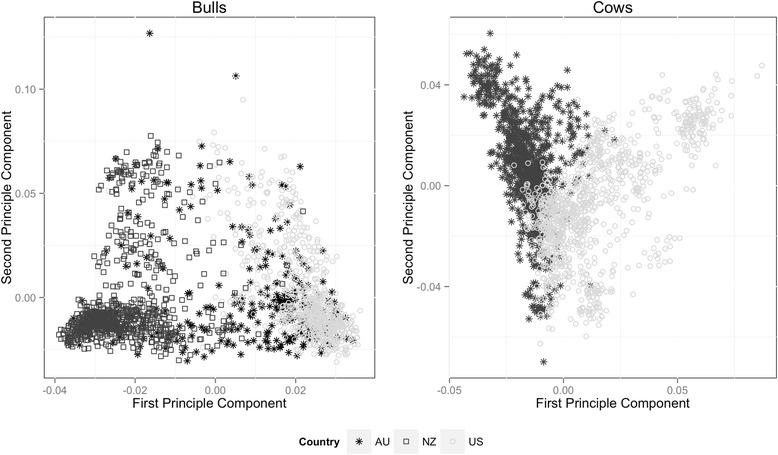
The populations consisted of a subset of genotyped Jersey cows born in US (n = 1047) and AU (n = 886) and Jersey bulls progeny tested from the US (n = 736), AU (n = 306) and NZ (n = 768). Differences and similarities across populations were characterized using a principal component analysis (PCA) and a run of homozygosity (ROH) statistic (ROH45), which counts the frequency of a single nucleotide polymorphism (SNP) being in a ROH of at least 45 SNP. Regions that exhibited high frequencies of ROH45 and those that had significantly different ROH45 frequencies between populations were investigated for their association with milk yield traits. Within sex, the PCA revealed slight differentiation between the populations, with the greatest occurring between the US and NZ bulls. Regions with high levels of ROH45 for all populations were detected on BTA3 and BTA7 while several other regions differed in ROH45 frequency across populations, the largest number occurring for the US and NZ bull contrast. In addition, multiple regions with different ROH45 frequencies across populations were found to be associated with milk yield traits.
CONCLUSION
Multiple regions exhibited differential ROH45 across AU, NZ and US cow and bull populations, an interpretation is that locations of the genome are undergoing differential directional selection. Two regions on BTA3 and BTA7 had high ROH45 frequencies across all populations and will be investigated further to determine the gene(s) undergoing directional selection.
背景
各国奶牛的育种目标总体相似,但环境和管理条件可能存在差异,这会导致对给定性状施加略有不同的选择压力。这可能会对基因组中的基因座产生不同的选择压力,如果差异足够大,可能会产生具有高纯合度水平的差异区域。本研究的目的是描述来自美国(US)、澳大利亚(AU)和新西兰(NZ)的泽西奶牛和公牛纯合度相关指标在位置和频率上的差异与相似性。
结果
这些群体包括在美国出生的经基因分型的泽西奶牛子集(n = 1047)、澳大利亚的(n = 886),以及来自美国(n = 736)、澳大利亚(n = 306)和新西兰(n = 768)的经后裔测定的泽西公牛。使用主成分分析(PCA)和纯合度连续片段(ROH)统计量(ROH45)来描述各群体之间的差异与相似性,ROH45统计单个核苷酸多态性(SNP)处于至少45个SNP的ROH中的频率。研究了表现出高ROH45频率的区域以及群体间ROH45频率存在显著差异的区域与产奶性状的关联。在性别内部,PCA显示各群体之间存在轻微分化,美国和新西兰公牛之间的分化最大。在BTA3和BTA7上检测到所有群体中ROH45水平较高的区域,而其他几个区域的ROH45频率在群体间存在差异,美国和新西兰公牛对比中差异区域数量最多。此外,发现多个群体间ROH45频率不同的区域与产奶性状相关。
结论
在澳大利亚、新西兰和美国的奶牛和公牛群体中,多个区域表现出不同的ROH45,一种解释是基因组的这些位置正在经历不同的定向选择。BTA3和BTA7上的两个区域在所有群体中都有较高的ROH45频率,将进一步研究以确定正在经历定向选择的基因。



 Zotero 插件