
美国和澳大利亚泽西奶牛近亲繁殖衰退影响区域及其与加性遗传效应的关联研究。
Investigation of regions impacting inbreeding depression and their association with the additive genetic effect for United States and Australia Jersey dairy cattle.
作者信息
Howard Jeremy T, Haile-Mariam Mekonnen, Pryce Jennie E, Maltecca Christian
机构信息
Department of Animal Science and Genetics Program, North Carolina State University, Raleigh, NC, 27695-7627, USA.
Department of Economic Development, Jobs, Transport and Resources and Dairy Futures Cooperative Research Centre, 5 Ring Road, Bundoora, VIC, 3083, Australia.
出版信息
BMC Genomics. 2015 Oct 19;16:813. doi: 10.1186/s12864-015-2001-7.
BACKGROUND
Variation in environment, management practices, nutrition or selection objectives has led to a variety of different choices being made in the use of genetic material between countries. Differences in genome-level homozygosity between countries may give rise to regions that result in inbreeding depression to differ. The objective of this study was to characterize regions that have an impact on a runs of homozygosity (ROH) metric and estimate their association with the additive genetic effect of milk (MY), fat (FY) and protein yield (PY) and calving interval (CI) using Australia (AU) and United States (US) Jersey cows.
METHODS
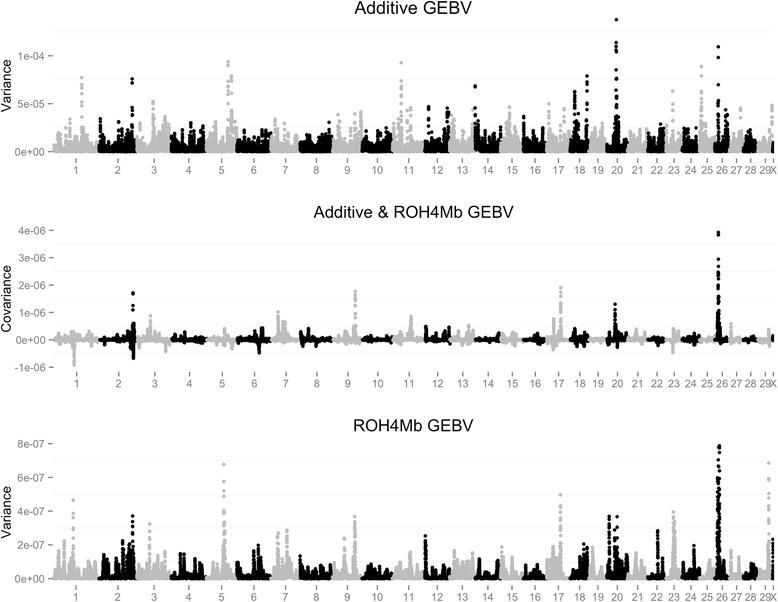
Genotyped cows with phenotypes on MY, FY and PY (n = 6751 US; n = 3974 AU) and CI (n = 5816 US; n = 3905 AU) were used in a two-stage analysis. A ROH statistic (ROH4Mb), which counts the frequency of a SNP being in a ROH of at least 4 Mb was calculated across the genome. In the first stage, residuals were obtained from a model that accounted for the portion explained by the estimated breeding value. In the second stage, these residuals were regressed on ROH4Mb using a single marker regression model and a gradient boosted machine (GBM) algorithm. The relationship between the additive and ROH4Mb of a region was characterized based on the (co)variance of 500 kb estimated genomic breeding values derived from a Bayesian LASSO analysis. Phenotypes to determine ROH4Mb and additive effects were residuals from the two-stage approach and yield deviations, respectively.
RESULTS
Associations between yield traits and ROH4Mb were found for regions on BTA13, BTA23 and BTA25 for the US population and BTA3, BTA7, BTA17 for the AU population. Only one association (BTA7) was found for CI and ROH4Mb for the US population. Multiple potential epistatic interactions were characterized based on the GBM analysis. Lastly, the covariance sign between ROH4Mb and additive SNP effect of a region was heterogeneous across the genome.
CONCLUSION
We identified multiple genomic regions associated with ROH4Mb in US and AU Jersey females. The covariance of regions impacting ROH4Mb and the additive genetic effect were positive and negative, which provides evidence that the homozygosity effect is location dependent.
背景
环境、管理方式、营养或选择目标的差异导致各国在遗传物质使用方面做出了各种不同的选择。各国基因组水平纯合度的差异可能导致近亲繁殖衰退的区域有所不同。本研究的目的是对影响纯合子连续片段(ROH)指标的区域进行特征分析,并利用澳大利亚(AU)和美国(US)的泽西奶牛估计这些区域与牛奶产量(MY)、脂肪产量(FY)、蛋白质产量(PY)以及产犊间隔(CI)的加性遗传效应之间的关联。
方法
对具有MY、FY和PY表型(美国n = 6751头;澳大利亚n = 3974头)以及CI表型(美国n = 5816头;澳大利亚n = 3905头)的基因分型奶牛进行两阶段分析。计算全基因组中一个单核苷酸多态性(SNP)位于至少4 Mb的ROH中的频率的ROH统计量(ROH4Mb)。在第一阶段,从一个考虑了估计育种值所解释部分的模型中获得残差。在第二阶段,使用单标记回归模型和梯度提升机(GBM)算法将这些残差对ROH4Mb进行回归。基于贝叶斯LASSO分析得出的500 kb估计基因组育种值的协方差,对一个区域的加性效应与ROH4Mb之间的关系进行特征分析。用于确定ROH4Mb和加性效应的表型分别是两阶段方法的残差和产量偏差。
结果
在美国群体中,发现BTA13、BTA23和BTA25区域以及澳大利亚群体中BTA3、BTA7、BTA17区域的产量性状与ROH4Mb之间存在关联。在美国群体中,仅发现CI与ROH4Mb之间存在一个关联(BTA7)。基于GBM分析确定了多个潜在的上位性相互作用。最后,一个区域的ROH4Mb与加性SNP效应之间的协方差符号在全基因组中是异质的。
结论
我们在美国和澳大利亚的泽西母牛中鉴定出了多个与ROH4Mb相关的基因组区域。影响ROH4Mb的区域与加性遗传效应的协方差有正有负,这为纯合度效应依赖于位置提供了证据。


 Zotero 插件