Dange Rahul B, Agarwal Deepmala, Teruyama Ryoichi, Francis Joseph
Comparative Biomedical Sciences, School of Veterinary Medicine, Louisiana State University, 1909 Skip Bertman Drive, Baton Rouge, LA, 70803, USA.
William Hansel Cancer Prevention Laboratory, Pennington Biomedical Research Center, 6400 Perkins Road, Baton Rouge, LA, 70808, USA.
J Neuroinflammation. 2015 Feb 18;12:31. doi: 10.1186/s12974-015-0242-7.
Despite the availability of several antihypertensive medications, the morbidity and mortality caused by hypertension is on the rise, suggesting the need for investigation of novel signaling pathways involved in its pathogenesis. Recent evidence suggests the role of toll-like receptor (TLR) 4 in various inflammatory diseases, including hypertension. The role of the brain in the initiation and progression of all forms of hypertension is well established, but the role of brain TLR4 in progression of hypertension has never been explored. Therefore, we investigated the role of TLR4 within the paraventricular nucleus (PVN; an important cardioregulatory center in the brain) in an animal model of human essential hypertension. We hypothesized that a TLR4 blockade within the PVN causes a reduction in mean arterial blood pressure (MAP), inflammatory cytokines and sympathetic drive in hypertensive animals.
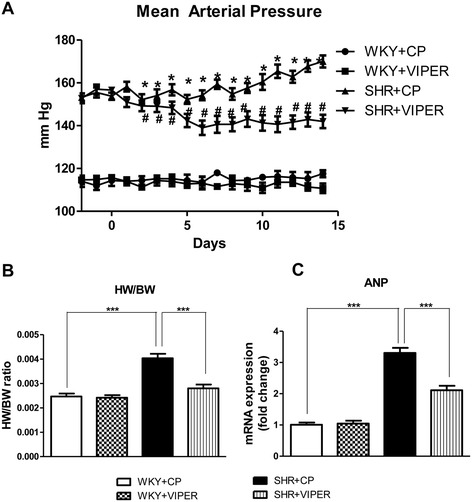
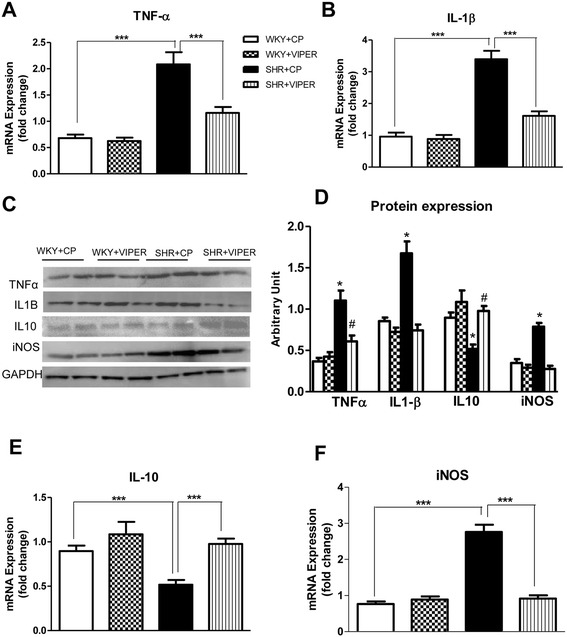
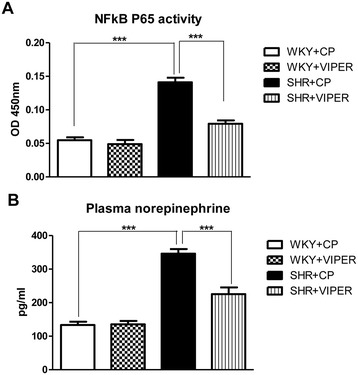
Spontaneously hypertensive rats (SHR) and normotensive Wistar Kyoto (WKY) rats were administered either a specific TLR4 blocker, viral inhibitory peptide (VIPER), or control peptide in their PVN for 14 days. MAP was recorded continuously by radiotelemetry. PVN and blood were collected for the measurement of pro-inflammatory cytokines (Tumor Necrosis Factor (TNF)-α, interleukin (IL)-1β), anti-inflammatory cytokine IL-10, inducible nitric oxide synthase (iNOS), TLR4, nuclear factor (NF) κB activity and plasma norepinephrine (NE) and high mobility group box (HMGB)1 expression, respectively.
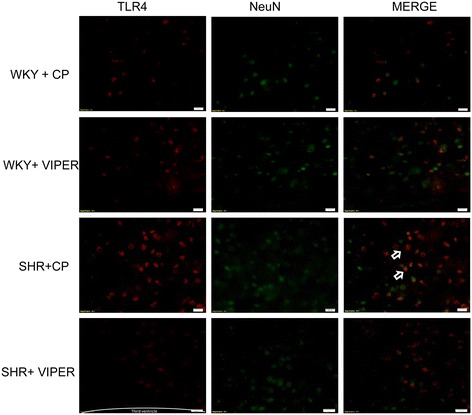
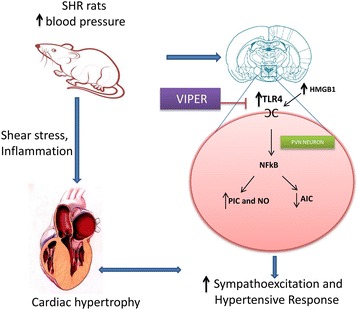
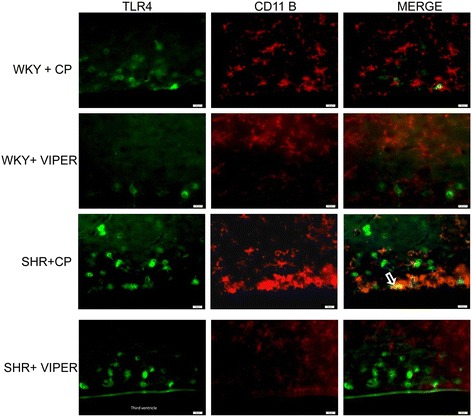
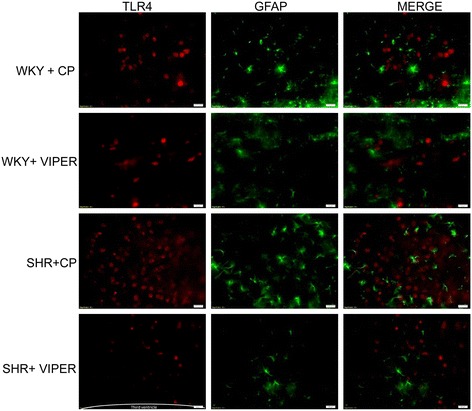
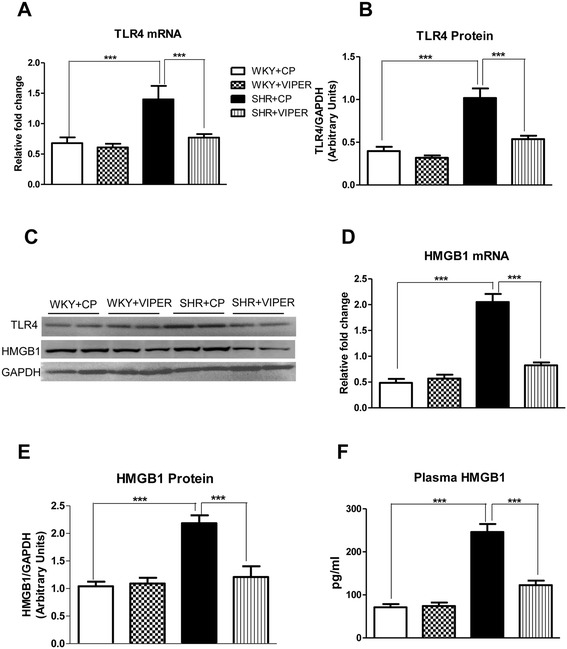
Hypertensive rats exhibited significantly higher levels of TLR4 in the PVN. TLR4 inhibition within the PVN attenuated MAP, improved cardiac hypertrophy, reduced TNF-α, IL-1β, iNOS levels, and NFκB activity in SHR but not in WKY rats. These results were associated with a reduction in plasma NE and HMGB1 levels and an increase in IL-10 levels in SHR.
This study demonstrates that TLR4 upregulation in PVN plays an important role in hypertensive response. Our results provide mechanistic evidence that hypertensive response in SHR are mediated, at least in part, by TLR4 in the PVN and that inhibition of TLR4 within the PVN attenuates blood pressure and improves inflammation, possibly via reduction in sympathetic activity.
尽管有多种抗高血压药物,但高血压导致的发病率和死亡率仍在上升,这表明需要研究参与其发病机制的新信号通路。最近的证据表明,Toll样受体(TLR)4在包括高血压在内的各种炎症性疾病中发挥作用。大脑在所有形式高血压的发生和发展中的作用已得到充分证实,但脑内TLR4在高血压进展中的作用从未被探讨过。因此,我们在人类原发性高血压动物模型中研究了室旁核(PVN,大脑中一个重要的心脏调节中心)内TLR4的作用。我们假设,PVN内的TLR4阻断可降低高血压动物的平均动脉血压(MAP)、炎性细胞因子和交感神经驱动。
将自发性高血压大鼠(SHR)和正常血压的Wistar Kyoto(WKY)大鼠的PVN分别给予特异性TLR4阻断剂病毒抑制肽(VIPER)或对照肽,持续14天。通过无线电遥测连续记录MAP。分别收集PVN和血液,用于测量促炎细胞因子(肿瘤坏死因子(TNF)-α、白细胞介素(IL)-1β)、抗炎细胞因子IL-10、诱导型一氧化氮合酶(iNOS)、TLR4、核因子(NF)κB活性以及血浆去甲肾上腺素(NE)和高迁移率族蛋白盒(HMGB)1的表达。
高血压大鼠PVN中的TLR4水平显著更高。PVN内的TLR4抑制可减轻SHR的MAP,改善心脏肥大,降低TNF-α、IL-1β、iNOS水平和NFκB活性,但对WKY大鼠无此作用。这些结果与SHR血浆NE和HMGB1水平降低以及IL-10水平升高有关。
本研究表明,PVN中TLR4上调在高血压反应中起重要作用。我们的结果提供了机制证据,表明SHR中的高血压反应至少部分由PVN中的TLR4介导,并且PVN内TLR4的抑制可降低血压并改善炎症,可能是通过降低交感神经活动实现的。