Cooper Andrew J M, Dearnley Katie, Williams Kate M, Sharp Stephen J, van Sluijs Esther M F, Brage Soren, Sutton Stephen, Griffin Simon J
MRC Epidemiology Unit, University of Cambridge, School of Clinical Medicine, Institute of Metabolic Science, Cambridge Biomedical Campus, Cambridge, UK.
Behavioural Science Group, Primary Care Unit, Department of Public Health and Primary Care, University of Cambridge, Institute of Public Health, Robinson Way, Cambridge, CB2 0SR, UK.
BMC Public Health. 2015 Mar 27;15:296. doi: 10.1186/s12889-015-1654-0.
Web-based interventions for physical activity offer several advantages over face-to-face, print-and telephone-based interventions and are scalable and potentially cost-effective. Recent reviews of web-based interventions in adults show that they have positive but small effects on physical activity but identify a number of limitations including a reliance on self-report measures of outcome. This trial used an objective measure of physical activity to assess the effectiveness of three minimal contact interventions: 1) A multi-component web-based intervention incorporating objective monitoring and graphical feedback of physical activity; 2) A version of the first intervention that consisted only of objective monitoring plus web-based graphical feedback; and 3) Self-monitoring of physical activity using a paper diary.
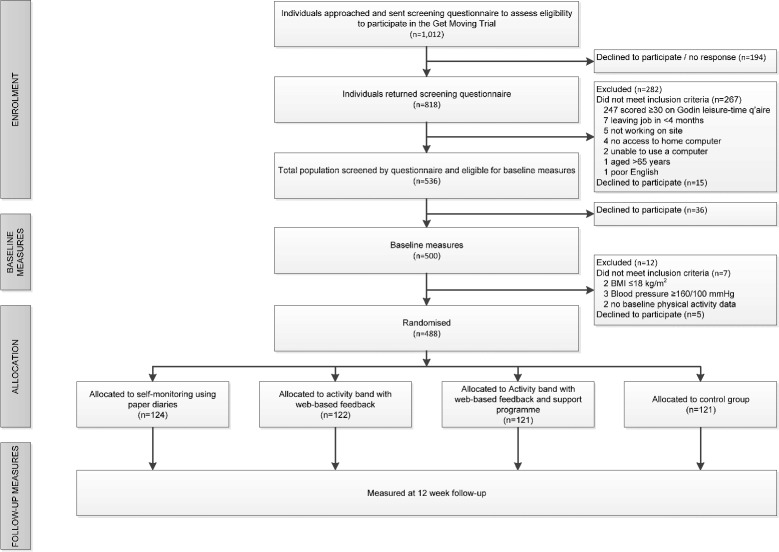
METHODS/DESIGN: Get Moving is an individually randomised controlled trial with allocation of 488 participants to one of three interventions or to a no-intervention control group. Participants are physically inactive working adults aged 18-65 years. They attended a baseline assessment session at which anthropometric, biological and questionnaire measures were taken and they completed a treadmill exercise test. They then wore a combined movement and heart rate monitor for six days and nights before being randomised to one of the four trial arms. The baseline measures were repeated at the follow-up assessment which took place approximately 12 weeks post-randomisation, conducted by staff blind to group allocation. Participants wore the movement and heart rate monitor for six days and nights before this. The co-primary outcomes are: physical activity energy expenditure measured using individually calibrated combined heart-rate and movement data; and cardiorespiratory fitness measured using a sub-maximal treadmill exercise test.
Strengths of the trial include the use of an objective measure of physical activity, a measure of cardiorespiratory fitness, relatively large sample size and the use of robust methods of randomisation, allocation concealment and blinding to outcome assessment. Get Moving will contribute to the evidence base on minimal contact interventions for increasing physical activity. The interventions could be implemented in other settings such as primary care.
ISRCTN31844443. Registered 18 June 2010.
基于网络的体育活动干预比面对面、印刷品和电话干预具有多种优势,且具有可扩展性和潜在的成本效益。最近对成人基于网络干预的综述表明,它们对体育活动有积极但微小的影响,但也指出了一些局限性,包括依赖自我报告的结果测量。本试验使用体育活动的客观测量方法来评估三种最低限度接触干预的效果:1)一种基于网络的多成分干预,包括体育活动的客观监测和图形反馈;2)第一种干预的一个版本,仅包括客观监测加基于网络的图形反馈;3)使用纸质日记自我监测体育活动。
方法/设计:“动起来”是一项个体随机对照试验,将488名参与者分配到三种干预措施之一或无干预对照组。参与者为年龄在18 - 65岁、身体不活跃的在职成年人。他们参加了一次基线评估会议,会上进行了人体测量、生物学测量和问卷调查,并完成了一次跑步机运动测试。然后,他们在随机分配到四个试验组之一之前,佩戴运动和心率监测器六天六夜。在随机分组后约12周进行的随访评估中,由对分组情况不知情的工作人员重复进行基线测量。在此之前,参与者再次佩戴运动和心率监测器六天六夜。共同主要结局为:使用单独校准的心率和运动数据组合测量的体育活动能量消耗;以及使用次最大强度跑步机运动测试测量的心肺适能。
该试验的优势包括使用体育活动的客观测量方法、心肺适能测量方法、相对较大的样本量以及使用稳健的随机化、分配隐藏和结果评估盲法。“动起来”将为增加体育活动的最低限度接触干预的证据基础做出贡献。这些干预措施可在其他环境中实施,如初级保健。
ISRCTN31844443。2010年6月18日注册。