Hartmann Erik K, Ziebart Alexander, Thomas Rainer, Liu Tanghua, Schad Arno, Tews Martha, Moosmann Bernd, Kamuf Jens, Duenges Bastian, Thal Serge C, David Matthias
Department of Anesthesiology, Medical Center of the Johannes Gutenberg-University, Langenbeckstrasse 1, 55131, Mainz, Germany.
Institute of Pathology, Medical Center of the Johannes Gutenberg-University, Langenbeckstrasse 1, 55131, Mainz, Germany.
BMC Pulm Med. 2015 Feb 7;15:7. doi: 10.1186/s12890-015-0002-6.
The lectin-like domain of TNF-α can be mimicked by synthetic TIP peptides and represents an innovative pharmacologic option to treat edematous respiratory failure. TIP inhalation was shown to reduce pulmonary edema and improve gas exchange. In addition to its edema resolution effect, TIP peptides may exert some anti-inflammatory properties. The present study therefore investigates the influence of the inhaled TIP peptide AP318 on intrapulmonary inflammatory response in a porcine model of systemic sepsis.
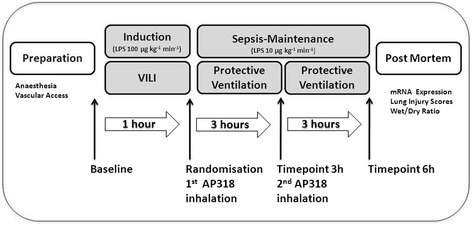
In a randomized-blinded setting lung injury was induced in 18 pigs by lipopolysaccharide-infusion and a second hit with a short period of ventilator-induced lung stress, followed by a six-hour observation period. The animals received either two inhalations with the peptide (AP318, 2×1 mg kg(-1)) or vehicle. Post-mortem pulmonary expression of inflammatory and mechanotransduction markers were determined by real-time polymerase chain reaction (IL-1β, IL-6, TNF-α, COX-2, iNOS, amphiregulin, and tenascin-c). Furthermore, regional histopathological lung injury, edema formation and systemic inflammation were quantified.
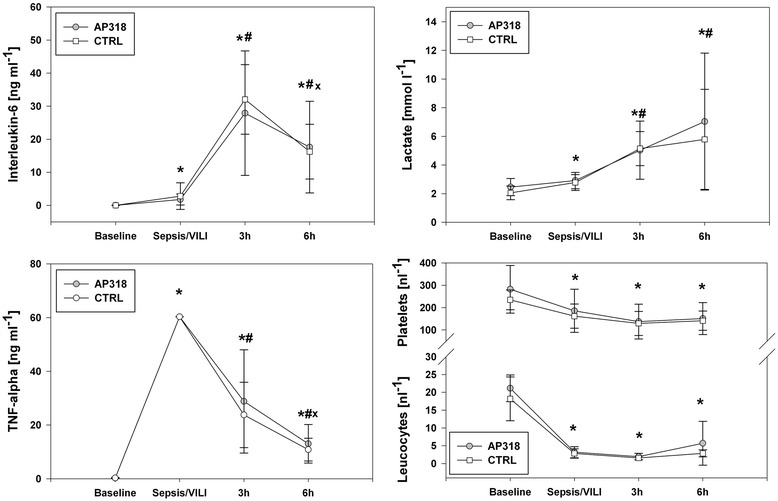
Despite similar systemic response to lipopolysaccharide infusion in both groups, pulmonary inflammation (IL-6, TNF-α, COX-2, tenascin-c) was significantly mitigated by AP318. Furthermore, a Western blot analysis shows a significantly lower of COX-2 protein level. The present sepsis model caused minor lung edema formation and moderate gas exchange impairment. Six hours after onset pathologic scoring showed no improvement, while gas exchange parameters and pulmonary edema formation were similar in the two groups.
In summary, AP318 significantly attenuated intrapulmonary inflammatory response even without the presence or resolution of severe pulmonary edema in a porcine model of systemic sepsis-associated lung injury. These findings suggest an anti-inflammatory mechanism of the lectin-like domain beyond mere edema reabsorption in endotoxemic lung injury in vivo.
肿瘤坏死因子-α(TNF-α)的凝集素样结构域可被合成的TIP肽模拟,这代表了一种治疗水肿性呼吸衰竭的创新药理学选择。吸入TIP已被证明可减轻肺水肿并改善气体交换。除了其消除水肿的作用外,TIP肽可能还具有一些抗炎特性。因此,本研究调查了吸入的TIP肽AP318对系统性脓毒症猪模型肺内炎症反应的影响。
在随机双盲实验中,通过输注脂多糖并在短时间内施加呼吸机诱导的肺应激进行二次打击,在18头猪中诱导肺损伤,随后进行6小时观察期。动物接受两次肽吸入(AP318,2×1 mg·kg⁻¹)或赋形剂。通过实时聚合酶链反应(IL-1β、IL-6、TNF-α、COX-2、iNOS、双调蛋白和腱生蛋白-c)测定炎症和机械转导标志物的死后肺表达。此外,对局部组织病理学肺损伤、水肿形成和全身炎症进行量化。
尽管两组对脂多糖输注的全身反应相似,但AP318可显著减轻肺部炎症(IL-6、TNF-α、COX-2、腱生蛋白-c)。此外,蛋白质印迹分析显示COX-2蛋白水平显著降低。本脓毒症模型导致轻微的肺水肿形成和中度的气体交换受损。发病6小时后,病理评分无改善,而两组的气体交换参数和肺水肿形成相似。
总之,在系统性脓毒症相关肺损伤的猪模型中,即使不存在严重肺水肿或肺水肿未消退,AP318也能显著减轻肺内炎症反应。这些发现表明,在体内内毒素血症性肺损伤中,凝集素样结构域的抗炎机制不仅仅是单纯的水肿重吸收。