Huang Yi Fang, Chang Chung Ta, Muo Chih Hsin, Tsai Chun Hao, Shen Yu Fu, Wu Ching Zong
Department of General Dentistry, Chang Gung Memorial Hospital, Linkou, Taiwan; School of Dentistry, College of Oral Medicine, Taipei Medical University, Taipei, Taiwan.
School of Dentistry, College of Oral Medicine, Taipei Medical University, Taipei, Taiwan; Department of Emergency Medicine, Far Eastern Memorial Hospital, Taipei, Taiwan.
PLoS One. 2015 Apr 16;10(4):e0120756. doi: 10.1371/journal.pone.0120756. eCollection 2015.
Little is currently known about the risk of developing bisphosphonate-related osteonecrosis of the jaw (BRONJ). This study sought to determine the incidence of BRONJ in osteoporotic patients. We also sought to identify the nature and types of risk factors of osteonecrosis of jaw (ONJ) related to the use of oral bisphosphonates (BPs).
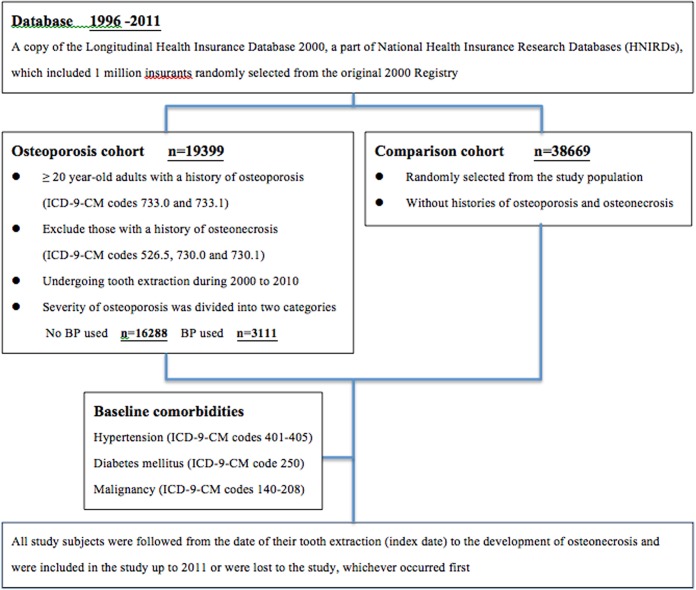
Data from the National Health Insurance system of Taiwan. This cohort study included 19,399 adult osteoporosis patients received dental extraction in 2000-2010 (osteoporosis cohort) and 38,669 age and gender matched comparisons selected from dental extraction people without osteoporosis and osteonecrosis history (comparison cohort). All study subjects were followed from the date of their dental extraction (index date) to the development of ONJ and were included in the study up to 2011 or were lost to the study, whichever occurred first. Cox proportional hazard regression was used to estimate the hazard ratio and 95% confidence intervals for the two cohorts.
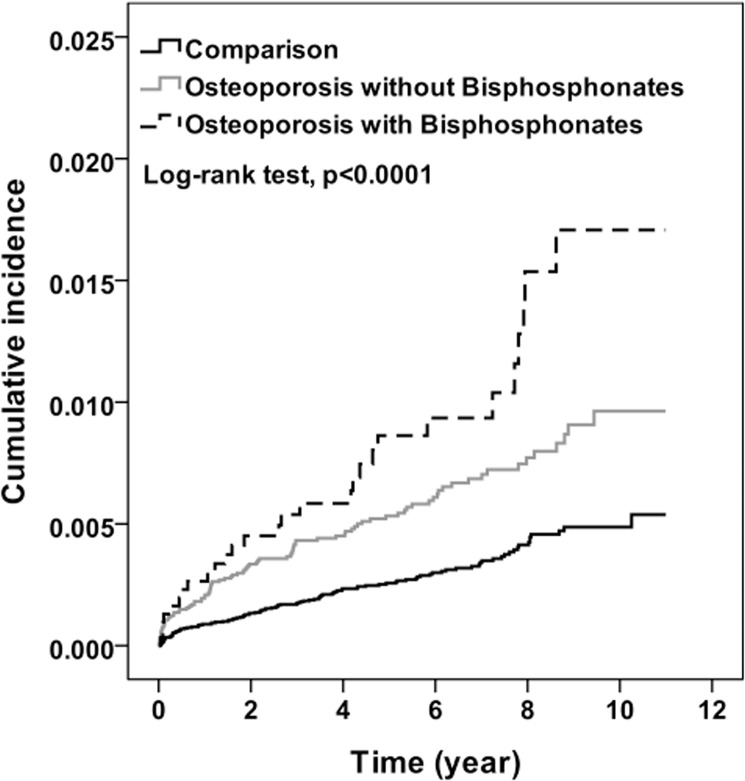
Patients with osteoporosis had a significantly higher risk to develop ONJ than healthy persons (adjusted HR, 2.05; 95% confidence interval, 1.58-2.65). The risk of ONJ increased with the severity of osteoporosis, no matter whether patient with cancer or not. A cumulative effect of dental extraction frequency may increase the risk of ONJ.
We concluded that ONJ is caused by a number of factors. Osteoporosis and past dental history play the very important roles, while BPs play the synergistic effect.
目前对于双膦酸盐相关颌骨坏死(BRONJ)发生风险的了解甚少。本研究旨在确定骨质疏松患者中BRONJ的发生率。我们还试图明确与口服双膦酸盐(BPs)使用相关的颌骨坏死(ONJ)风险因素的性质和类型。
来自台湾国民健康保险系统的数据。这项队列研究纳入了2000年至2010年间接受拔牙的19399名成年骨质疏松患者(骨质疏松队列),以及从无骨质疏松和骨坏死病史的拔牙人群中选取的38669名年龄和性别匹配的对照者(对照队列)。所有研究对象从拔牙日期(索引日期)开始随访至ONJ发生,截至2011年被纳入研究,或失访,以先发生者为准。采用Cox比例风险回归来估计两个队列的风险比和95%置信区间。
骨质疏松患者发生ONJ的风险显著高于健康人(调整后HR,2.05;95%置信区间,1.58 - 2.65)。无论是否患有癌症,ONJ的风险均随骨质疏松严重程度增加。拔牙频率的累积效应可能会增加ONJ的风险。
我们得出结论,ONJ由多种因素引起。骨质疏松和既往牙科病史起着非常重要的作用,而BPs起协同作用。