Bolormaa Sunduimijid, Pryce Jennie E, Zhang Yuandan, Reverter Antonio, Barendse William, Hayes Ben J, Goddard Michael E
Victorian Department of Economic Development, Jobs, Transport and Resources, Bundoora, VIC, 3083, Australia.
Animal Genetics and Breeding Unit, UNE, Armidale, NSW, 2351, Australia.
Genet Sel Evol. 2015 Apr 2;47(1):26. doi: 10.1186/s12711-015-0114-8.
A better understanding of non-additive variance could lead to increased knowledge on the genetic control and physiology of quantitative traits, and to improved prediction of the genetic value and phenotype of individuals. Genome-wide panels of single nucleotide polymorphisms (SNPs) have been mainly used to map additive effects for quantitative traits, but they can also be used to investigate non-additive effects. We estimated dominance and epistatic effects of SNPs on various traits in beef cattle and the variance explained by dominance, and quantified the increase in accuracy of phenotype prediction by including dominance deviations in its estimation.
Genotype data (729 068 real or imputed SNPs) and phenotypes on up to 16 traits of 10 191 individuals from Bos taurus, Bos indicus and composite breeds were used. A genome-wide association study was performed by fitting the additive and dominance effects of single SNPs. The dominance variance was estimated by fitting a dominance relationship matrix constructed from the 729 068 SNPs. The accuracy of predicted phenotypic values was evaluated by best linear unbiased prediction using the additive and dominance relationship matrices. Epistatic interactions (additive × additive) were tested between each of the 28 SNPs that are known to have additive effects on multiple traits, and each of the other remaining 729 067 SNPs.
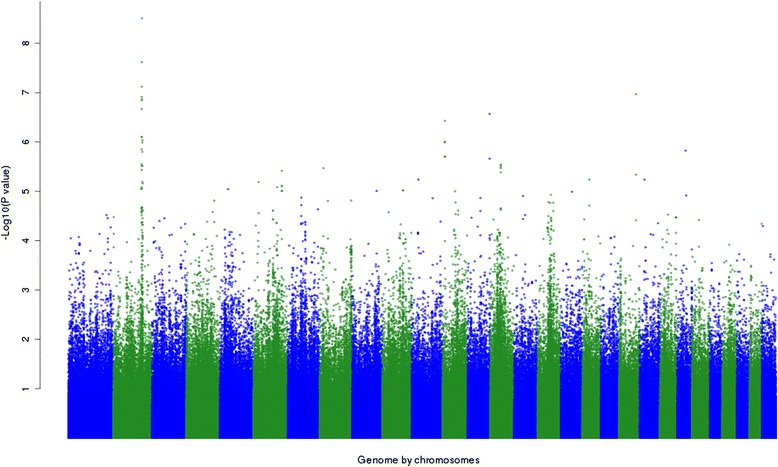
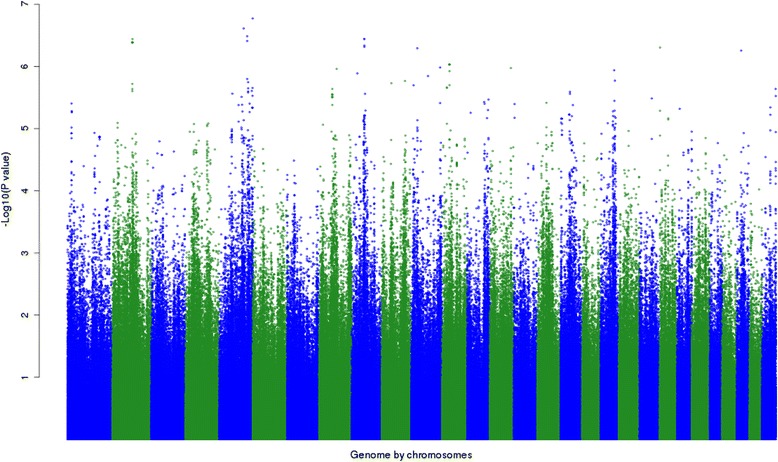
The number of significant dominance effects was greater than expected by chance and most of them were in the direction that is presumed to increase fitness and in the opposite direction to inbreeding depression. Estimates of dominance variance explained by SNPs varied widely between traits, but had large standard errors. The median dominance variance across the 16 traits was equal to 5% of the phenotypic variance. Including a dominance deviation in the prediction did not significantly increase its accuracy for any of the phenotypes. The number of additive × additive epistatic effects that were statistically significant was greater than expected by chance.
Significant dominance and epistatic effects occur for growth, carcass and fertility traits in beef cattle but they are difficult to estimate precisely and including them in phenotype prediction does not increase its accuracy.
更好地理解非加性方差有助于增进对数量性状的遗传控制和生理学的认识,并改进对个体遗传值和表型的预测。全基因组单核苷酸多态性(SNP)面板主要用于绘制数量性状的加性效应图谱,但也可用于研究非加性效应。我们估计了肉牛中SNP对各种性状的显性和上位性效应以及显性所解释的方差,并通过在表型预测估计中纳入显性偏差来量化预测准确性的提高。
使用了来自欧洲牛、印度牛和杂交品种的10191个个体的多达16个性状的基因型数据(729068个真实或推算的SNP)和表型。通过拟合单个SNP的加性和显性效应进行全基因组关联研究。通过拟合由729068个SNP构建的显性关系矩阵来估计显性方差。使用加性和显性关系矩阵通过最佳线性无偏预测来评估预测表型值的准确性。在已知对多个性状有加性效应的28个SNP中的每一个与其余729067个SNP中的每一个之间测试上位性相互作用(加性×加性)。
显著显性效应的数量大于偶然预期,并且其中大多数的方向被认为会提高适应性,与近亲繁殖衰退方向相反。SNP所解释的显性方差估计值在不同性状之间差异很大,但标准误很大。16个性状的中位显性方差等于表型方差的5%。在预测中纳入显性偏差对任何表型的准确性均未产生显著提高。具有统计学显著性的加性×加性上位性效应的数量大于偶然预期。
肉牛的生长、胴体和繁殖性状存在显著的显性和上位性效应,但难以精确估计,将它们纳入表型预测并不能提高其准确性。