Wei Ting, Zhang Peng, Wang Ke, Ding Ruixia, Yang Baoping, Nie Junfeng, Jia Zhikuan, Han Qingfang
The Chinese Institute of Water-saving Agriculture, Northwest A&F University, Yangling, 712100, Shaanxi, China; Key Laboratory of Crop Physi-ecology and Tillage Science in Northwestern Loess Plateau, Ministry of Agriculture, Northwest A&F University, Yangling, 712100, Shaanxi, China.
Key Laboratory of Crop Physi-ecology and Tillage Science in Northwestern Loess Plateau, Ministry of Agriculture, Northwest A&F University, Yangling, 712100, Shaanxi, China.
PLoS One. 2015 Apr 16;10(4):e0120994. doi: 10.1371/journal.pone.0120994. eCollection 2015.
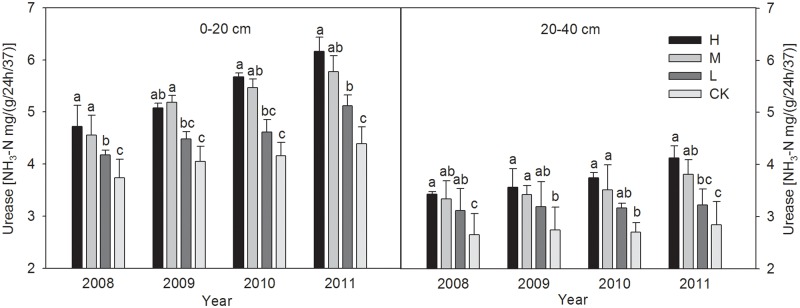
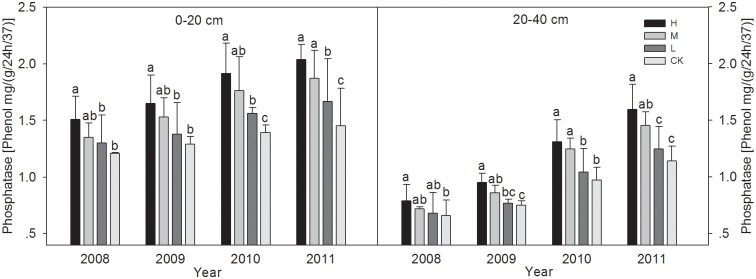
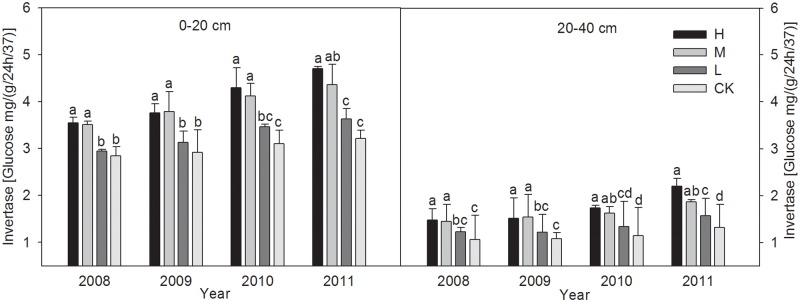
Soil infertility is the main barrier to dryland agricultural production in China. To provide a basis for the establishment of a soil amelioration technical system for rainfed fields in the semiarid area of northwest China, we conducted a four-year (2007-2011) field experiment to determine the effects of wheat straw incorporation on the arid soil nutrient levels of cropland cultivated with winter wheat after different straw incorporation levels. Three wheat straw incorporation levels were tested (H: 9000 kg hm(-2), M: 6000 kg hm(-2), and L: 3000 kg hm(-2)) and no straw incorporation was used as the control (CK). The levels of soil nutrients, soil organic carbon (SOC), soil labile organic carbon (LOC), and enzyme activities were analyzed each year after the wheat harvest. After straw incorporation for four years, the results showed that variable straw amounts had different effects on the soil fertility indices, where treatment H had the greatest effect. Compared with CK, the average soil available N, available P, available K, SOC, and LOC levels were higher in the 0-40 cm soil layers after straw incorporation treatments, i.e., 9.1-30.5%, 9.8-69.5%, 10.3-27.3%, 0.7-23.4%, and 44.4-49.4% higher, respectively. On average, the urease, phosphatase, and invertase levels in the 0-40 cm soil layers were 24.4-31.3%, 9.9-36.4%, and 42.9-65.3% higher, respectively. Higher yields coupled with higher nutrient contents were achieved with H, M and L compared with CK, where these treatments increased the crop yields by 26.75%, 21.51%, and 7.15%, respectively.
土壤贫瘠是中国旱地农业生产的主要障碍。为了给中国西北半干旱地区雨养农田土壤改良技术体系的建立提供依据,我们进行了为期四年(2007 - 2011年)的田间试验,以确定不同麦秸添加水平下,冬小麦种植农田中添加小麦秸秆对干旱土壤养分水平的影响。试验设置了三个麦秸添加水平(高:9000 kg hm(-2),中:6000 kg hm(-2),低:3000 kg hm(-2)),并以不添加秸秆作为对照(CK)。每年小麦收获后分析土壤养分、土壤有机碳(SOC)、土壤活性有机碳(LOC)和酶活性水平。麦秸添加四年后,结果表明,不同数量的秸秆对土壤肥力指标有不同影响,其中高量处理影响最大。与对照相比,麦秸添加处理后0 - 40 cm土层中土壤碱解氮、有效磷、速效钾、SOC和LOC平均水平分别提高了9.1 - 30.5%、9.8 - 69.5%、10.3 - 27.3%、0.7 - 23.4%和44.4 - 49.4%。平均而言,0 - 40 cm土层中脲酶、磷酸酶和蔗糖酶水平分别提高了24.4 - 31.3%、9.9 - 36.4%和42.9 - 65.3%。与对照相比,高量、中量和低量处理的产量和养分含量更高,这些处理分别使作物产量提高了26.75%、21.51%和7.15%。