Ramallo-Fariña Yolanda, García-Pérez Lidia, Castilla-Rodríguez Iván, Perestelo-Pérez Lilisbeth, Wägner Ana María, de Pablos-Velasco Pedro, Domínguez Armando Carrillo, Cortés Mauro Boronat, Vallejo-Torres Laura, Ramírez Marcos Estupiñán, Martín Pablo Pedrianes, García-Puente Ignacio, Salinero-Fort Miguel Ángel, Serrano-Aguilar Pedro Guillermo
Fundación Canaria de Investigación Sanitaria (FUNCANIS), Tenerife, Spain.
Servicio de Evaluación del Servicio Canario de la Salud (SESCS), Tenerife, Spain.
Implement Sci. 2015 Apr 9;10:47. doi: 10.1186/s13012-015-0233-1.
Type 2 diabetes mellitus is a chronic disease whose health outcomes are related to patients and healthcare professionals' decision-making. The Diabetes Intervention study in the Canary Islands (INDICA study) aims to evaluate the effectiveness and cost-effectiveness of educational interventions supported by new technology decision tools for type 2 diabetes patients and primary care professionals in the Canary Islands.
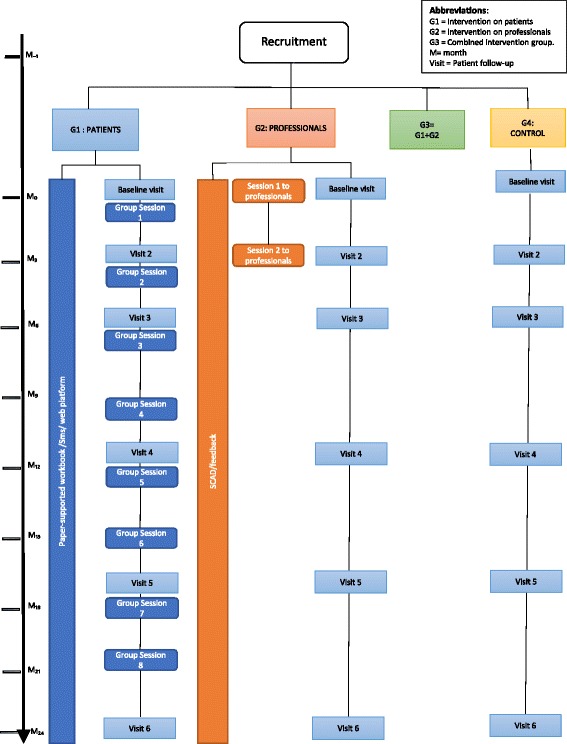
METHODS/DESIGN: The INDICA study is an open, community-based, multicenter, clinical controlled trial with random allocation by clusters to one of three interventions or to usual care. The setting is primary care where physicians and nurses are invited to participate. Patients with diabetes diagnosis, 18-65 years of age, and regular users of mobile phone were randomly selected. Patients with severe comorbidities were excluded. The clusters are primary healthcare practices with enough professionals and available places to provide the intervention. The calculated sample size was 2,300 patients. Patients in group 1 are receiving an educational group program of eight sessions every 3 months led by trained nurses and monitored by means of logs and a web-based platform and tailored semi-automated SMS for continuous support. Primary care professionals in group 2 are receiving a short educational program to update their diabetes knowledge, which includes a decision support tool embedded into the electronic clinical record and a monthly feedback report of patients' results. Group 3 is receiving a combination of the interventions for patients and professionals. The primary endpoint is the change in HbA1c in 2 years. Secondary endpoints are cardiovascular risk factors, macrovascular and microvascular diabetes complications, quality of life, psychological outcomes, diabetes knowledge, and healthcare utilization. Data is being collected from interviews, questionnaires, clinical examinations, and records. Generalized linear mixed models with repeated time measurements will be used to analyze changes in outcomes. The cost-effectiveness analysis, from the healthcare services perspective, involves direct medical costs per quality-adjusted life year gained and two periods, a 'within-trial' period and a lifetime Markov model. Deterministic and probabilistic sensitivity analyses are planned.
This ongoing trial aims to set up the implementation of evidence-based programs in the clinical setting for chronic patients.
Clinical Trial.gov NCT01657227.
2型糖尿病是一种慢性病,其健康结局与患者及医护人员的决策相关。加那利群岛糖尿病干预研究(INDICA研究)旨在评估新技术决策工具支持的教育干预措施对加那利群岛2型糖尿病患者及初级保健专业人员的有效性和成本效益。
方法/设计:INDICA研究是一项开放的、基于社区的多中心临床对照试验,通过整群随机分配至三种干预措施之一或常规护理。研究场所为邀请医生和护士参与的初级保健机构。随机选取年龄在18 - 65岁、确诊糖尿病且经常使用手机的患者。排除患有严重合并症的患者。整群为有足够专业人员和场地提供干预措施的初级医疗保健机构。计算得出的样本量为2300名患者。第1组患者每3个月接受由经过培训的护士主导的为期8节的教育小组课程,并通过日志和基于网络的平台进行监测,同时定制半自动短信以提供持续支持。第2组初级保健专业人员接受一个简短的教育项目以更新其糖尿病知识,该项目包括嵌入电子临床记录的决策支持工具以及患者结果的月度反馈报告。第3组接受针对患者和专业人员的综合干预措施。主要终点是2年内糖化血红蛋白(HbA1c)的变化。次要终点包括心血管危险因素、糖尿病大血管和微血管并发症、生活质量、心理结局、糖尿病知识以及医疗保健利用情况。数据通过访谈、问卷、临床检查和记录收集。将使用具有重复时间测量的广义线性混合模型来分析结局变化。从医疗保健服务角度进行的成本效益分析涉及每获得一个质量调整生命年的直接医疗成本以及两个阶段,即“试验期间”和终身马尔可夫模型。计划进行确定性和概率性敏感性分析。
这项正在进行的试验旨在在临床环境中为慢性病患者建立基于证据的项目实施方案。
ClinicalTrials.gov NCT01657227