Department of Social Medicine and Department of Pharmacy of the First Affiliated Hospital, Zhejiang University School of Medicine, Hangzhou, Zhejiang Province, China.
Department of Investment and Insurance, Zhejiang Financial College, Hangzhou, Zhejiang Province, China.
J Diabetes Res. 2019 Jan 3;2019:6516581. doi: 10.1155/2019/6516581. eCollection 2019.
The Chronic Care Model, based on core elements of team-centered care in chronic diseases, has widely been accepted. This study was aimed at evaluating the effectiveness of the Chronic Care Model in type 2 diabetes management.
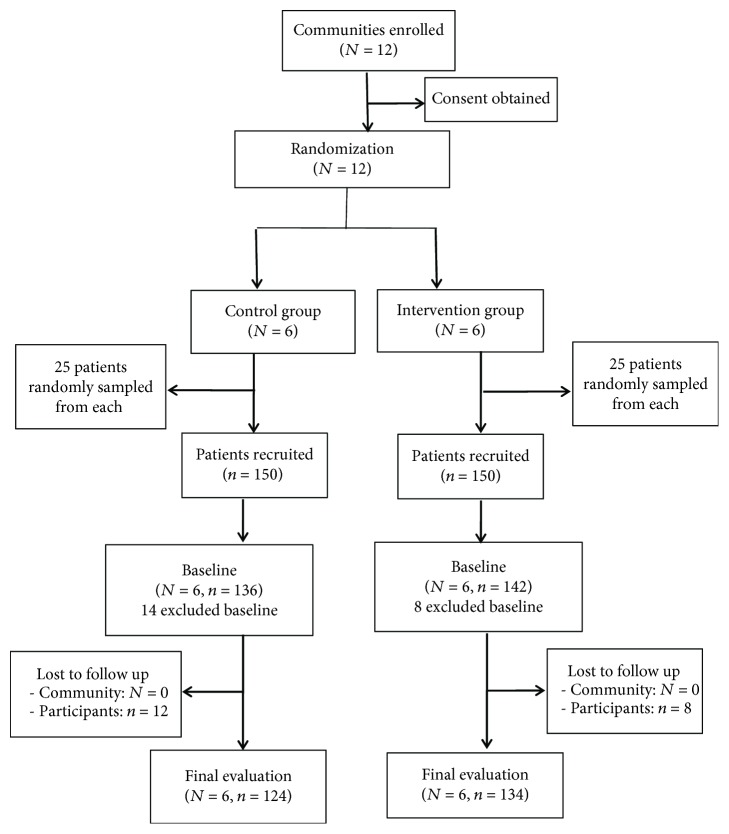
A group randomized experimental study was conducted. Twelve communities of the Zhaohui Community Health Service Center in Hangzhou, China, were randomly assigned into an intervention group ( = 6) receiving the Chronic Care Model-based intervention and a control group ( = 6) receiving conventional care. A total of three hundred patients, twenty-five for each community, aged ≥18 years with type 2 diabetes for at least 1-year duration, were recruited. Data of health behaviors, clinical outcomes, and health-related quality of life (Short-Form 36-item questionnaire) were collected before and after a 9-month intervention and analyzed using descriptive statistics, -test, chi-square test, binary logistic regression, and linear mixed regression. A total of 258 patients (134 in intervention and 124 in control) who completed the baseline and follow-up evaluations and the entire intervention were included in the final analyses.
Health behaviors such as drinking habit (OR = 0.07, 95% CI: 0.01, 0.75), physical activity (OR = 2.92, 95% CI: 1.18, 7.25), and diet habit (OR = 4.30, 95% CI: 1.49, 12.43) were improved. The intervention group had a remarkable reduction in glycated hemoglobin (from 7.17% to 6.60%, < 0.001). The quality of life score changes of the role limitation due to physical problems (mean = 9.97, 95% CI: 3.33, 16.60), social functioning (mean = 6.50, 95% CI: 2.37, 10.64), role limitation due to emotional problems (mean = 8.06, 95% CI: 2.15, 13.96), and physical component summary score (mean = 3.31, 95% CI: 1.22, 5.39) were improved in the intervention group compared to the control group.
The Chronic Care Model-based intervention helped improve some health behaviors, clinical outcomes, and quality of life of type 2 diabetes patients in China in a short term.
基于慢性病团队照护核心要素的慢性病照护模式已被广泛接受。本研究旨在评估慢性病照护模式在 2 型糖尿病管理中的效果。
采用群组随机实验研究。在中国杭州朝晖社区卫生服务中心的 12 个社区中,将其随机分为干预组(n=6)和对照组(n=6)。干预组接受基于慢性病照护模式的干预,对照组接受常规护理。共招募了 300 名年龄≥18 岁、患有 2 型糖尿病至少 1 年的患者,每个社区 25 名。在干预前和干预 9 个月后收集健康行为、临床结局和健康相关生活质量(SF-36 量表)的数据,采用描述性统计、t 检验、卡方检验、二项逻辑回归和线性混合回归进行分析。共纳入 258 名患者(干预组 134 名,对照组 124 名)完成了基线和随访评估以及整个干预过程,最终分析包括这些患者。
健康行为(如饮酒习惯、体力活动和饮食习惯)得到改善。干预组糖化血红蛋白显著降低(从 7.17%降至 6.60%,<0.001)。与对照组相比,干预组的生理问题所致角色受限(平均=9.97,95%置信区间:3.33,16.60)、社会功能(平均=6.50,95%置信区间:2.37,10.64)、情绪问题所致角色受限(平均=8.06,95%置信区间:2.15,13.96)和生理成分综合评分(平均=3.31,95%置信区间:1.22,5.39)的变化更明显。
在短期内,基于慢性病照护模式的干预有助于改善中国 2 型糖尿病患者的某些健康行为、临床结局和生活质量。