Cysique Lucette A, Hewitt Timothy, Croitoru-Lamoury Juliana, Taddei Kevin, Martins Ralph N, Chew Constance S N, Davies Nicholas N W S, Price Patricia, Brew Bruce J
University of New South Wales, St. Vincent's Hospital Clinical School, Sydney, Australia.
Neuroscience Research Australia, Sydney, Australia.
BMC Neurol. 2015 Apr 1;15:51. doi: 10.1186/s12883-015-0298-0.
Cerebrospinal fluid (CSF) biomarkers Aβ1-42, t-tau and p-tau have a characteristic pattern in Alzheimer's Disease (AD). Their roles in HIV-associated neurocognitive disorder (HAND) remains unclear.
Adults with chronic treated HIV disease were recruited (n = 43, aged 56.7 ± 7.9; 32% aged 60+; median HIV duration 20 years, >95% plasma and CSF HIV RNA <50 cp/mL, on cART for a median 24 months). All underwent standard neuropsychological testing (61% had HAND), APOE genotyping (30.9% carried APOE ε4 and 7.1% were ε4 homozygotes) and a lumbar puncture. Concentrations of Aβ1-42, t-tau and p-tau were assessed in the CSF using commercial ELISAs. Current neurocognitive status was defined using the continuous Global Deficit Score, which grades impairment in clinically relevant categories. History of HAND was recorded. Univariate correlations informed multivariate models, which were corrected for nadir CD4-T cell counts and HIV duration.
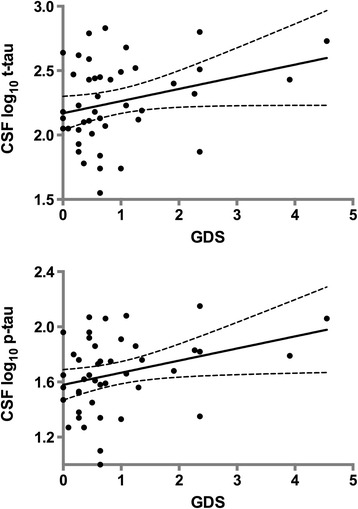
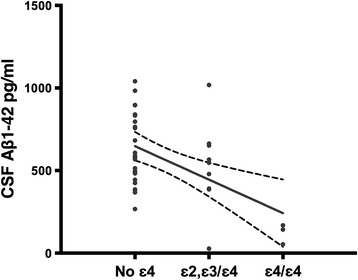
Carriage of APOE ε4 predicted markedly lower levels of CSF Aβ1-42 in univariate (r = -.50; p = .001) and multivariate analyses (R(2) = .25; p < .0003). Greater levels of neurocognitive impairment were associated with higher CSF levels of p-tau in univariate analyses (r = .32; p = .03) and multivariate analyses (R(2) = .10; p = .03). AD risk prediction cut-offs incorporating all three CSF biomarkers suggested that 12.5% of participants had a high risk for AD. Having a CSF-AD like profile was more frequent in those with current (p = .05) and past HIV-associated dementia (p = .03).
Similarly to larger studies, APOE ε4 genotype was not directly associated with HAND, but moderated CSF levels of Aβ1-42 in a minority of participants. In the majority of participants, increased CSF p-tau levels were associated with current neurocognitive impairment. Combined CSF biomarker risk for AD in the current HIV+ sample is more than 10 times greater than in the Australian population of the same age. Larger prospective studies are warranted.
脑脊液(CSF)生物标志物Aβ1-42、总tau蛋白(t-tau)和磷酸化tau蛋白(p-tau)在阿尔茨海默病(AD)中具有特征性模式。它们在HIV相关神经认知障碍(HAND)中的作用仍不清楚。
招募接受过慢性治疗的HIV感染者(n = 43,年龄56.7±7.9岁;32%年龄在60岁以上;HIV感染中位时间20年,>95%的血浆和脑脊液HIV RNA<50拷贝/mL,接受抗逆转录病毒治疗(cART)的中位时间为24个月)。所有人均接受标准神经心理学测试(61%患有HAND)、APOE基因分型(30.9%携带APOE ε4,7.1%为ε4纯合子)以及腰椎穿刺。使用商业酶联免疫吸附测定法(ELISA)评估脑脊液中Aβ1-42、t-tau和p-tau的浓度。使用连续全球缺陷评分定义当前神经认知状态,该评分对临床相关类别中的损伤进行分级。记录HAND病史。单变量相关性为多变量模型提供信息,多变量模型针对最低CD4-T细胞计数和HIV感染时间进行了校正。
在单变量分析(r = -0.50;p = 0.001)和多变量分析(R(2)=0.25;p < 0.0003)中,APOE ε4的携带均预示脑脊液Aβ1-42水平显著降低。在单变量分析(r = 0.32;p = 0.03)和多变量分析(R(2)=0.10;p = 0.03)中,更高水平的神经认知障碍与脑脊液中更高水平的p-tau相关。纳入所有三种脑脊液生物标志物的AD风险预测临界值表明,12.5%的参与者具有较高的AD风险。在当前患有(p = 0.05)和既往患有HIV相关痴呆(p = 0.03)的患者中,具有脑脊液AD样特征更为常见。
与更大规模的研究相似,APOE ε4基因型与HAND无直接关联,但在少数参与者中调节了脑脊液Aβ1-42水平。在大多数参与者中,脑脊液p-tau水平升高与当前神经认知障碍相关。当前HIV阳性样本中脑脊液生物标志物联合的AD风险比同年龄的澳大利亚人群高10倍以上。有必要进行更大规模的前瞻性研究。