University of California, San Diego, San Diego, CA, USA.
J Neurovirol. 2013 Apr;19(2):150-6. doi: 10.1007/s13365-013-0152-3. Epub 2013 Feb 14.
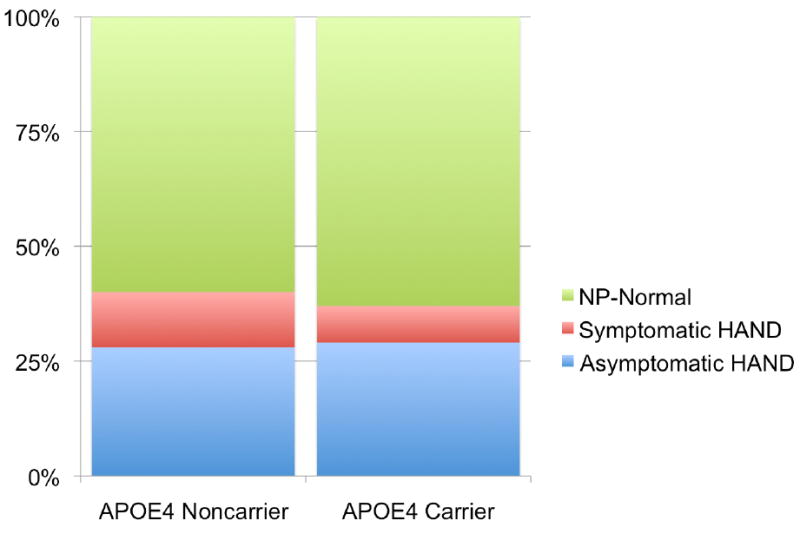
This is a cross-sectional, observational study to evaluate the hypothesis that HIV-seropositive (HIV+) apolipoprotein E4 (APOE4) carriers are at increased risk for HIV-associated neurocognitive disorders (HAND) compared to APOE4 noncarriers with HIV in the CNS HIV Antiretroviral Therapy Effects Research (CHARTER) Group sample. APOE genotype was determined in 466 CHARTER participants with varying disease stages and histories of antiretroviral treatment who did not have severe psychiatric or medical comorbid conditions that preclude diagnosis of HAND. HAND diagnoses were based on results of comprehensive neurobehavioral evaluation and use of current neuroAIDS diagnostic criteria. HAND status consists of two levels: neuropsychologically normal status (i.e., no HAND) and any HAND diagnosis (i.e., asymptomatic neurocognitive impairment, minor neurocognitive disorder, HIV-associated dementia). Logistic regression analyses revealed no association between APOE4 carrier status and HAND, and there were no interactions between APOE4 carrier status and ethnicity, age, substance use disorders, duration of infection, or nadir CD4. Results did not differ when analysis was restricted to symptomatic HAND, and no APOE4 gene dose-dependent relationship to HAND emerged. APOE4 status was not associated with concurrent HAND in this large, well-characterized sample. This does not preclude emergence of an association between APOE4 status and HAND as this population ages. Prospective, longitudinal studies are needed to examine APOE4 as a risk factor for neurocognitive decline, incident HAND at older ages, and potential associations with cerebrospinal fluid amyloid.
这是一项横断面、观察性研究,旨在评估以下假设:与 HIV 无神经认知障碍(HAND)的 CNS HIV 抗逆转录病毒治疗效果研究(CHARTER)组样本中的 APOE4 非携带者相比,HIV 阳性(HIV+)载脂蛋白 E4(APOE4)携带者发生 HIV 相关神经认知障碍(HAND)的风险增加。在 CHARTER 组的 466 名参与者中,根据不同的疾病阶段和抗逆转录病毒治疗史,确定了 APOE 基因型,且这些参与者没有严重的精神或医学合并症,从而排除了 HAND 的诊断。HAND 的诊断基于综合神经行为评估的结果和当前神经艾滋病诊断标准。HAND 状态包括两个级别:神经心理学正常状态(即无 HAND)和任何 HAND 诊断(即无症状神经认知障碍、轻度认知障碍、HIV 相关痴呆)。逻辑回归分析显示,APOE4 携带者状态与 HAND 之间没有关联,并且 APOE4 携带者状态与种族、年龄、物质使用障碍、感染持续时间或最低 CD4 之间没有相互作用。当分析仅限于有症状的 HAND 时,结果没有差异,也没有出现 APOE4 基因剂量与 HAND 之间的关系。在这个大型、特征明确的样本中,APOE4 状态与同时发生的 HAND 无关。这并不能排除随着这一人群年龄的增长,APOE4 状态与 HAND 之间出现关联的可能性。需要前瞻性、纵向研究来检查 APOE4 作为神经认知衰退、年龄较大时 HAND 的发生率以及与脑脊液淀粉样蛋白的潜在关联的风险因素。