Sakai Ryoko, Cho Soo-Kyung, Nanki Toshihiro, Watanabe Kaori, Yamazaki Hayato, Tanaka Michi, Koike Ryuji, Tanaka Yoshiya, Saito Kazuyoshi, Hirata Shintaro, Amano Koichi, Nagasawa Hayato, Sumida Takayuki, Hayashi Taichi, Sugihara Takahiko, Dobashi Hiroaki, Yasuda Shinsuke, Sawada Tetsuji, Ezawa Kazuhiko, Ueda Atsuhisa, Fujii Takao, Migita Kiyoshi, Miyasaka Nobuyuki, Harigai Masayoshi
Department of Pharmacovigilance, Graduate School of Medical and Dental Sciences, Tokyo Medical and Dental University, 1-5-45, Yushima, Bunkyo-ku, Tokyo, 113-8519, Japan.
Department of Rheumatology, Graduate School of Medical and Dental Sciences, Tokyo Medical and Dental University, 1-5-45, Yushima, Bunkyo-ku, Tokyo, 113-8519, Japan.
Arthritis Res Ther. 2015 Mar 23;17(1):74. doi: 10.1186/s13075-015-0583-8.
The objective of this study was to directly compare the safety of tocilizumab (TCZ) and TNF inhibitors (TNFIs) in rheumatoid arthritis (RA) patients in clinical practice.
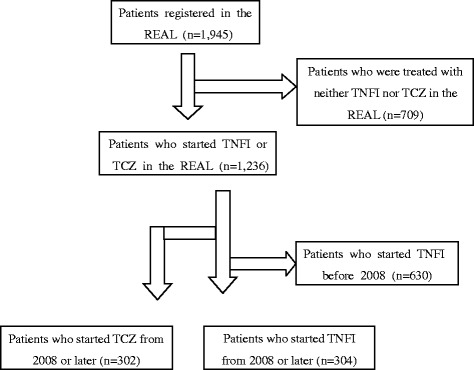
This prospective cohort study included RA patients starting TCZ [TCZ group, n=302, 224.68 patient-years (PY)] or TNFIs [TNFI group, n=304, 231.01 PY] from 2008 to 2011 in the registry of Japanese RA patients on biologics for long-term safety registry. We assessed types and incidence rates (IRs) of serious adverse events (SAEs) and serious infections (SIs) during the first year of treatment. Risks of the biologics for SAEs or SIs were calculated using the Cox regression hazard analysis.
Patients in the TCZ group had longer disease duration (P<0.001), higher disease activity (P=0.019) and more frequently used concomitant corticosteroids (P<0.001) than those in the TNFI group. The crude IR (/100 PY) of SIs [TCZ 10.68 vs. TNFI 3.03; IR ratio (95% confidence interval [CI]), 3.53 (1.52 to 8.18)], but not SAEs [21.36 vs. 14.72; 1.45 (0.94 to 2.25)], was significantly higher in the TCZ group compared with the TNFI group. However, after adjusting for covariates using the Cox regression hazard analysis, treatment with TCZ was not associated with higher risk for SAEs [hazard ratio (HR) 1.28, 95% CI 0.75 to 2.19] or SIs (HR 2.23, 95% CI 0.93 to 5.37).
The adjusted risks for SAEs and SIs were not significantly different between TCZ and TNFIs, indicating an influence of clinical characteristics of the patients on the safety profile of the biologics in clinical practice.
本研究的目的是在临床实践中直接比较托珠单抗(TCZ)和肿瘤坏死因子抑制剂(TNFIs)在类风湿关节炎(RA)患者中的安全性。
这项前瞻性队列研究纳入了2008年至2011年在日本RA患者生物制剂长期安全性登记处开始使用TCZ(TCZ组,n = 302,224.68患者年[PY])或TNFIs(TNFI组,n = 304,231.01 PY)的RA患者。我们评估了治疗第一年期间严重不良事件(SAEs)和严重感染(SIs)的类型和发生率(IRs)。使用Cox回归风险分析计算生物制剂发生SAEs或SIs的风险。
与TNFI组相比,TCZ组患者的病程更长(P < 0.001),疾病活动度更高(P = 0.019),更频繁使用联合糖皮质激素(P < 0.001)。与TNFI组相比,TCZ组SIs的粗IR(/100 PY)[TCZ为10.68 vs. TNFI为3.03;IR比(95%置信区间[CI]),3.53(1.52至8.18)]显著更高,但SAEs并非如此[21.36 vs. 14.72;1.45(0.94至2.25)]。然而,在使用Cox回归风险分析对协变量进行调整后,使用TCZ治疗与SAEs[风险比(HR)1.28,95%CI 0.75至2.19]或SIs(HR 2.23,95%CI 0.93至5.37)的较高风险无关。
TCZ和TNFIs之间SAEs和SIs的调整风险无显著差异,表明患者的临床特征对临床实践中生物制剂安全性的影响。