Chamieh Marie Claire, Moore Helen J, Summerbell Carolyn, Tamim Hani, Sibai Abla Mehio, Hwalla Nahla
Department of Nutrition, Faculty of Agriculture and Food Sciences, American University of Beirut, PO Box 11-0236, Riad El-Solh, Beirut, 1107-2020, Lebanon.
School of Medicine, Pharmacy and Health, Durham University, Stockton-on-Tees, UK.
BMC Public Health. 2015 Mar 21;15:279. doi: 10.1186/s12889-015-1605-9.
The prevalence of obesity within countries varies by gender, age, lifestyle and socioeconomic factors. Identification of behavioural factors that are associated with obesity within the country's context is critical for the development of effective public health programs which aim to prevent and manage obesity. The objective of this study was to assess age and gender differentials in the prevalence of obesity in Lebanon and examine correlates of obesity with a focus on socioeconomic disparities.
Following the WHO STEPwise guidelines, a national survey was conducted in Lebanon in 2008-2009. Households were selected randomly from all Governorates based on stratified cluster sampling method. One adult aged 20 years and over was randomly selected from each household for the interview. Anthropometric measurements and 24 hour recall dietary intake were obtained. The final sample included 1244 men and 1453 women. Descriptive statistics were computed for BMI, waist circumference, and percent body fat. Multivariate logistic regression analysis was carried out to assess the relationship between energy intake and obesity adjusted for relevant co-variables.
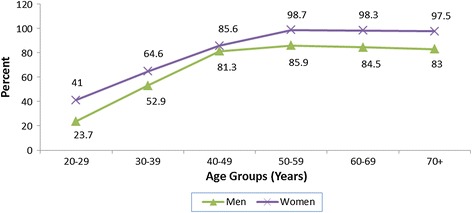
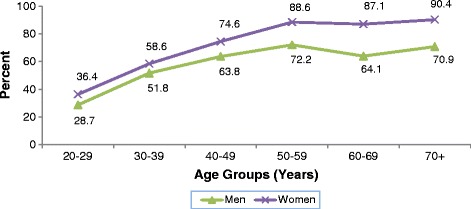
The prevalence of obesity among Lebanese adults was 26.1%. Gender differences in obesity estimates were observed across age groups and the three obesity classes, with men showing higher prevalence rates at the younger age groups (20-49 years), and women showing higher prevalence rates in older age groups (50 years and above). Obesity showed significant associations with socio-economic status in women; it decreased with higher educational attainment (OR = 0.54, 95% CI: 0.32, 0.91), greater household assets (OR = 0.26; 95% CI: 0.10, 0.72) and lower crowding index (OR = 0.62; 95% CI: 0.39, 0.98), net of the effect of other co-variates. There was a significant positive association between obesity and energy intake in both genders, and a negative association between obesity and physical activity, significantly among women.
Lifestyle and socioeconomic determinants of obesity are identified in this Lebanese population. Policy makers and service providers need to tailor public health strategies to tackle obesity accordingly.
各国肥胖症的患病率因性别、年龄、生活方式和社会经济因素而异。确定在该国背景下与肥胖症相关的行为因素,对于制定旨在预防和管理肥胖症的有效公共卫生项目至关重要。本研究的目的是评估黎巴嫩肥胖症患病率的年龄和性别差异,并着重从社会经济差距方面研究肥胖症的相关因素。
按照世界卫生组织的逐步指南,2008 - 2009年在黎巴嫩开展了一项全国性调查。基于分层整群抽样方法,从所有省份随机选取家庭。从每个家庭中随机挑选一名20岁及以上的成年人进行访谈。获取了人体测量数据和24小时回顾性膳食摄入量。最终样本包括1244名男性和1453名女性。计算了体重指数、腰围和体脂百分比的描述性统计数据。进行多变量逻辑回归分析,以评估在调整相关协变量后能量摄入与肥胖症之间的关系。
黎巴嫩成年人肥胖症的患病率为26.1%。在各年龄组和三种肥胖类别中均观察到肥胖症估计值的性别差异,男性在较年轻年龄组(20 - 49岁)的患病率较高,而女性在较年长年龄组(50岁及以上)的患病率较高。肥胖症与女性的社会经济地位存在显著关联;随着教育程度提高(比值比 = 0.54,95%置信区间:0.32,0.91)、家庭资产增加(比值比 = 0.26;95%置信区间:0.10,0.72)和拥挤指数降低(比值比 = 0.62;95%置信区间:0.39,0.98),肥胖症患病率下降,排除了其他协变量的影响。肥胖症与能量摄入在两性中均存在显著正相关,而肥胖症与身体活动存在负相关,在女性中尤为显著。
在该黎巴嫩人群中确定了肥胖症的生活方式和社会经济决定因素。政策制定者和服务提供者需要据此制定针对性的公共卫生策略来应对肥胖症。