Department of Public Health, Director of Center for Asian Health, College of Public Health, 1301 Cecil B Moore Ave. Ritter Annex, Rm 913, Philadelphia, PA, 19122, USA.
Center for Asian Health and College of Public Health, Temple University, Philadelphia, PA, 19122, USA.
BMC Infect Dis. 2015 Mar 8;15:120. doi: 10.1186/s12879-015-0854-7.
Hepatitis B Virus (HBV) disproportionately affects new immigrants from endemic regions such as China. Untreated infections increase health risks for liver diseases including cancer. Yet most of those infected are unaware of their disease limiting prevention and early treatment options. The purpose of this community based study was to evaluate a heuristic model identifying factors contributing to Hepatitis B (HBV) screening among Chinese Americans.
A cross-sectional design included a sample of 924 Chinese men and women 18 years of age and older of which 718 had complete data for final analysis. Confirmatory factor analysis verified conceptual indicators including access/satisfaction with health care and enabling, predisposing, cultural, and health belief factors. Structural equation modeling was used to identify direct and indirect predictors of Hepatitis B screening.
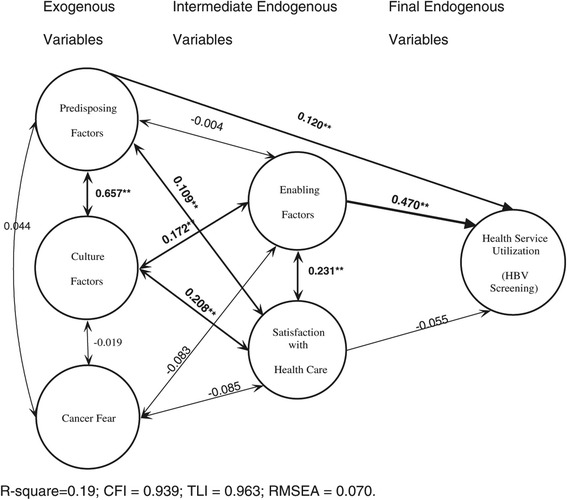
Bivariate analysis revealed that Chinese respondents who were never screened for HBV were significantly more likely to be below age 40 (69.8%), male (69.2%), had less than a high school education (76.4%), with less than 6 years living in the US (72.8%) and had no health insurance (79.2%). The final model identified enabling factors (having health insurance, a primary health care provider to go to when sick and more frequent visits to a doctor in the last year) as the strongest predictor of HBV screening (coefficient = 0.470, t = 7.618, p < .001). Predisposing factors (education variables) were also significantly related to HBV screening. Cultural factors and Satisfaction with Health care were associated with HBV screening only through their significant relationships with enabling factors.
The tested theoretical model shows promise in predicting HBV testing among Chinese Americans. Increasing access to health care by expanding insurance options and improving culturally sensitivity in health systems are critical to reach new immigrants like Chinese for HBV screening. Yet such strategies are consistent with DHHS Action plan for the Prevention and Treatment of Viral Hepatitis. Implementing community-based strategies like partnering with relevant Community-Based Organizations are important for meeting HBV policy targets.
乙型肝炎病毒(HBV)在来自中国等流行地区的新移民中不成比例地存在。未经治疗的感染会增加患肝病(包括癌症)的健康风险。然而,大多数感染者并不知道自己的疾病,这限制了预防和早期治疗的选择。本社区基础研究的目的是评估一种启发式模型,该模型确定了导致美籍华人乙型肝炎(HBV)筛查的因素。
采用横断面设计,纳入了 924 名年龄在 18 岁及以上的中国男性和女性,其中 718 人完成了最终分析的完整数据。验证性因素分析验证了包括获得/对医疗保健的满意度和使能、倾向、文化和健康信念因素等概念指标。结构方程模型用于确定乙型肝炎筛查的直接和间接预测因素。
单变量分析显示,从未接受过乙型肝炎筛查的中国受访者更有可能年龄在 40 岁以下(69.8%)、男性(69.2%)、受教育程度低于高中(76.4%)、在美国居住时间少于 6 年(72.8%)和没有医疗保险(79.2%)。最终模型确定了使能因素(有医疗保险、生病时可以去看的初级保健提供者和过去一年中更频繁地看医生)是乙型肝炎筛查的最强预测因素(系数=0.470,t=7.618,p<.001)。倾向因素(教育变量)也与乙型肝炎筛查显著相关。文化因素和对医疗保健的满意度仅通过与使能因素的显著关系与乙型肝炎筛查相关。
经过测试的理论模型在预测美籍华人的乙型肝炎检测方面显示出了前景。通过扩大保险选择和提高医疗保健系统的文化敏感性来增加获得医疗保健的机会,对于接触像中国人这样的新移民进行乙型肝炎筛查至关重要。然而,这些策略与 DHHS 防治病毒性肝炎行动计划一致。实施社区为基础的策略,如与相关社区组织合作,对于实现乙型肝炎政策目标非常重要。