von Hippel Paul T
Center for Health and Social Policy, LBJ School of Public Affairs, University of Texas, Austin, 2315 Red River, Box Y, Austin, TX, 78712, USA.
BMC Med Res Methodol. 2015 Apr 14;15:35. doi: 10.1186/s12874-015-0024-z.
Estimated effects vary across studies, partly because of random sampling error and partly because of heterogeneity. In meta-analysis, the fraction of variance that is due to heterogeneity is estimated by the statistic I(2). We calculate the bias of I(2), focusing on the situation where the number of studies in the meta-analysis is small. Small meta-analyses are common; in the Cochrane Library, the median number of studies per meta-analysis is 7 or fewer.
We use Mathematica software to calculate the expectation and bias of I(2).
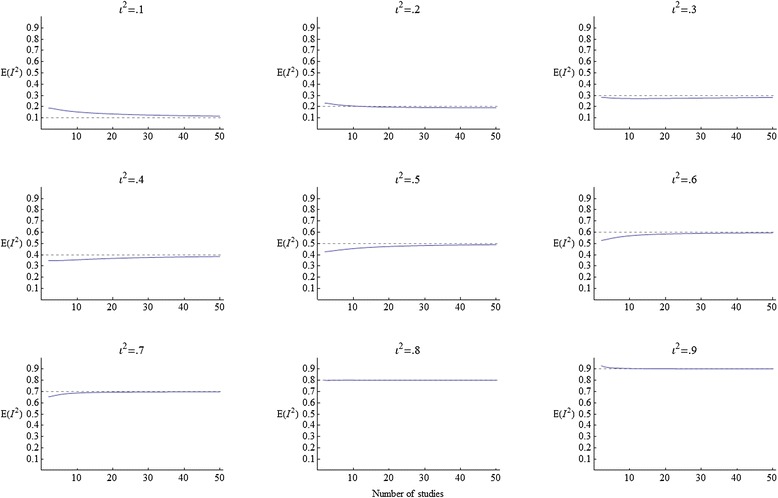
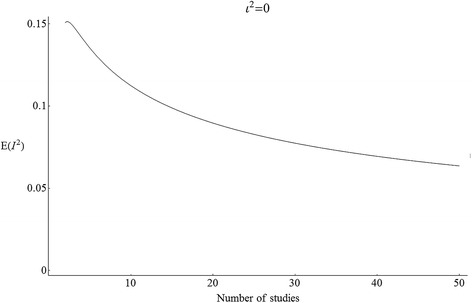
I(2) has a substantial bias when the number of studies is small. The bias is positive when the true fraction of heterogeneity is small, but the bias is typically negative when the true fraction of heterogeneity is large. For example, with 7 studies and no true heterogeneity, I(2) will overestimate heterogeneity by an average of 12 percentage points, but with 7 studies and 80 percent true heterogeneity, I(2) can underestimate heterogeneity by an average of 28 percentage points. Biases of 12-28 percentage points are not trivial when one considers that, in the Cochrane Library, the median I(2) estimate is 21 percent.
The point estimate I(2) should be interpreted cautiously when a meta-analysis has few studies. In small meta-analyses, confidence intervals should supplement or replace the biased point estimate I(2).
不同研究的估计效应有所不同,部分原因是随机抽样误差,部分原因是异质性。在荟萃分析中,由异质性导致的方差比例通过统计量I(2)来估计。我们计算I(2)的偏差,重点关注荟萃分析中研究数量较少的情况。小型荟萃分析很常见;在考科蓝图书馆中,每个荟萃分析的研究数量中位数为7个或更少。
我们使用Mathematica软件来计算I(2)的期望值和偏差。
当研究数量较少时,I(2)存在较大偏差。当真正的异质性比例较小时,偏差为正,但当真正的异质性比例较大时,偏差通常为负。例如,对于7项研究且不存在真正的异质性时,I(2)将平均高估异质性12个百分点,但对于7项研究且真正的异质性为80%时,I(2)可能会平均低估异质性28个百分点。考虑到在考科蓝图书馆中,I(2)的中位数估计值为21%,12 - 28个百分点的偏差并非微不足道。
当荟萃分析的研究数量较少时,应谨慎解释点估计值I(2)。在小型荟萃分析中,置信区间应补充或替代有偏差的点估计值I(2)。