Li Hua, Mohamed Ahmed A, Sharad Shashwat, Umeda Elizabeth, Song Yingjie, Young Denise, Petrovics Gyorgy, McLeod David G, Sesterhenn Isabell A, Sreenath Taduru, Dobi Albert, Srivastava Shiv
Center for Prostate Disease Research, Department of Surgery, Uniformed Services University of the Health Sciences, Bethesda, MD 20814, USA.
Urology Service, Walter Reed National Military Medical Center, Bethesda, MD 20814, USA.
Oncotarget. 2015 Jun 20;6(17):15137-49. doi: 10.18632/oncotarget.3526.
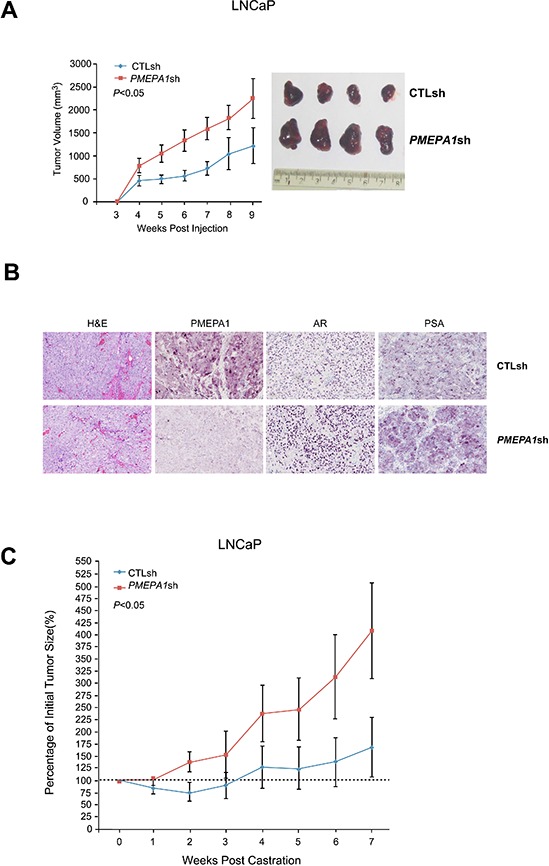
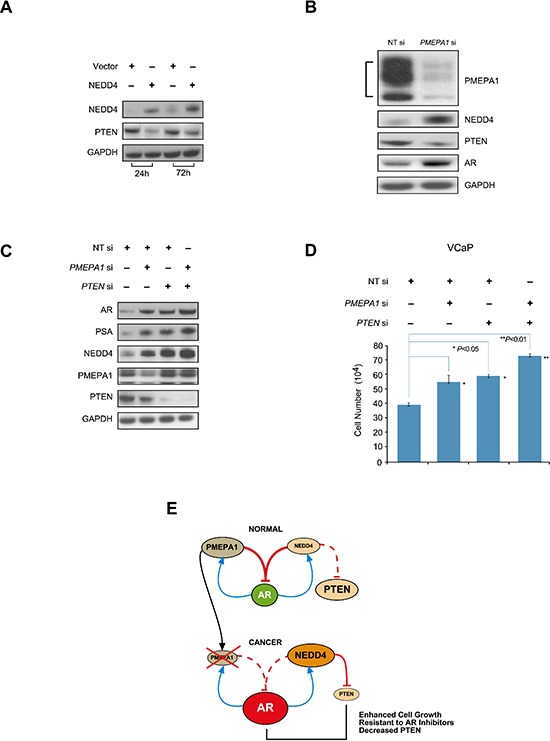
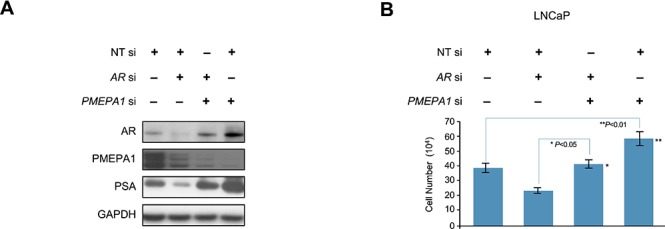
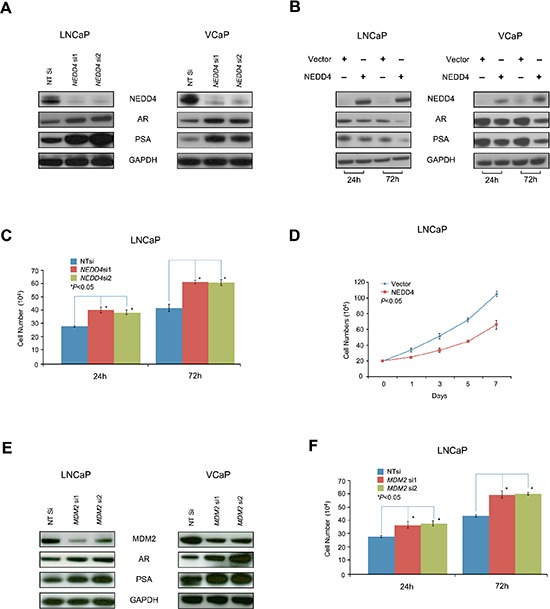
Androgen Receptor (AR) is the male hormone receptor and a nuclear transcription factor which plays a central role in the growth of normal and malignant prostate gland. Our earlier studies defined a mechanistic model for male hormone dependent regulation of AR protein levels in prostate cancer (CaP) cells through a negative feed-back loop between AR and PMEPA1, an androgen induced NEDD4 E3 ubiquitin ligase binding protein. This report focuses on the impact of PMEPA1 silencing on CaP biology. PMEPA1 knockdown accelerated the growth of CaP tumor cells in athymic nude mice. In cell culture models knockdown of PMEPA1 resulted in resistance to AR inhibitors enzalutamide and bicalutamide. While, AR protein down regulation by NEDD4 was PMEPA1 dependent, we also noted a PMEPA1 independent downregulation of PTEN by NEDD4. In a subset of human CaP, decreased PMEPA1 mRNA expression significantly correlated with increased levels of AR transcription target PSA, as a surrogate for elevated AR. This study highlights that silencing of PMEPA1 accelerates the growth of CaP cells through AR, NEDD4 and PTEN. Thus, the therapeutic restoration of PMEPA1 represents a promising complementary strategy correcting for AR and PTEN defects in CaP. Statement of significance: Here we define that silencing of PMEPA1 facilitates the growth of CaP cells and modulates AR through NEDD4 and PTEN. The restoration of PMEPA1 represents a promising complementary therapeutic strategy correcting for AR and PTEN defects.
雄激素受体(AR)是一种男性激素受体,也是一种核转录因子,在正常前列腺和前列腺癌细胞的生长中起着核心作用。我们早期的研究通过AR与PMEPA1(一种雄激素诱导的NEDD4 E3泛素连接酶结合蛋白)之间的负反馈环,定义了前列腺癌细胞中雄激素依赖性调节AR蛋白水平的机制模型。本报告重点关注PMEPA1沉默对前列腺癌生物学的影响。PMEPA1基因敲低加速了无胸腺裸鼠前列腺癌细胞的生长。在细胞培养模型中,PMEPA1基因敲低导致对AR抑制剂恩杂鲁胺和比卡鲁胺产生抗性。虽然NEDD4对AR蛋白的下调依赖于PMEPA1,但我们也注意到NEDD4对PTEN的下调不依赖于PMEPA1。在一部分人类前列腺癌中,PMEPA1 mRNA表达降低与AR转录靶点前列腺特异性抗原(PSA)水平升高显著相关,可作为AR升高的替代指标。本研究强调,PMEPA1沉默通过AR、NEDD4和PTEN加速前列腺癌细胞的生长。因此,PMEPA1的治疗性恢复是一种有前景的补充策略,可纠正前列腺癌中的AR和PTEN缺陷。重要性声明:在这里,我们确定PMEPA1沉默促进前列腺癌细胞的生长,并通过NEDD4和PTEN调节AR。PMEPA1的恢复是一种有前景的补充治疗策略,可纠正AR和PTEN缺陷。