Wang Jian, Feng Li, Zhu Zhitu, Zheng Minghuan, Wang Diane, Chen Zhihong, Sun Hongzhi
Department of Pulmonary Medicine, Zhongshan Hospital, Fudan University, Shanghai, China.
Minghang Hospital, Fudan University, Shanghai, China.
J Transl Med. 2015 Mar 21;13:96. doi: 10.1186/s12967-015-0439-7.
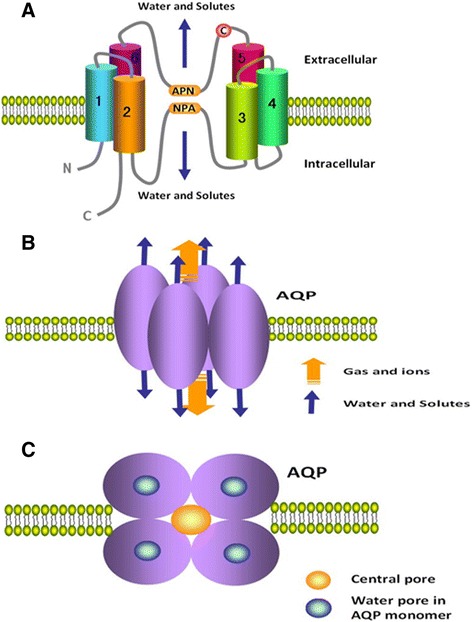
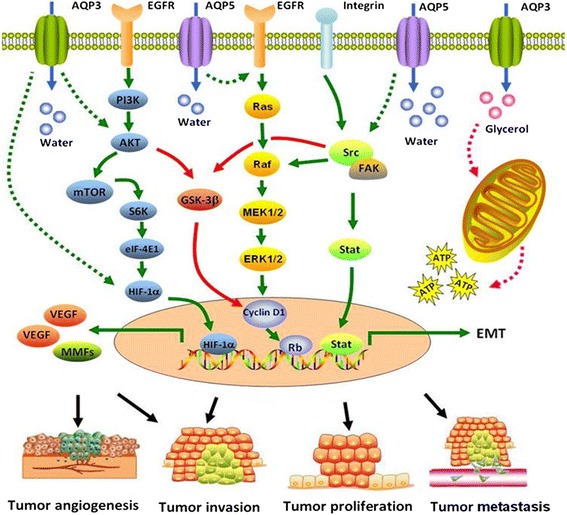
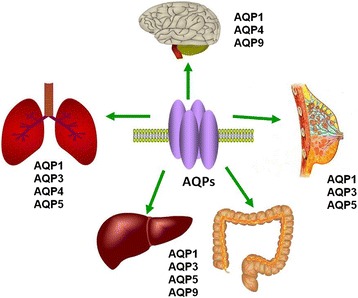
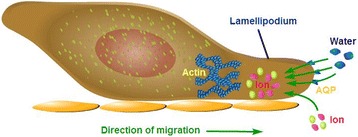
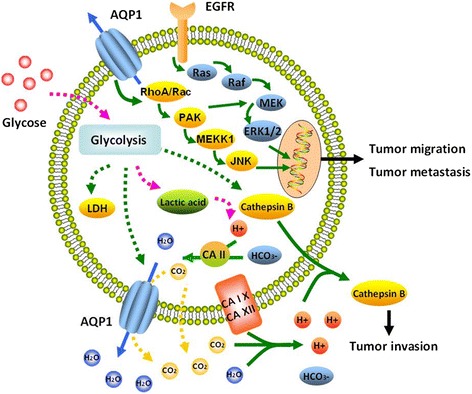
Aquaporins (AQPs) are a family of water channel proteins distributed in various human tissues, responsible for the transport of small solutes such as glycerol, even gas and ions. The expression of AQPs has been found in more than 20 human cancer types and is significantly correlated with the severity of histological tumors and prognosis of patients with cancer. More recent evidence showed that AQPs could also play a role in tumor-associated edema, tumor cell proliferation and migration, and tumor angiogenesis in solid and hematological tumors. Inhibitors of AQPs in tumor cells and microvessels have been suggested as new therapeutic strategies. The present review overviews AQPs structures, expression variation among normal tissues and tumors, AQPs functions and roles in the development of cancer with special focuses on lung, colorectal, liver, brain and breast cancers, and potential AQPs-target inhibitors. We call the special attention to consider AQPs important as diagnostic and therapeutic biomarkers. It may be a novel anticancer therapy by the AQPs inhibition.
水通道蛋白(AQPs)是一类分布于人体各种组织中的水通道蛋白家族,负责运输甘油等小分子溶质,甚至气体和离子。已在20多种人类癌症类型中发现AQPs的表达,且其与组织学肿瘤的严重程度及癌症患者的预后显著相关。最近的证据表明,AQPs在实体瘤和血液肿瘤的肿瘤相关水肿、肿瘤细胞增殖和迁移以及肿瘤血管生成中也可能发挥作用。肿瘤细胞和微血管中AQPs的抑制剂已被提议作为新的治疗策略。本综述概述了AQPs的结构、正常组织和肿瘤之间的表达差异、AQPs在癌症发生发展中的功能和作用,特别关注肺癌、结直肠癌、肝癌、脑癌和乳腺癌,以及潜在的AQPs靶向抑制剂。我们特别提请注意将AQPs视为重要的诊断和治疗生物标志物。抑制AQPs可能是一种新型抗癌疗法。