Leaf David E, Croy Heather E, Abrahams Sara J, Raed Anas, Waikar Sushrut S
Division of Renal Medicine, Brigham and Women's Hospital, 75 Francis Street, Boston, MA, 02115, USA.
Crit Care. 2015 Mar 10;19(1):80. doi: 10.1186/s13054-015-0812-1.
Decreased production of cathelicidin antimicrobial protein-18 (hCAP18) has been proposed to be a key mechanism linking decreased 25-hydroxyvitamin D (25D) levels with adverse outcomes among critically ill patients. However, few studies in humans have directly assessed plasma hCAP18 levels, and no study has evaluated the association between hCAP18 levels and adverse outcomes among critically ill patients.
We performed a single-center, prospective cohort study among 121 critically ill patients admitted to intensive care units (ICUs) between 2008 and 2012. We measured plasma hCAP18, 25D, D-binding protein, and parathyroid hormone levels on ICU day 1. The primary endpoint was 90-day mortality. Secondary endpoints included hospital mortality, sepsis, acute kidney injury, duration of mechanical ventilation, and hospital length of stay.
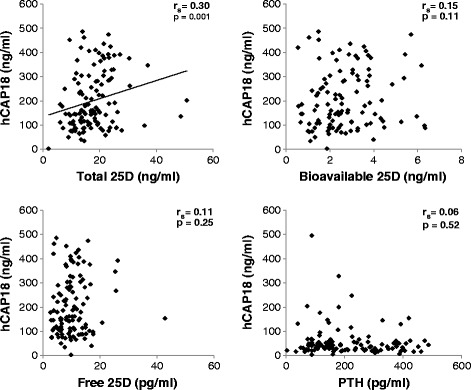
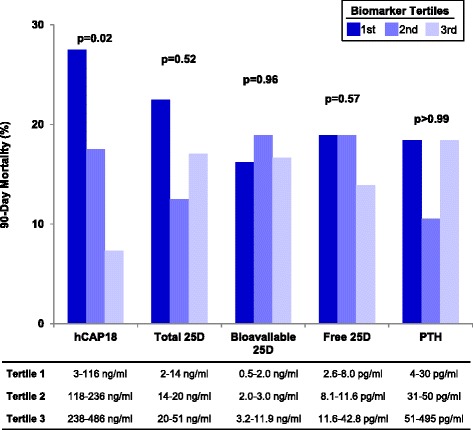
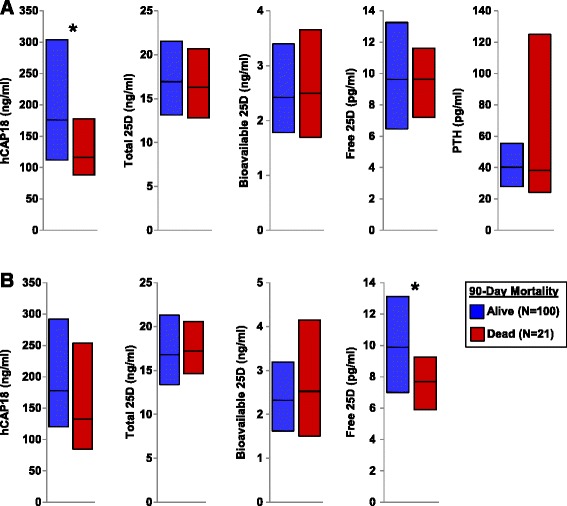
ICU day 1 hCAP18 levels were directly correlated with 25D levels (Spearman's rho (rs) = 0.30, P = 0.001). In multivariate analyses adjusted for age and Acute Physiology and Chronic Health Evaluation II (APACHE II) score, patients with hCAP18 levels in the lowest compared to highest tertile on ICU day 1 had a 4.49 (1.08 to 18.67) greater odds of 90-day mortality, and also had greater odds of sepsis. ICU day 1 levels of other analytes were not associated with 90-day mortality.
Lower 25D levels on ICU day 1 are associated with lower hCAP18 levels, which are in turn associated with a greater risk of 90-day mortality. These findings provide a potential mechanistic basis for the frequently observed association between low 25D levels and poor outcomes in critically ill patients.
有人提出,抗菌肽18(hCAP18)生成减少是将25-羟基维生素D(25D)水平降低与危重症患者不良结局联系起来的关键机制。然而,针对人类的研究中很少有直接评估血浆hCAP18水平的,也没有研究评估危重症患者中hCAP18水平与不良结局之间的关联。
我们在2008年至2012年期间对121名入住重症监护病房(ICU)的危重症患者进行了一项单中心前瞻性队列研究。我们在入住ICU第1天测量了血浆hCAP18、25D、维生素D结合蛋白和甲状旁腺激素水平。主要终点是90天死亡率。次要终点包括医院死亡率、脓毒症、急性肾损伤、机械通气时间和住院时间。
入住ICU第1天的hCAP18水平与25D水平直接相关(斯皮尔曼等级相关系数(rs)=0.30,P=0.001)。在根据年龄和急性生理与慢性健康状况评分系统II(APACHE II)评分进行调整的多变量分析中,入住ICU第1天hCAP18水平处于最低三分位数组的患者与最高三分位数组相比,90天死亡率的比值比高4.49(1.08至18.67),脓毒症的比值比也更高。入住ICU第1天其他分析物的水平与90天死亡率无关。
入住ICU第1天较低的25D水平与较低的hCAP18水平相关,而较低水平的hCAP18又与90天死亡率较高的风险相关。这些发现为危重症患者中经常观察到的低25D水平与不良结局之间的关联提供了潜在的机制基础。