Kühberger Anton, Fritz Astrid, Lermer Eva, Scherndl Thomas
Department of Psychology and Centre of Cognitive Neuroscience, University of Salzburg, Hellbrunnerstr. 34, 5020, Salzburg, Austria.
Österreichisches Zentrum für Begabtenförderung und Begabungsforschung, Salzburg, Austria.
BMC Res Notes. 2015 Mar 17;8:84. doi: 10.1186/s13104-015-1020-4.
Statistical significance is an important concept in empirical science. However the meaning of the term varies widely. We investigate into the intuitive understanding of the notion of significance.
We described the results of two different experiments published in a major psychological journal to a sample of students of psychology, labeling the findings as 'significant' versus 'non-significant.' Participants were asked to estimate the effect sizes and sample sizes of the original studies.
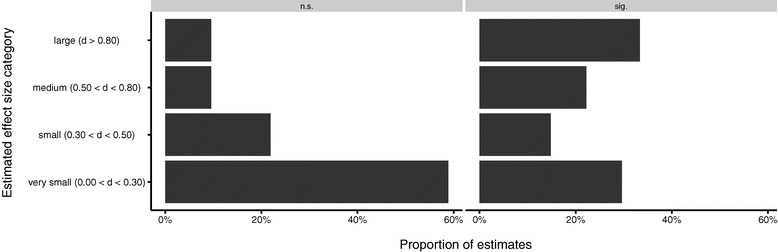
Labeling the results of a study as significant was associated with estimations of a big effect, but was largely unrelated to sample size. Similarly, non-significant results were estimated as near zero in effect size.
After considerable training in statistics, students largely equate statistical significance with medium to large effect sizes, rather than with large sample sizes. The data show that students assume that statistical significance is due to real effects, rather than to 'statistical tricks' (e.g., increasing sample size).
统计显著性是实证科学中的一个重要概念。然而,该术语的含义差异很大。我们调查了对显著性概念的直观理解。
我们向心理学专业的学生样本描述了发表在一本主要心理学杂志上的两项不同实验的结果,将这些发现标记为“显著”与“不显著”。参与者被要求估计原始研究的效应大小和样本大小。
将一项研究的结果标记为显著与对大效应的估计相关,但在很大程度上与样本大小无关。同样,不显著的结果在效应大小方面被估计为接近零。
经过大量的统计学训练后,学生们在很大程度上把统计显著性等同于中等至大的效应大小,而不是大的样本大小。数据表明,学生们认为统计显著性是由于真实效应,而不是“统计技巧”(例如,增加样本大小)。