• 文献检索
  • 文档翻译
  • 深度研究
  • 学术资讯
  • Suppr Zotero 插件Zotero 插件
  • 邀请有礼
  • 套餐&价格
  • 历史记录
应用&插件
Suppr Zotero 插件Zotero 插件浏览器插件Mac 客户端Windows 客户端微信小程序
定价
高级版会员购买积分包购买API积分包
服务
文献检索文档翻译深度研究API 文档MCP 服务
关于我们
关于 Suppr公司介绍联系我们用户协议隐私条款
关注我们

Suppr 超能文献

核心技术专利:CN118964589B侵权必究
粤ICP备2023148730 号-1Suppr @ 2026

文献检索

告别复杂PubMed语法,用中文像聊天一样搜索,搜遍4000万医学文献。AI智能推荐,让科研检索更轻松。

立即免费搜索

文件翻译

保留排版,准确专业,支持PDF/Word/PPT等文件格式,支持 12+语言互译。

免费翻译文档

深度研究

AI帮你快速写综述,25分钟生成高质量综述,智能提取关键信息,辅助科研写作。

立即免费体验

加勒比地区的药用植物知识:非洲裔加勒比人、美洲印第安人和梅斯蒂索人社区的比较研究。

Medicinal plant knowledge in Caribbean Basin: a comparative study of Afrocaribbean, Amerindian and Mestizo communities.

作者信息

Torres-Avilez Wendy, Méndez-González Martha, Durán-García Rafael, Boulogne Isabelle, Germosén-Robineau Lionel

机构信息

Laboratory of Applied and Theoretical Ethnobiology (LEA), Federal Rural University of Pernambuco, Av. Dom Manoel de Medeiros s/n, Dois Irmãos, Recife, Pernambuco, CEP, 52171-900, Brazil.

Centro de Investigación Científica de Yucatán A.C. Unidad de Recursos Naturales, TRAMIL (Program of Applied Research to Popular Medicine in the Caribbean), Calle 43 No. 130, Colonia Chuburná de Hidalgo, Mérida, Yucatán, CP, 97200, México.

出版信息

J Ethnobiol Ethnomed. 2015 Feb 25;11:18. doi: 10.1186/s13002-015-0008-4.

DOI:10.1186/s13002-015-0008-4
PMID:25889031
原文链接:https://pmc.ncbi.nlm.nih.gov/articles/PMC4347915/
Abstract

BACKGROUND

The Caribbean Basin has complex biogeographical and cultural histories that have shaped its highly diverse botanical and cultural landscapes. As a result, the current ethnic composition of the Basin is a heterogeneous mixture including Amerindian, Afrocaribbean and a wide range of Mestizo populations. A comparison was done of the medicinal plant repertoires used by these groups to identify the proportion of native species they include and any differences between the groups.

METHODS

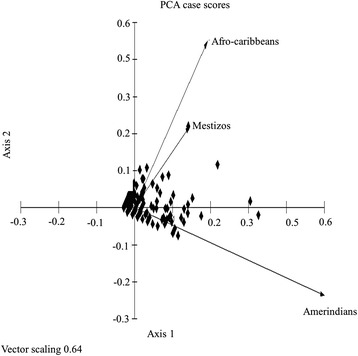
The TRAMIL program has involved application of ethnopharmacological surveys to gather data on the medicinal plants used for primary care in 55 locations the Caribbean Basin. Three Afrocaribbean, three Amerindian and three Mestizo communities were selected taking in account the Ethnic prevalence. Differences in native and exotic plant used by groups and between groups were done using contingency tables. Identification of differences in the numbers of native and exotic plants used within each group was done with a one sample Z -test for proportions. Similarity in medicinal species use was estimated using the Sørensen Similarity Index. Species use value (UV) was estimated and a principal components analysis (PCA) run to determine differences between groups.

RESULTS

The 1,753 plant records generated from the surveys of the nine communities included in the analysis covered 389 species from 300 genera and 98 families. The studied groups used different numbers of native and exotic species: Afrocaribbean (99 natives, 49 exotics); Amerindian (201 natives, 46 exotics); and Mestizo (63 natives, 44 exotics). The proportion of natives to exotics was significantly different in between the Afrocaribbean and Amerindian communities, and between the Amerindian and Mestizo communities, but not between the Afrocaribbean and Mestizo communities. In the PCA, the groups were disparate in terms of the use value they assigned to the medicinal species; these were determined according to species with high use value and those used exclusively be a particular group

CONCLUSIONS

Although migration, cultural intermixing and a consequent hybridization of medicinal plant knowledge have occurred in the Caribbean Basin, the results highlight differences between the three studied groups in terms of the medicinal plant repertoire they employ for primary health care.

摘要

背景

加勒比地区拥有复杂的生物地理和文化历史,塑造了其高度多样的植物景观和文化景观。因此,该地区目前的种族构成是一个异质混合体,包括美洲印第安人、非洲裔加勒比人和各种各样的混血人群。对这些群体所使用的药用植物种类进行了比较,以确定其中本土物种的比例以及各群体之间的差异。

方法

TRAMIL项目涉及应用民族植物学调查来收集加勒比地区55个地点用于初级保健的药用植物数据。考虑到种族分布情况,选择了三个非洲裔加勒比人社区、三个美洲印第安人社区和三个混血社区。使用列联表分析各群体以及群体之间使用本土植物和外来植物的差异。通过单样本Z检验比例来确定每个群体中使用的本土植物和外来植物数量的差异。使用索伦森相似性指数估计药用物种使用的相似性。估计物种使用价值(UV)并进行主成分分析(PCA)以确定群体之间的差异。

结果

对分析中包括的九个社区进行调查产生的1753条植物记录涵盖了来自300属98科的389种植物。所研究的群体使用的本土和外来物种数量不同:非洲裔加勒比人(99种本土植物,49种外来植物);美洲印第安人(201种本土植物,46种外来植物);混血人群(63种本土植物,44种外来植物)。非洲裔加勒比人社区与美洲印第安人社区之间,以及美洲印第安人社区与混血人群社区之间,本土植物与外来植物的比例存在显著差异,但非洲裔加勒比人社区与混血人群社区之间没有显著差异。在主成分分析中,各群体在赋予药用物种的使用价值方面存在差异;这些差异是根据具有高使用价值的物种以及特定群体专门使用的物种来确定的。

结论

尽管加勒比地区发生了移民、文化融合以及随之而来的药用植物知识杂交,但结果突出了三个研究群体在用于初级卫生保健的药用植物种类方面的差异。
https://cdn.ncbi.nlm.nih.gov/pmc/blobs/c118/4347915/c9400acb80e5/13002_2015_8_Fig1_HTML.jpg

相似文献

1
Medicinal plant knowledge in Caribbean Basin: a comparative study of Afrocaribbean, Amerindian and Mestizo communities.加勒比地区的药用植物知识:非洲裔加勒比人、美洲印第安人和梅斯蒂索人社区的比较研究。
J Ethnobiol Ethnomed. 2015 Feb 25;11:18. doi: 10.1186/s13002-015-0008-4.
2
Ethnomedicinal survey of a maroon community in Brazil's Atlantic tropical forest.巴西大西洋热带森林中一个逃亡黑奴社区的民族药用调查。
J Ethnopharmacol. 2016 Apr 2;181:37-49. doi: 10.1016/j.jep.2016.01.014. Epub 2016 Jan 21.
3
Medicinal plants for gastrointestinal diseases among the Kuki-Chin ethnolinguistic groups across Bangladesh, India, and Myanmar: A comparative and network analysis study.孟加拉国、印度和缅甸的库基-钦民族语言群体用于治疗胃肠道疾病的药用植物:一项比较和网络分析研究。
J Ethnopharmacol. 2020 Apr 6;251:112415. doi: 10.1016/j.jep.2019.112415. Epub 2020 Jan 7.
4
Ethnopharmacological survey of medicinal plants used in traditional medicine by the communities of Mount Hermon, Lebanon.黎巴嫩赫尔蒙山社区传统医学中使用的药用植物的民族药理学调查。
J Ethnopharmacol. 2015 Sep 15;173:139-56. doi: 10.1016/j.jep.2015.06.052. Epub 2015 Jul 9.
5
TRAMIL ethnomedicinal survey in Jamaica.特立尼达和多巴哥的传统医学民族医学调查。
J Ethnopharmacol. 2015 Jul 1;169:314-27. doi: 10.1016/j.jep.2015.04.027. Epub 2015 Apr 27.
6
Medicinal ethnobotany of wild plants: a cross-cultural comparison around Georgia-Turkey border, the Western Lesser Caucasus.野生植物的药用民族植物学:格鲁吉亚-土耳其边境,小高加索西部地区的跨文化比较。
J Ethnobiol Ethnomed. 2020 Nov 23;16(1):71. doi: 10.1186/s13002-020-00415-y.
7
Ethnopharmacological study of medicinal plants in Sarvabad, Kurdistan province, Iran.伊朗库尔德斯坦省萨尔瓦巴德药用植物的民族药理学研究。
J Ethnopharmacol. 2022 Apr 24;288:114985. doi: 10.1016/j.jep.2022.114985. Epub 2022 Jan 13.
8
Inventorization of some ayurvedic plants and their ethnomedicinal use in Kakrajhore forest area of West Bengal.对西孟加拉邦卡卡乔勒森林地区的一些阿育吠陀植物及其民族医学用途进行编目。
J Ethnopharmacol. 2017 Feb 2;197:231-241. doi: 10.1016/j.jep.2016.08.014. Epub 2016 Aug 30.
9
Treatment of leishmaniasis in the Oyapock basin (French Guiana): A K.A.P. survey and analysis of the evolution of phytotherapy knowledge amongst Wayãpi Indians.奥亚波克流域(法属圭亚那)利什曼病的治疗:对 Wayãpi 印第安人植物疗法知识演变的 K.A.P. 调查与分析。
J Ethnopharmacol. 2011 Oct 11;137(3):1228-39. doi: 10.1016/j.jep.2011.07.044. Epub 2011 Jul 26.
10
Medicinal utilization of exotic plants by Bapedi traditional healers to treat human ailments in Limpopo province, South Africa.南非林波波省巴佩迪传统治疗师利用外来植物治疗人类疾病的药用用途。
J Ethnopharmacol. 2012 Dec 18;144(3):646-55. doi: 10.1016/j.jep.2012.10.005. Epub 2012 Oct 13.

引用本文的文献

1
Medicinal Plants and Plant-Based Remedies in Grande-Terre: An Ethnopharmacological Approach.瓜德罗普岛的药用植物及植物疗法:一种民族药理学方法
Plants (Basel). 2023 Feb 2;12(3):654. doi: 10.3390/plants12030654.
2
Medicinal plants cultivated in urban home gardens in Heredia, Costa Rica.哥斯达黎加赫雷迪亚市家庭园艺中种植的药用植物。
J Ethnobiol Ethnomed. 2022 Feb 12;18(1):7. doi: 10.1186/s13002-022-00505-z.
3
Knowledge, Attitudes and Practices on the Use of Botanical Medicines in a Rural Caribbean Territory.加勒比地区一个乡村地区使用植物药的知识、态度和实践

本文引用的文献

1
The use of medicinal plants by migrant people: adaptation, maintenance, and replacement.移民人群对药用植物的使用:适应、维持和替代。
Evid Based Complement Alternat Med. 2012;2012:807452. doi: 10.1155/2012/807452. Epub 2011 Nov 10.
2
The prevalence of herbal medicine home use and concomitant use with pharmaceutical medicines in Jamaica.草药在家中使用的流行程度以及与药物同时使用的情况在牙买加。
J Ethnopharmacol. 2011 Sep 1;137(1):305-11. doi: 10.1016/j.jep.2011.05.025. Epub 2011 May 27.
3
TRAMIL ethnopharmalogical survey in Les Saintes (Guadeloupe, French West Indies): a comparative study.
Front Pharmacol. 2021 Oct 27;12:713855. doi: 10.3389/fphar.2021.713855. eCollection 2021.
4
Phytotherapies in motion: French Guiana as a case study for cross-cultural ethnobotanical hybridization.动态中的植物疗法:以法属圭亚那为例的跨文化民族植物学杂交。
J Ethnobiol Ethnomed. 2020 Sep 16;16(1):54. doi: 10.1186/s13002-020-00404-1.
5
Hybridising Medicine: Illness, Healing and the Dynamics of Reciprocal Exchange on the Upper Guinea Coast (West Africa).《融合医学:疾病、治愈与西非上几内亚海岸的互惠交流动态》
Med Hist. 2016 Apr;60(2):181-205. doi: 10.1017/mdh.2016.3.
TRAMIL 民族药理学调查在圣徒群岛(瓜德罗普,法属西印度群岛):一项比较研究。
J Ethnopharmacol. 2011 Feb 16;133(3):1039-50. doi: 10.1016/j.jep.2010.11.034. Epub 2010 Nov 19.
4
Mao's heritage: medicinal plant knowledge among the Bai in Shaxi, China, at a crossroads between distinct local and common widespread practice.毛泽东的遗产:中国沙溪白族的药用植物知识,处于独特的地方实践与普遍广泛实践的十字路口。
J Ethnopharmacol. 2009 Jun 22;123(2):213-28. doi: 10.1016/j.jep.2009.03.014. Epub 2009 Mar 24.
5
Traditional uses of medicinal plants in Valvestino (Italy).意大利瓦尔韦斯蒂诺药用植物的传统用途。
J Ethnopharmacol. 2009 Jan 12;121(1):106-16. doi: 10.1016/j.jep.2008.10.005. Epub 2008 Nov 1.
6
Cross-cultural adaptation in urban ethnobotany: the Colombian folk pharmacopoeia in London.城市民族植物学中的跨文化适应:伦敦的哥伦比亚民间药典
J Ethnopharmacol. 2008 Dec 8;120(3):342-59. doi: 10.1016/j.jep.2008.09.004. Epub 2008 Sep 18.
7
Ethnobotanical study of medicinal plants used by the Andean people of Canta, Lima, Peru.秘鲁利马坎塔地区安第斯人民使用的药用植物的民族植物学研究。
J Ethnopharmacol. 2007 May 4;111(2):284-94. doi: 10.1016/j.jep.2006.11.018. Epub 2006 Dec 2.
8
Knowledge and use of medicinal plants by people around Debre Libanos monastery in Ethiopia.埃塞俄比亚德布雷利巴诺斯修道院周边居民对药用植物的认知与使用情况。
J Ethnopharmacol. 2007 May 4;111(2):271-83. doi: 10.1016/j.jep.2006.11.019. Epub 2006 Nov 28.
9
Re-examining hypotheses concerning the use and knowledge of medicinal plants: a study in the Caatinga vegetation of NE Brazil.重新审视关于药用植物使用与知识的假说:巴西东北部卡廷加植被地区的一项研究。
J Ethnobiol Ethnomed. 2006 Jul 26;2:30. doi: 10.1186/1746-4269-2-30.
10
Antibacterial properties of tropical plants from Puerto Rico.波多黎各热带植物的抗菌特性。
Phytomedicine. 2006 Mar;13(4):272-6. doi: 10.1016/j.phymed.2004.11.009. Epub 2005 Sep 19.