Bazos Dorothy A, LaFave Lea R Ayers, Suresh Gautham, Shannon Kevin C, Nuwaha Fred, Splaine Mark E
Community Engagement, the Prevention Research Center at Dartmouth, The Dartmouth Institute for Health Policy and Clinical Practice, Dartmouth College, 35 Centerra Parkway, Lebanon, NH, 03766, USA.
, 501 South Street, Bow, NH, 03304, USA.
Implement Sci. 2015 Mar 8;10:30. doi: 10.1186/s13012-015-0215-3.
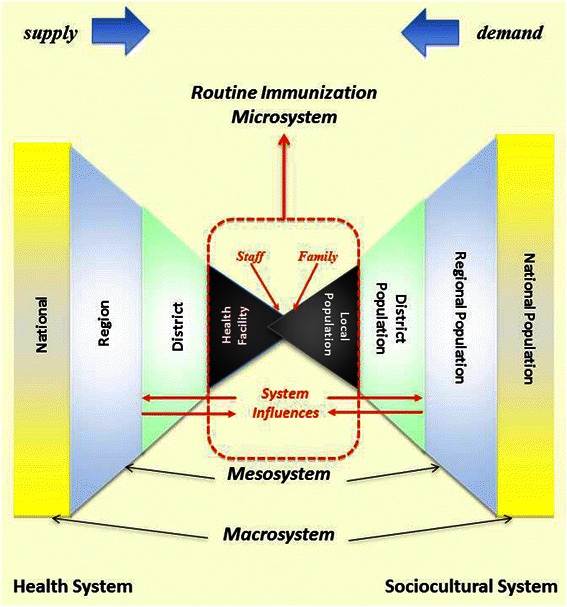
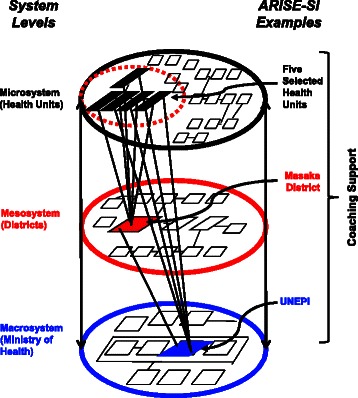
Although global efforts to support routine immunization (RI) system strengthening have resulted in higher immunization rates, the World Health Organization (WHO) estimates that the proportion of children receiving recommended DPT3 vaccines has stagnated at 80% for the past 3 years (WHO Fact sheet-Immunization coverage 2014, WHO, 2014). Meeting the WHO goal of 90% national DPT3 coverage may require locally based strategies to support conventional approaches. The Africa Routine Immunization Systems Essentials-System Innovation (ARISE-SI) initiative is a proof-of-concept study to assess the application of the Microsystems Quality Improvement Approach for generating local solutions to strengthen RI systems and reach those unreached by current efforts in Masaka District, Uganda.
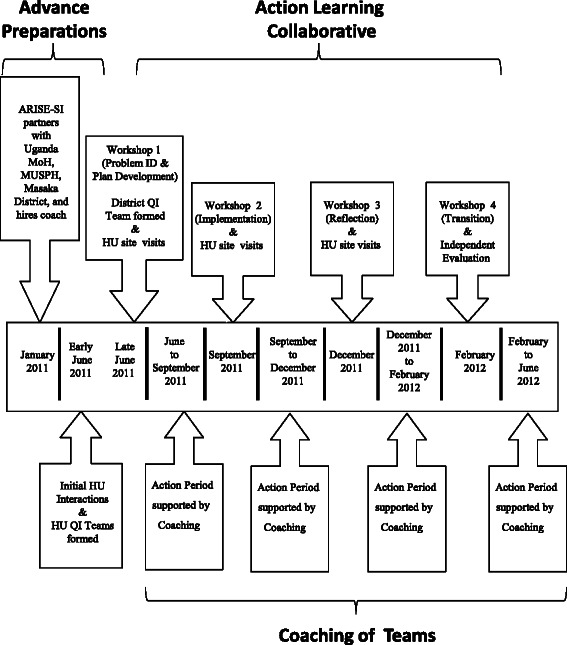
The ARISE-SI intervention had three components: health unit (HU) advance preparations, an action learning collaborative, and coaching of improvement teams. The intervention was informed and assessed using qualitative and quantitative methods. Data collection focused on changes and outcomes of improvement efforts among five HUs and one district-level team during the intervention (June 2011-February 2012) and five follow-up months.
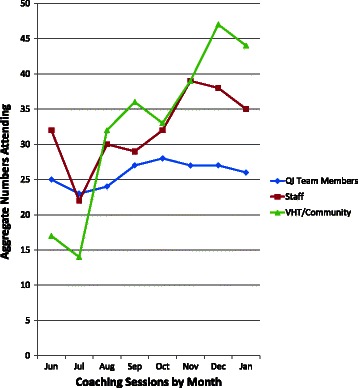
Workshops and team meetings had a 95% attendance rate. All teams gained RI system knowledge and implemented changes to address locally identified problems. Specific changes included: RI register implementation and expanded use, Child Health Card provision and monitoring, staff cross-training, staffing pattern changes, predictable outreach schedules, and health system leader--community leader meetings. Several RI system barriers prevalent across Masaka District (e.g., lack of backup HU gas cylinders, inadequate outreach transportation, and village health team underutilization) were successfully addressed. Three of five HUs significantly increased the vaccines administered. All improvements were sustained 5 months post-intervention. External evaluation validated the findings of high levels of participant engagement, empowerment to make change, and willingness to sustain improvements.
The Microsystems Quality Improvement Approach is a comprehensive approach, grounded in systems thinking, and coupled with intensive coaching. It provides a robust framework for engaging teams in the development of unique local solutions that strengthen RI systems in resource poor settings. The sustained improvements in local RI systems from this study provide evidence that this approach may be an effective framework for enhancing the WHO's Reaching Every District (RED) immunization strategy.
尽管全球为支持加强常规免疫(RI)系统做出了努力,免疫接种率有所提高,但世界卫生组织(WHO)估计,在过去三年中,接受推荐的三联疫苗(DPT3)接种的儿童比例一直停滞在80%(WHO情况说明书 - 2014年免疫接种覆盖率,WHO,2014)。要实现WHO提出的全国DPT3覆盖率达到90%的目标,可能需要基于当地的策略来支持传统方法。非洲常规免疫系统要素 - 系统创新(ARISE - SI)倡议是一项概念验证研究,旨在评估微系统质量改进方法在乌干达马萨卡区的应用,以生成当地解决方案来加强RI系统,并覆盖当前努力尚未触及的人群。
ARISE - SI干预措施包括三个部分:卫生单位(HU)的前期准备、行动学习协作以及对改进团队的指导。采用定性和定量方法为干预措施提供信息并进行评估。数据收集重点关注干预期间(2011年6月至2012年2月)以及随后五个月的随访期间,五个卫生单位和一个区级团队改进工作的变化和成果。
研讨会和团队会议的出勤率达到95%。所有团队都获得了RI系统知识,并实施了变革以解决当地发现的问题。具体变革包括:实施并扩大使用RI登记册、提供和监测儿童健康卡、工作人员交叉培训、人员配置模式改变、可预测的外展计划以及卫生系统领导者与社区领导者会议。马萨卡区普遍存在的几个RI系统障碍(例如,卫生单位备用气瓶短缺、外展交通不足以及乡村卫生团队利用不足)得到了成功解决。五个卫生单位中有三个显著增加了疫苗接种量。所有改进措施在干预后五个月内得以维持。外部评估证实了高水平的参与者参与度、进行变革的自主权以及维持改进的意愿等调查结果。
微系统质量改进方法是一种基于系统思维并辅以强化指导的综合方法。它为促使团队制定独特的当地解决方案以加强资源匮乏地区的RI系统提供了一个强大的框架。本研究中当地RI系统的持续改进证明,该方法可能是加强WHO的“覆盖每个区”(RED)免疫战略的有效框架。