Rolskov Bojsen Signe, Räder Sune Bernd Emil Werner, Holst Anders Gaardsdal, Kayser Lars, Ringsted Charlotte, Hastrup Svendsen Jesper, Konge Lars
Centre for Clinical Education, Rigshospitalet, Afsnit 5404, Teilumbygningen, Blegdamsvej 9, 2100, Copenhagen, Denmark.
Department of Cardiology, Hillerød Hospital, Dyrehavevej 29, 3400, Hillerød, Denmark.
BMC Med Educ. 2015 Mar 7;15:36. doi: 10.1186/s12909-015-0319-0.
Electrocardiogram (ECG) interpretation is of great importance for patient management. However, medical students frequently lack proficiency in ECG interpretation and rate their ECG training as inadequate. Our aim was to examine the effect of a standalone web-based ECG tutorial and to assess the retention of skills using multiple follow-up intervals.
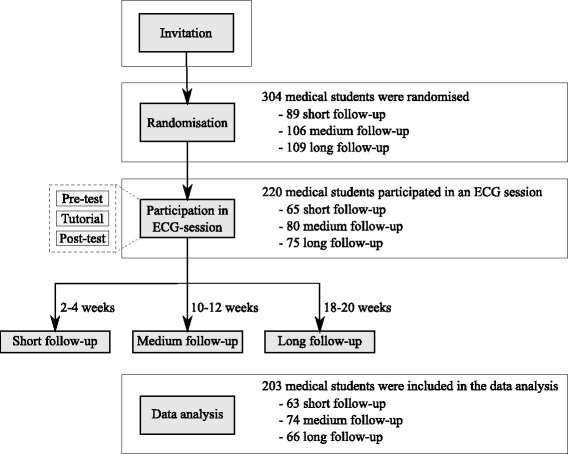
203 medical students were included in the study. All participants completed a pre-test, an ECG tutorial, and a post-test. The participants were also randomised to complete a retention-test after short (2-4 weeks), medium (10-12 weeks), or long (18-20 weeks) follow-up. Intragroup comparisons of test scores were done using paired-samples t-test. Intergroup comparisons of test scores were performed using independent-samples t-test and ANOVA, whereas demographic data were compared using ANOVA and Chi-squared test.
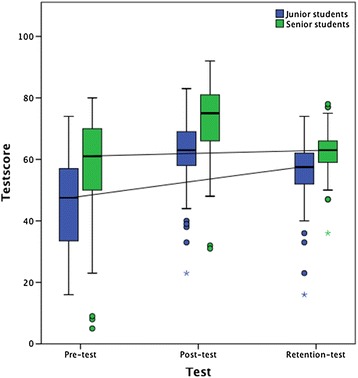
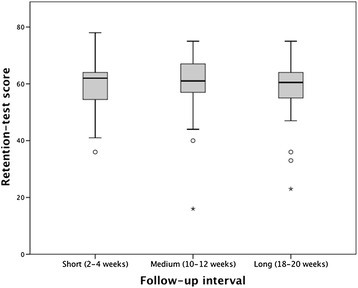
The overall mean test score improved significantly from 52.7 (SD 16.8) in the pre-test to 68.4 (SD 12.3) in the post-test (p < 0.001). Junior and senior students demonstrated significantly different baseline scores (45.5 vs. 57.8 points; p < 0.001), but showed comparable score gains (16.5 and 15.1 points, respectively; p = 0.48). All three follow-up groups experienced a decrease in test score between post-test and retention-test: from 67.4 (SD 12.3) to 60.2 (SD 8.3) in the short follow-up group, from 71.4 (SD 12.0) to 60.8 (SD 8.9) in the medium follow-up group, and from 66.1 (SD 12.1) to 58.6 (SD 8.6) in the long follow-up group (p < 0.001 for all). However, there were no significant differences in mean retention-test score between the groups (p = 0.33). Both junior and senior students showed a decline in test score at follow-up (from 62.0 (SD 10.6) to 56.2 (SD 9.8) and from 72.9 (SD 11.4) to 62.5 (SD 6.6), respectively). When comparing the pre-test to retention-test delta scores, junior students had learned significantly more than senior students (junior students improved 10.7 points and senior students improved 4.7 points, p = 0.003).
A standalone web-based ECG tutorial can be an effective means of teaching ECG interpretation skills to medical students. The newly acquired skills are, however, rapidly lost when the intervention is not repeated.
心电图(ECG)解读对患者管理至关重要。然而,医学生在心电图解读方面常常缺乏熟练度,并认为他们的心电图培训不足。我们的目的是研究一个独立的基于网络的心电图教程的效果,并使用多个随访间隔来评估技能的保持情况。
203名医学生纳入本研究。所有参与者均完成了预测试、心电图教程及后测试。参与者还被随机分配在短(2 - 4周)、中(10 - 12周)或长(18 - 20周)随访后完成留存测试。测试分数的组内比较采用配对样本t检验。测试分数的组间比较采用独立样本t检验和方差分析,而人口统计学数据则采用方差分析和卡方检验进行比较。
总体平均测试分数从前测试的52.7(标准差16.8)显著提高到后测试的68.4(标准差12.3)(p < 0.001)。低年级和高年级学生的基线分数有显著差异(45.5分对57.8分;p < 0.001),但分数增长相当(分别为16.5分和15.1分;p = 0.48)。所有三个随访组在后测试和留存测试之间的测试分数均有所下降:短随访组从67.4(标准差12.3)降至60.2(标准差8.3),中随访组从71.4(标准差12.0)降至60.8(标准差8.9),长随访组从66.1(标准差12.1)降至58.6(标准差8.6)(所有p < 0.001)。然而,组间留存测试平均分数无显著差异(p = 0.33)。低年级和高年级学生在随访时测试分数均下降(分别从62.0(标准差10.6)降至56.2(标准差9.8)以及从72.9(标准差11.4)降至62.5(标准差6.6))。比较预测试和留存测试的差值分数时,低年级学生比高年级学生学得显著更多(低年级学生提高10.7分,高年级学生提高4.7分,p = 0.003)。
一个独立的基于网络的心电图教程可以是向医学生教授心电图解读技能的有效手段。然而,当不重复干预时,新获得的技能会迅速丧失。