Gupta Tejpal, Hotwani Chandni, Kannan Sadhana, Master Zubin, Rangarajan Venkatesh, Murthy Vedang, Budrukkar Ashwini, Ghosh-Laskar Sarbani, Agarwal Jai Prakash
Department of Radiation Oncology, Tata Memorial Hospital and ACTREC, Tata Memorial Centre, Parel, Mumbai, 400 012, India.
Department of Epidemiology & Clinical Trials Unit - Clinical Research Secretariat, Tata Memorial Hospital and ACTREC, Tata Memorial Centre, Parel, Mumbai, 400 012, India.
Radiat Oncol. 2015 Mar 15;10:67. doi: 10.1186/s13014-015-0371-2.
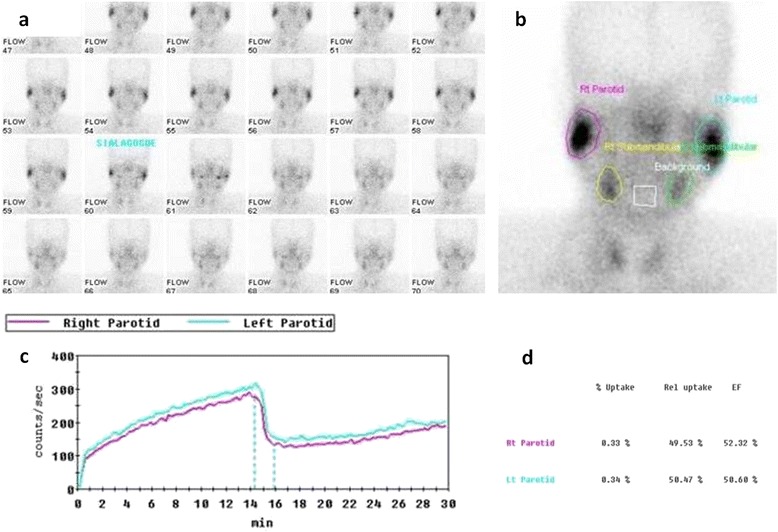
To estimate dose-response relationship using dynamic quantitative (99m)Tc-pertechnate scintigraphy in head-neck cancer patients treated with parotid-sparing conformal radiotherapy.
Dynamic quantitative pertechnate salivary scintigraphy was performed pre-treatment and subsequently periodically after definitive radiotherapy. Reduction in salivary function following radiotherapy was quantified by salivary excretion fraction (SEF) ratios. Dose-response curves were modeled using standardized methodology to calculate tolerance dose 50 (TD50) for parotid glands.
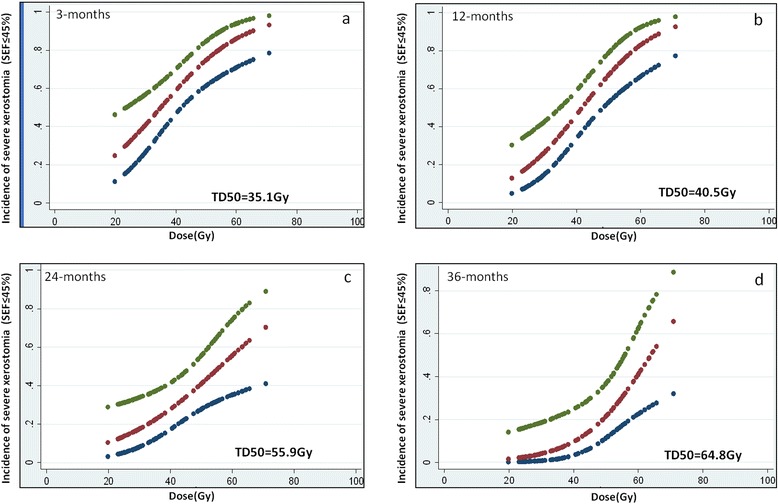
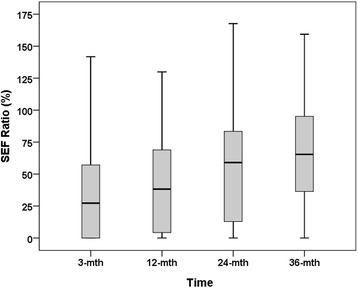
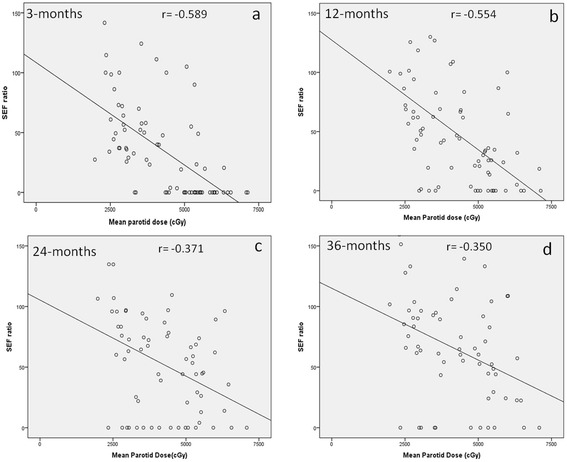
Salivary gland function was significantly affected by radiotherapy with maximal decrease in SEF ratios at 3-months, with moderate functional recovery over time. There was significant inverse correlation between SEF ratios and mean parotid doses at 3-months (r = -0.589, p<0.001); 12-months (r = -0.554, p<0.001); 24-months (r = -0.371, p = 0.002); and 36-months (r=-0.350, p=0.005) respectively. Using a post-treatment SEF ratio <45% as the scintigraphic criteria to define severe salivary toxicity, the estimated TD50 value with its 95% confidence interval (95% CI) for the parotid gland was 35.1Gy (23.6-42.6Gy), 41.3Gy (34.6-48.8Gy), 55.9Gy (47.4-70.0Gy) and 64.3Gy (55.8-70.0Gy) at 3, 12, 24, and 36-months respectively.
There is consistent decline in parotid function even after conformal radiotherapy with moderate recovery over time. Dynamic quantitative pertechnate scintigraphy is a simple, reproducible, and minimally invasive test of major salivary gland function.
利用动态定量(99m)锝高锝酸盐闪烁扫描术评估腮腺保留型适形放疗的头颈癌患者的剂量反应关系。
在确定性放疗前及放疗后定期进行动态定量高锝酸盐唾液闪烁扫描术。放疗后唾液功能的降低通过唾液排泄分数(SEF)比值进行量化。采用标准化方法构建剂量反应曲线,以计算腮腺的耐受剂量50(TD50)。
放疗对唾液腺功能有显著影响,SEF比值在3个月时下降最大,随后功能有一定程度的恢复。3个月时SEF比值与腮腺平均剂量之间存在显著负相关(r = -0.589,p<0.001);12个月时(r = -0.554,p<0.001);24个月时(r = -0.371,p = 0.002);36个月时(r = -0.350,p = 0.005)。以治疗后SEF比值<45%作为闪烁扫描标准来定义严重唾液毒性,腮腺的估计TD50值及其95%置信区间(95%CI)在3个月、12个月、24个月和36个月时分别为35.1Gy(23.6 - 42.6Gy)、41.3Gy(34.6 - 48.8Gy)、55.9Gy(47.4 - 70.0Gy)和64.3Gy(55.8 - 70.0Gy)。
即使在适形放疗后,腮腺功能仍持续下降,但随着时间推移有一定程度的恢复。动态定量高锝酸盐闪烁扫描术是一种简单、可重复且微创的主要唾液腺功能检测方法。