Agarwal Gina, Angeles Ricardo N, McDonough Beatrice, McLeod Brent, Marzanek Francine, Pirrie Melissa, Dolovich Lisa
Department of Family Medicine, Faculty of Health Sciences, McMaster University, McMaster Innovation Park, 175 Longwood Road South, Suite 201A, Hamilton, ON, L8P 0A1, Canada.
City of Hamilton, Public Health Services, Unit 8-1447 Upper Ottawa, Hamilton, ON, L8W 3J6, Canada.
BMC Res Notes. 2015 Apr 1;8:113. doi: 10.1186/s13104-015-1061-8.
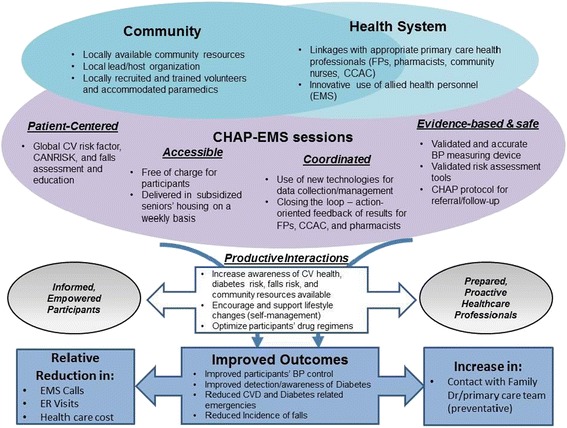
Older adults have higher risk of developing cardiovascular disease, diabetes and falls, leading to costly emergency medical service (EMS) calls and emergency room visits. We developed the Community Health Assessment Program through EMS (CHAP-EMS) that focuses on health promotion/prevention of hypertension and diabetes, links with primary care practitioners, targets seniors living in subsidized housing, and aims to reduce morbidity from these conditions, thereby reducing EMS calls. In this pilot study, we evaluated the feasibility of implementing the CHAP-EMS, attendance rates, prevalence of high blood pressure and cardiovascular risk factors.
In this pilot study the CHAP-EMS was implemented in the intervention site over a 12 month period. BP, lifestyle, cardiovascular risk and EMS call rates were collected and descriptive analyses performed. Participants were residents (low income seniors) of a subsidized housing complex in Hamilton, Ontario. Two paramedics provided once-weekly sessions, measuring BP, assessing diabetes/lifestyle risk (CANRISK questionnaire) and discussed prevention/local wellness activities in the intervention site. Follow up was invited.
A total of 1365 visits with 79 unique participants occurred; 48 (25.2%) visited at least twice; mean age was 72.2; 87.2% were 65 years of age and older and 68.1% were female; 90.3% had a family doctor. Overall, 45.2% had elevated BP initially from the total; 50.0% of participants previously diagnosed with hypertension had elevated BP while 33.3% not previously diagnosed had elevated BP. Almost 1 in 5 (19.4%) had diabetes; 66.7% had moderate to high risk of developing diabetes.
This pilot study indicates that CHAP-EMS is a feasible program that could have impact on BP, lifestyle factors, diabetes risk and EMS calls in the buildings in which it was implemented.
老年人患心血管疾病、糖尿病和跌倒的风险更高,这导致了昂贵的紧急医疗服务(EMS)呼叫和急诊室就诊。我们开发了通过紧急医疗服务进行的社区健康评估项目(CHAP-EMS),该项目专注于高血压和糖尿病的健康促进/预防,与初级保健医生建立联系,以居住在补贴住房中的老年人为目标人群,并旨在降低这些疾病的发病率,从而减少EMS呼叫。在这项试点研究中,我们评估了实施CHAP-EMS的可行性、出勤率、高血压患病率和心血管危险因素。
在这项试点研究中,CHAP-EMS在干预地点实施了12个月。收集了血压、生活方式、心血管风险和EMS呼叫率,并进行了描述性分析。参与者是安大略省汉密尔顿一个补贴住房小区的居民(低收入老年人)。两名护理人员每周提供一次课程,测量血压,评估糖尿病/生活方式风险(CANRISK问卷),并在干预地点讨论预防/当地健康活动。邀请进行随访。
共进行了1365次就诊,涉及79名不同的参与者;48人(25.2%)至少就诊两次;平均年龄为72.2岁;87.2%的人年龄在65岁及以上,68.1%为女性;90.3%的人有家庭医生。总体而言,最初总共有45.2%的人血压升高;先前被诊断患有高血压的参与者中有50.0%血压升高,而先前未被诊断的参与者中有33.3%血压升高。近五分之一(19.4%)的人患有糖尿病;66.7%的人有中度至高度患糖尿病风险。
这项试点研究表明,CHAP-EMS是一个可行的项目,可能会对其实施所在建筑中的血压、生活方式因素、糖尿病风险和EMS呼叫产生影响。