Virginio Flávia, Oliveira Vidal Paloma, Suesdek Lincoln
Laboratório de Parasitologia, Instituto Butantan, São Paulo, SP, Brasil.
Programa de Pós-Graduação em Biologia da Relação Patógeno-Hospedeiro, Instituto de Ciências Biomédicas, Universidade de São Paulo, São Paulo, SP, Brasil.
Parasit Vectors. 2015 Mar 14;8:159. doi: 10.1186/s13071-015-0769-6.
Sexual dimorphism in animals has been studied from different perspectives for decades. In 1874 Darwin hypothesized that it was related to sexual selection, and even after nearly 140 years, when additional empirical data has become available and the subject has been investigated from a contemporary viewpoint, this idea is still supported. Although mosquito (Culicidae) wings are of great importance as they play a sex-specific role, little is known about wing sexual dimorphism in these pathogen-vector insects. Detection and characterization of wing sexual dimorphism in culicids may indirectly enhance our knowledge of their epidemiology or reveal sex-linked genes, aspects that have been discussed by vector control initiatives and developers of genetically modified mosquitoes.
Using geometric morphometrics, we carried out a comparative assessment of wing sexual dimorphism in ten culicid species of medical/veterinary importance from genera Culex, Aedes, Anopheles and Ochlerotatus collected in Brazil.
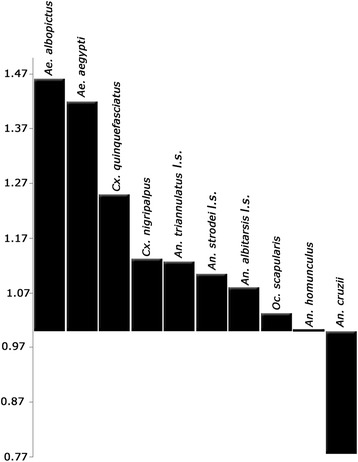
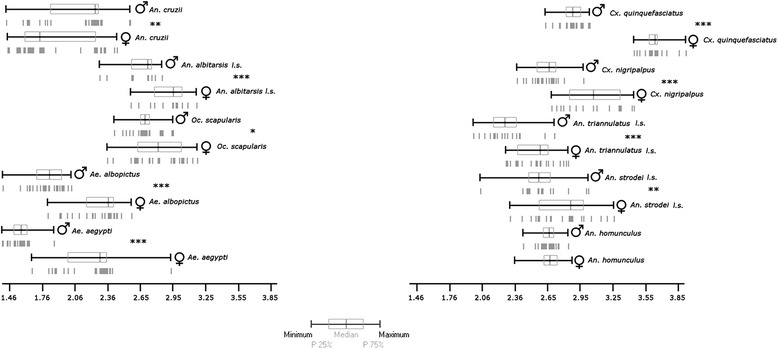
Discriminant analysis revealed significant sexual dimorphism in all the species studied, indicating that phenotypic expression of wing shape in mosquitoes is indeed sex-specific. A cross-validated test performed to reclassify the sexes with and without allometry yielded very similar results. Mahalanobis distances among the ten species showed that the species had different patterns of shape sexual dimorphism and that females are larger than males in some species.
Wing morphology differed significantly between species. The finding of sexual dimorphism in all the species would suggest that the wing geometry of Culicidae is canalized. Although sexual dimorphism is prevalent, species-specific patterns occur. Allometry was not the main determinant of sexual dimorphism, which suggests that sexual selection or other evolutionary mechanisms underlie wing sexual dimorphism in these insects.
几十年来,人们从不同角度对动物的两性异形进行了研究。1874年,达尔文提出这与性选择有关,即使在近140年后,当有了更多实证数据且从当代视角对该主题进行研究时,这一观点仍得到支持。尽管蚊子(蚊科)的翅膀因其具有性别特异性作用而非常重要,但对于这些病原体传播媒介昆虫翅膀的两性异形却知之甚少。检测和描述蚊科昆虫翅膀的两性异形可能会间接增进我们对其流行病学的了解,或揭示与性别相关的基因,这些方面已在病媒控制倡议和转基因蚊子开发者的讨论中有所涉及。
我们运用几何形态测量学,对从巴西采集的库蚊属、伊蚊属、按蚊属和澳蚊属中具有医学/兽医重要性的10种蚊科物种的翅膀两性异形进行了比较评估。
判别分析显示,在所研究的所有物种中均存在显著的两性异形,这表明蚊子翅膀形状的表型表达确实具有性别特异性。进行的交叉验证测试用于对有无异速生长的性别进行重新分类,结果非常相似。10个物种之间的马氏距离表明,这些物种具有不同的形状两性异形模式,且在某些物种中雌性比雄性大。
不同物种之间翅膀形态存在显著差异。所有物种中均发现两性异形这一结果表明,蚊科昆虫的翅膀几何形状是定型的。尽管两性异形普遍存在,但存在物种特异性模式。异速生长并非两性异形的主要决定因素,这表明性选择或其他进化机制是这些昆虫翅膀两性异形的基础。