Hashim Shahrul, Chin Leow Yeen, Krishnasamy Sivakumar, Sthaneswar Pavai, Raja Mokhtar Raja Amin
Division of Cardiothoracic Surgery, Department of Surgery, University Malaya Medical Centre, 50603, Kuala Lumpur, Malaysia.
Department of Pathology, University Malaya, 50603, Kuala Lumpur, Malaysia.
J Cardiothorac Surg. 2015 Mar 17;10:32. doi: 10.1186/s13019-015-0230-0.
Recently a biocompatible bone adhesive was introduced in addition to the sternal wires to expedite sternal union and improve patient recovery. In this study we aim to objectively assess the biomarker of pain in patient who received the biocompatible bone adhesive.
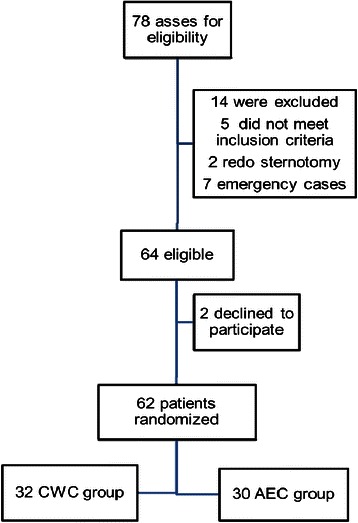
A total of 62 patients who underwent sternotomy were prospectively randomised to receive either conventional wire closure (CWC); 32 patients or adhesive enhanced closure in addition to sternal wire (AEC); 30 patients. Patients were monitored postoperatively at certain time intervals for incisional pain, serum Interleukin-6 (IL-6) level, analgesia used and postoperative complications. All patients were followed up for 4 weeks.
The post-operative pain scores with coughing were significantly higher in the CWC group at 24 hours and 48 hours. The postoperative IL 6 levels were significantly higher in the CWC group in comparison with the AEC group at 6 hours, 24 hours, and 48 hours. There were no significant differences in term of additional analgesia used. No adverse events from adhesive bone cement were observed during follow up.
Adhesive-enhanced sternal closure resulted in modest reduction of pain confirmed by reduction of pain biomarker. Justification of its routine use requires larger multicentre study.
最近,除胸骨钢丝外还引入了一种生物相容性骨黏合剂,以加速胸骨愈合并改善患者康复情况。在本研究中,我们旨在客观评估接受生物相容性骨黏合剂治疗患者的疼痛生物标志物。
共有62例行胸骨切开术的患者被前瞻性随机分为两组,分别接受传统钢丝闭合术(CWC);32例患者,或除胸骨钢丝外采用黏合剂增强闭合术(AEC);30例患者。术后定期监测患者的切口疼痛、血清白细胞介素-6(IL-6)水平、所用镇痛方法及术后并发症。所有患者均随访4周。
CWC组术后24小时和48小时咳嗽时的疼痛评分显著更高。CWC组术后6小时、24小时和48小时的IL-6水平显著高于AEC组。在额外使用镇痛药物方面无显著差异。随访期间未观察到骨黏合剂的不良事件。
黏合剂增强胸骨闭合术通过疼痛生物标志物的降低证实可适度减轻疼痛。其常规使用的合理性需要更大规模的多中心研究。