Kao Pei-Chun, Higginson Christopher I, Seymour Kelly, Kamerdze Morgan, Higginson Jill S
Department of Physical Therapy, University of Delaware, Newark, DE 19716, USA.
Department of Psychology, Loyola University Maryland, Baltimore, MD 21210, USA.
Gait Posture. 2015 May;41(4):947-53. doi: 10.1016/j.gaitpost.2015.03.347. Epub 2015 Apr 8.
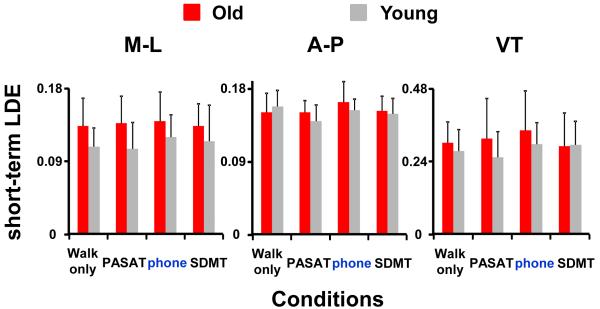
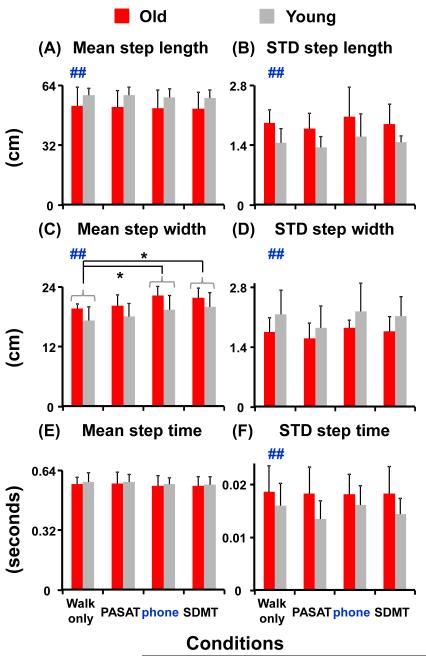
The number of falls and/or accidental injuries associated with cellular phone use during walking is growing rapidly. Understanding the effects of concurrent cell phone use on human gait may help develop safety guidelines for pedestrians. It was shown previously that older adults had more pronounced dual-task interferences than younger adults when concurrent cognitive task required visual information processing. Thus, cell phone use might have greater impact on walking stability in older than in younger adults. This study examined gait stability and variability during a cell phone dialing task (phone) and two classic cognitive tasks, the Paced Auditory Serial Addition Test (PASAT) and Symbol Digit Modalities Test (SDMT). Nine older and seven younger healthy adults walked on a treadmill at four different conditions: walking only, PASAT, phone, and SDMT. We computed short-term local divergence exponent (LDE) of the trunk motion (local stability), dynamic margins of stability (MOS), step spatiotemporal measures, and kinematic variability. Older and younger adults had similar values of short-term LDE during all conditions, indicating that local stability was not affected by the dual-task. Compared to walking only, older and younger adults walked with significantly greater average mediolateral MOS during phone and SDMT conditions but significantly less ankle angle variability during all dual-tasks and less knee angle variability during PASAT. The current findings demonstrate that healthy adults may try to control foot placement and joint kinematics during cell phone use or another cognitive task with a visual component to ensure sufficient dynamic margins of stability and maintain local stability.
行走时与使用手机相关的跌倒和/或意外伤害数量正在迅速增加。了解同时使用手机对人体步态的影响可能有助于制定行人安全指南。先前的研究表明,当同时进行的认知任务需要视觉信息处理时,老年人比年轻人有更明显的双重任务干扰。因此,使用手机可能对老年人行走稳定性的影响大于年轻人。本研究考察了在手机拨号任务(打电话)以及两项经典认知任务——听觉节律连续加法测试(PASAT)和符号数字模态测试(SDMT)过程中的步态稳定性和变异性。九名老年人和七名年轻健康成年人在跑步机上于四种不同条件下行走:仅行走、PASAT、打电话和SDMT。我们计算了躯干运动的短期局部发散指数(LDE)(局部稳定性)、动态稳定裕度(MOS)、步幅时空测量值和运动学变异性。在所有条件下,老年人和年轻人的短期LDE值相似,表明局部稳定性不受双重任务的影响。与仅行走相比,老年人和年轻人在打电话和SDMT条件下行走时,平均内外侧MOS显著更大,但在所有双重任务中踝关节角度变异性显著更小,在PASAT中膝关节角度变异性更小。当前研究结果表明,健康成年人在使用手机或另一项带有视觉成分的认知任务时,可能会试图控制足部位置和关节运动学,以确保有足够的动态稳定裕度并维持局部稳定性。