Minov J, Karadzinska-Bislimovska J, Vasilevska K, Stoleski S, Mijakoski D
Institute for Occupational Health of R. Macedonia - WHO Collaborating Center and GA2LEN Collaborating Center, Skopje, R. Macedonia.
Institute for Epidemiology and Biostatistics, Skopje, R. Macedonia.
Open Respir Med J. 2015 Mar 31;9:46-51. doi: 10.2174/1874306401509010046. eCollection 2015.
Non-cystic fibrosis bronchiectasis (NCFB) is a multidimensional disease, and no single isolated parameter is proved to have sufficient power for any overall determination of its severity and prognosis.
To compare the results of the assessment of the NCFB severity with respect to its prognosis in the same patients by two different validated scores, i.e. the FACED score and the Bronchiectasis Severity Index (BSI).
An observational study including 37 patients with NCFB (16 males and 21 female aged 46 to 76 years) was performed. All patients underwent evaluation of the variables incorporated in the FACED score (FEV1 % predicted, age, chronic colonization by Pseudomaonas aeruginosa, radiological extent of the disease, and dyspnea) and in the BSI (age, body mass index, FEV1 % predicted, hospitalization and exacerbations in previous year, dyspnea, chronic colonization by Pseudomaonas aeruginosa and other microrganisms, and radiological extent of the disease).
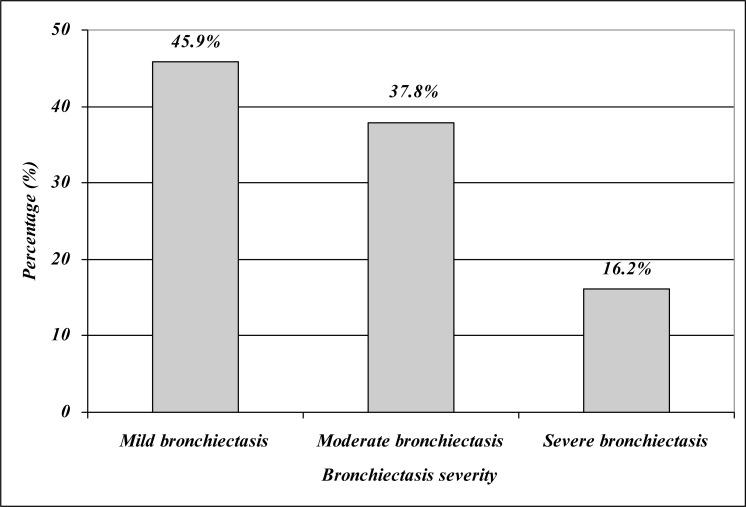
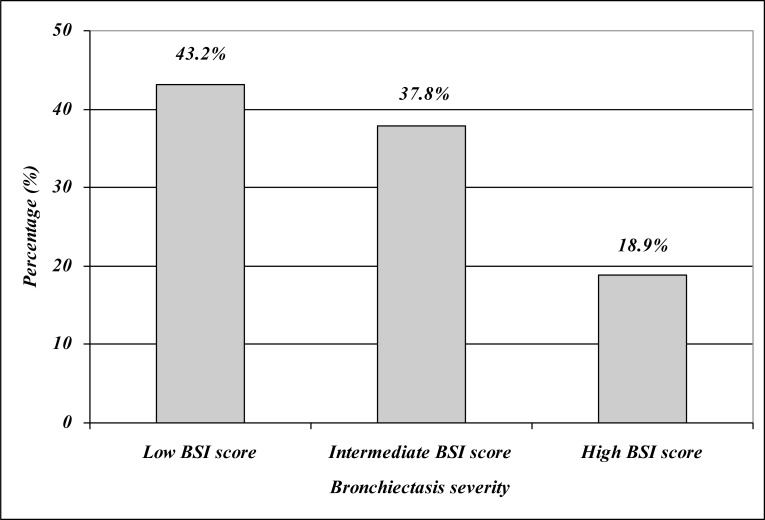
According to the value of the derived overall FACED score we found 17 patients (45.9%) with mild bronchiectasis, 14 patients (37.8%) with moderate bronchiectasis and 6 patients (16.2%) with severe bronchiectasis. The mean derived FACED score was 3.4 ± 1.3. In addition, according to the value of the derived overall BSI score, the frequency of patients with low, intermediate and high BSI score was 16 patients (43,2%), 14 patients (37.8%) and 7 patients (18.9%), respectively. The mean derived BSI score was 6.4 ± 2.5.
We found similar results by the assessment of the NCFB severity in regard to its prognosis by both the FACED score and the BSI. Further studies determining how these scores may impact clinical practice are needed.
非囊性纤维化支气管扩张症(NCFB)是一种多维度疾病,尚无单一孤立参数被证明有足够能力全面判定其严重程度和预后。
通过两种不同的有效评分系统,即FACED评分和支气管扩张严重程度指数(BSI),比较同一组患者中NCFB严重程度评估结果与其预后的关系。
开展一项观察性研究,纳入37例NCFB患者(16例男性,21例女性,年龄46至76岁)。所有患者均接受了FACED评分(预计FEV1%、年龄、铜绿假单胞菌慢性定植、疾病的放射学范围和呼吸困难)及BSI评分(年龄、体重指数、预计FEV1%、上一年的住院次数和急性加重次数、呼吸困难、铜绿假单胞菌和其他微生物的慢性定植以及疾病的放射学范围)所包含变量的评估。
根据得出的总体FACED评分值,我们发现17例患者(45.9%)为轻度支气管扩张,14例患者(37.8%)为中度支气管扩张,6例患者(16.2%)为重度支气管扩张。得出的FACED评分均值为3.4±1.3。此外,根据得出的总体BSI评分值,低、中、高BSI评分患者的频率分别为16例(43.2%)、14例(37.8%)和7例(18.9%)。得出的BSI评分均值为6.4±2.5。
我们发现,FACED评分和BSI在评估NCFB严重程度及其预后方面得出了相似结果。需要进一步开展研究以确定这些评分如何影响临床实践。