Tencerová Michaela, Kračmerová Jana, Krauzová Eva, Mališová Lucia, Kováčová Zuzana, Wedellová Zuzana, Šiklová Michaela, Štich Vladimir, Rossmeislová Lenka
Franco-Czech Laboratory for Clinical Research on Obesity, Third Faculty of Medicine, Charles University in Prague, Prague 10, CZ-100 00 Czech Republic; Department of Sport Medicine, Third Faculty of Medicine, Charles University in Prague, Prague, CZ-100 00 Czech Republic.
Franco-Czech Laboratory for Clinical Research on Obesity, Third Faculty of Medicine, Charles University in Prague, Prague 10, CZ-100 00 Czech Republic; Department of Sport Medicine, Third Faculty of Medicine, Charles University in Prague, Prague, CZ-100 00 Czech Republic; Second Internal Medicine Department, Vinohrady Teaching Hospital, Prague, Czech Republic.
PLoS One. 2015 Apr 20;10(3):e0122872. doi: 10.1371/journal.pone.0122872. eCollection 2015.
BACKGROUND/OBJECTIVES: Hyperglycemia represents one of possible mediators for activation of immune system and may contribute to worsening of inflammatory state associated with obesity. The aim of our study was to investigate the effect of a short-term hyperglycemia (HG) on the phenotype and relative content of immune cells in circulation and subcutaneous abdominal adipose tissue (SAAT) in obese women without metabolic complications.
SUBJECTS/METHODS: Three hour HG clamp with infusion of octreotide and control investigations with infusion of octreotide or saline were performed in three groups of obese women (Group1: HG, Group 2: Octreotide, Group 3: Saline, n=10 per group). Before and at the end of the interventions, samples of SAAT and blood were obtained. The relative content of immune cells in blood and SAAT was determined by flow cytometry. Gene expression analysis of immunity-related markers in SAAT was performed by quantitative real-time PCR.
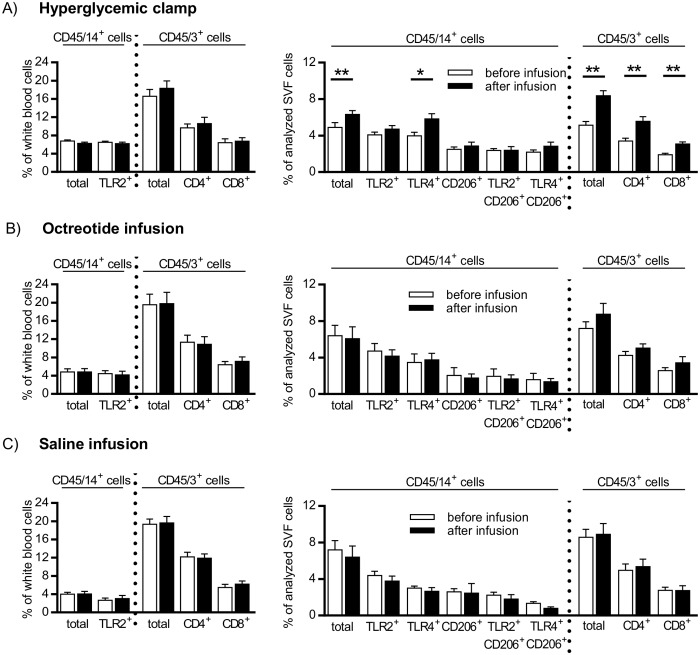
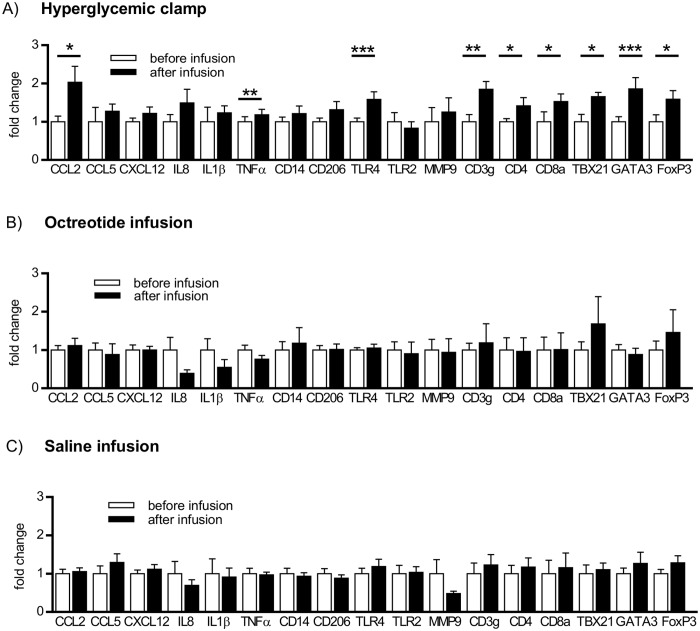
In blood, no changes in analysed immune cell population were observed in response to HG. In SAAT, HG induced an increase in the content of CD206 negative monocytes/macrophages (p<0.05) and T lymphocytes (both T helper and T cytotoxic lymphocytes, p<0.01). Further, HG promoted an increase of mRNA levels of immune response markers (CCL2, TLR4, TNFα) and lymphocyte markers (CD3g, CD4, CD8a, TBX21, GATA3, FoxP3) in SAAT (p<0.05 and 0.01). Under both control infusions, none of these changes were observed.
Acute HG significantly increased the content of monocytes and lymphocytes in SAAT of healthy obese women. This result suggests that the short-term HG can modulate an immune status of AT in obese subjects.
背景/目的:高血糖是激活免疫系统的可能介质之一,可能会导致与肥胖相关的炎症状态恶化。我们研究的目的是调查短期高血糖(HG)对无代谢并发症的肥胖女性循环系统和腹部皮下脂肪组织(SAAT)中免疫细胞表型及相对含量的影响。
对象/方法:对三组肥胖女性进行了为期三小时的HG钳夹试验,试验中注入奥曲肽,并对注入奥曲肽或生理盐水的对照组进行了研究(第1组:HG,第2组:奥曲肽,第3组:生理盐水,每组n = 10)。在干预前后,采集了SAAT和血液样本。通过流式细胞术测定血液和SAAT中免疫细胞的相对含量。通过定量实时PCR对SAAT中免疫相关标志物进行基因表达分析。
在血液中,未观察到分析的免疫细胞群体因HG而发生变化。在SAAT中,HG导致CD206阴性单核细胞/巨噬细胞含量增加(p<0.05)以及T淋巴细胞(辅助性T淋巴细胞和细胞毒性T淋巴细胞,p<0.01)含量增加。此外,HG促使SAAT中免疫反应标志物(CCL2、TLR4、TNFα)和淋巴细胞标志物(CD3g、CD4、CD8a、TBX21、GATA3、FoxP3)的mRNA水平升高(p<0.05和0.01)。在两种对照注入情况下,均未观察到这些变化。
急性HG显著增加了健康肥胖女性SAAT中单核细胞和淋巴细胞的含量。该结果表明,短期HG可调节肥胖受试者脂肪组织的免疫状态。