Yoon Hee, Kim Se Jin, Kim Kang, Lee Ji Eun, Jhun Byung Woo
Department of emergency medicine, Samsung Medical Center, Sungkyunkwan University School of Medicine, Seoul, South Korea.
Division of Pulmonary and Critical Care Medicine, Department of Medicine, The Armed Forces Capital Hospital, Seong-nam, South Korea.
PLoS One. 2015 Apr 20;10(4):e0124370. doi: 10.1371/journal.pone.0124370. eCollection 2015.
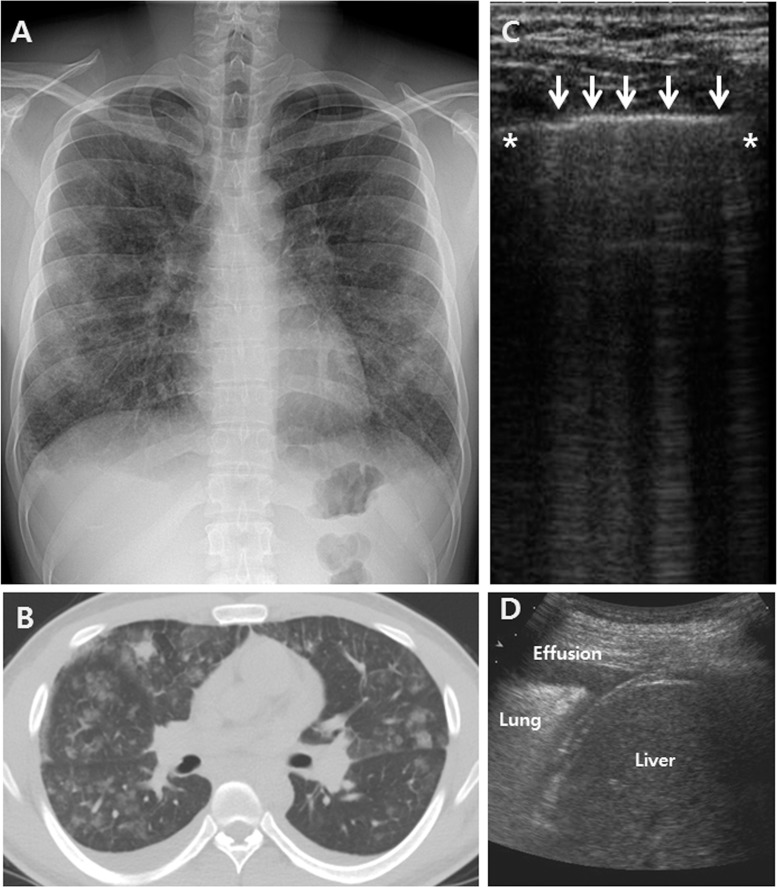
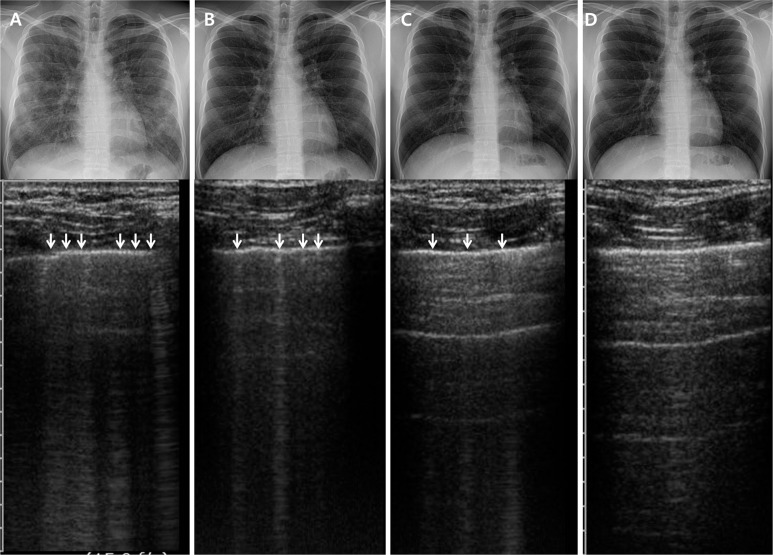
Thoracic ultrasound (TUS) is an easy-to-use imaging modality that aids physicians in the differential diagnosis of respiratory diseases. However, no data exist on the TUS findings of acute eosinophilic pneumonia (AEP) or their clinical utility in patients with AEP. Thus, we performed an observational study on TUS findings and their clinical utility for follow-up in patients with AEP. We prospectively screened patients who visited the emergency department for acute respiratory symptoms at the Armed Forces Capital Hospital in South Korea between February 2014 and July 2014. Of them, patients suspected to have AEP underwent an etiological investigation, including flexible bronchoscopy with bronchoalveolar lavage and TUS, and we evaluated TUS findings and serial changes on TUS during the treatment course compared with those from chest radiographs. In total, 22 patients with AEP were identified. The TUS examinations revealed that all patients exhibited multiple diffuse bilateral B-lines and lung sliding, with (n = 5) or without pleural effusion, which was consistent with alveolar-interstitial syndrome. B-line numbers fell during the course of treatment, as the lines became thinner and fainter. A-lines were evident in 19 patients on day 7 of hospitalization, when B-lines had disappeared in 13 patients, and all pleural effusion had resolved. All patients exhibited complete ultrasonic resolution by day 14, along with clinicoradiological improvement. Chest radiographs of five patients taken on day 7 seemed to show complete resolution, but several abnormal B-lines were evident on TUS performed the same day. As a result, our data show common TUS findings of AEP and suggest that AEP may be included as a differential diagnosis when multiple diffuse bilateral B-lines with preserved lung sliding are identified on a TUS examination in patients with acute symptoms, and that TUS is a useful modality for evaluating the treatment response in patients with AEP.
胸部超声(TUS)是一种易于使用的成像方式,可帮助医生对呼吸系统疾病进行鉴别诊断。然而,目前尚无关于急性嗜酸性粒细胞性肺炎(AEP)的TUS检查结果及其在AEP患者中的临床应用的数据。因此,我们对AEP患者的TUS检查结果及其在随访中的临床应用进行了一项观察性研究。我们前瞻性地筛选了2014年2月至2014年7月期间在韩国武装部队首都医院因急性呼吸道症状就诊于急诊科的患者。其中,疑似患有AEP的患者接受了病因学调查,包括经支气管镜肺活检和TUS检查,我们评估了TUS检查结果以及治疗过程中TUS的系列变化,并与胸部X线片结果进行比较。总共确定了22例AEP患者。TUS检查显示,所有患者均表现为双侧多发弥漫性B线和肺滑动征,伴有(n = 5)或不伴有胸腔积液,这与肺泡-间质综合征一致。在治疗过程中,B线数量减少,线条变细变淡。住院第7天时,19例患者出现A线,此时13例患者的B线消失,所有胸腔积液均已消退。到第14天时,所有患者的超声检查结果均完全恢复正常,临床和影像学也有所改善。5例患者在第7天拍摄的胸部X线片似乎显示完全恢复,但在同一天进行的TUS检查中仍可见几条异常B线。因此,我们的数据显示了AEP常见的TUS检查结果,并表明在急性症状患者的TUS检查中发现双侧多发弥漫性B线且肺滑动征保留时,AEP可作为鉴别诊断之一,而且TUS是评估AEP患者治疗反应的一种有用方式。