• 文献检索
  • 文档翻译
  • 深度研究
  • 学术资讯
  • Suppr Zotero 插件Zotero 插件
  • 邀请有礼
  • 套餐&价格
  • 历史记录
应用&插件
Suppr Zotero 插件Zotero 插件浏览器插件Mac 客户端Windows 客户端微信小程序
定价
高级版会员购买积分包购买API积分包
服务
文献检索文档翻译深度研究API 文档MCP 服务
关于我们
关于 Suppr公司介绍联系我们用户协议隐私条款
关注我们

Suppr 超能文献

核心技术专利:CN118964589B侵权必究
粤ICP备2023148730 号-1Suppr @ 2026

文献检索

告别复杂PubMed语法,用中文像聊天一样搜索,搜遍4000万医学文献。AI智能推荐,让科研检索更轻松。

立即免费搜索

文件翻译

保留排版,准确专业,支持PDF/Word/PPT等文件格式,支持 12+语言互译。

免费翻译文档

深度研究

AI帮你快速写综述,25分钟生成高质量综述,智能提取关键信息,辅助科研写作。

立即免费体验

引出并接受在线支持:使用计算机辅助内容分析来审视在线社会支持的动态变化。

Eliciting and receiving online support: using computer-aided content analysis to examine the dynamics of online social support.

作者信息

Wang Yi-Chia, Kraut Robert E, Levine John M

机构信息

Language Technologies Institute, School of Computer Science, Carnegie Mellon University, Pittsburgh, PA, United States.

出版信息

J Med Internet Res. 2015 Apr 20;17(4):e99. doi: 10.2196/jmir.3558.

DOI:10.2196/jmir.3558
PMID:25896033
原文链接:https://pmc.ncbi.nlm.nih.gov/articles/PMC4419194/
Abstract

BACKGROUND

Although many people with serious diseases participate in online support communities, little research has investigated how participants elicit and provide social support on these sites.

OBJECTIVE

The first goal was to propose and test a model of the dynamic process through which participants in online support communities elicit and provide emotional and informational support. The second was to demonstrate the value of computer coding of conversational data using machine learning techniques (1) by replicating results derived from human-coded data about how people elicit support and (2) by answering questions that are intractable with small samples of human-coded data, namely how exposure to different types of social support predicts continued participation in online support communities. The third was to provide a detailed description of these machine learning techniques to enable other researchers to perform large-scale data analysis in these communities.

METHODS

Communication among approximately 90,000 registered users of an online cancer support community was analyzed. The corpus comprised 1,562,459 messages organized into 68,158 discussion threads. Amazon Mechanical Turk workers coded (1) 1000 thread-starting messages on 5 attributes (positive and negative emotional self-disclosure, positive and negative informational self-disclosure, questions) and (2) 1000 replies on emotional and informational support. Their judgments were used to train machine learning models that automatically estimated the amount of these 7 attributes in the messages. Across attributes, the average Pearson correlation between human-based judgments and computer-based judgments was .65.

RESULTS

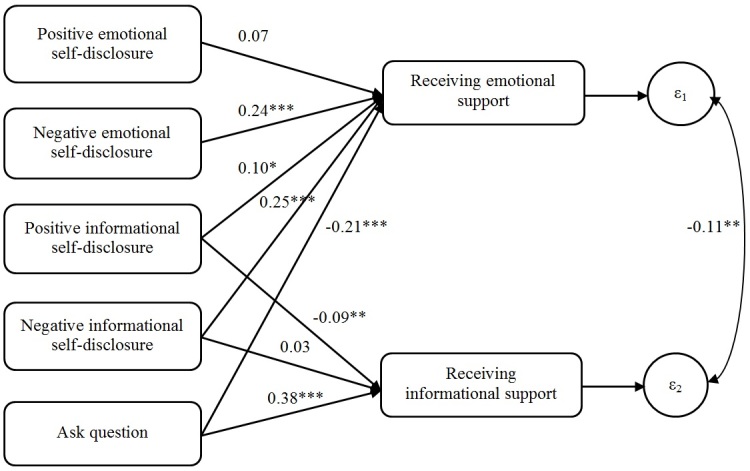
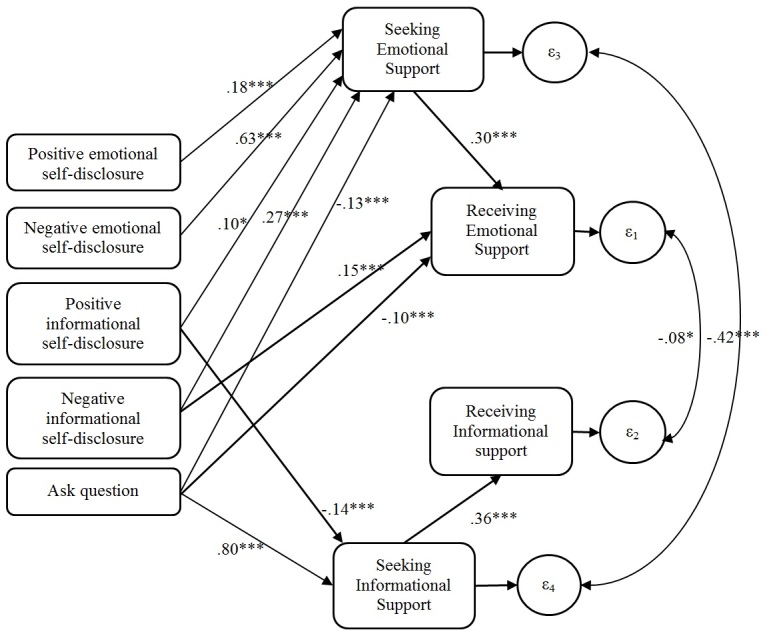
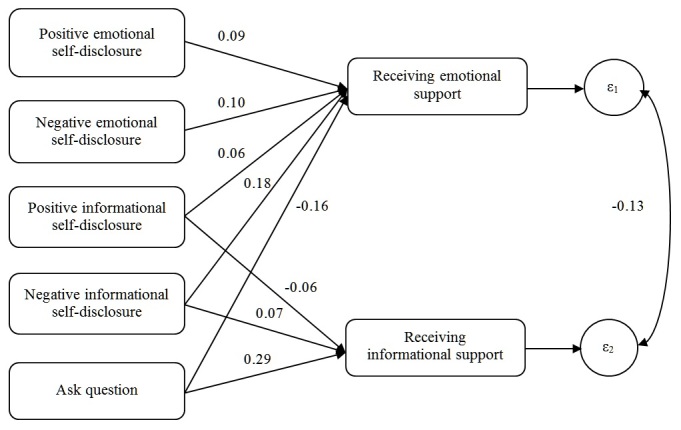
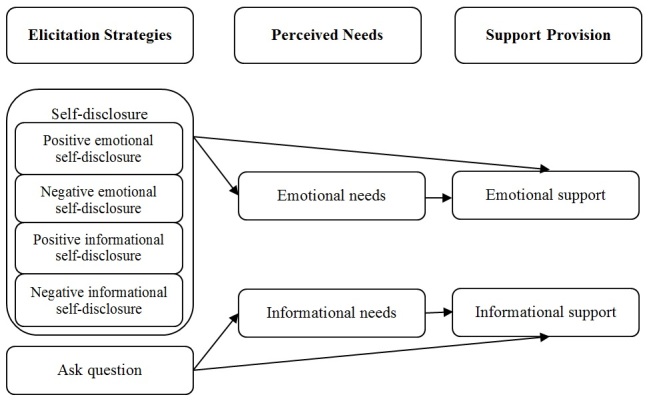
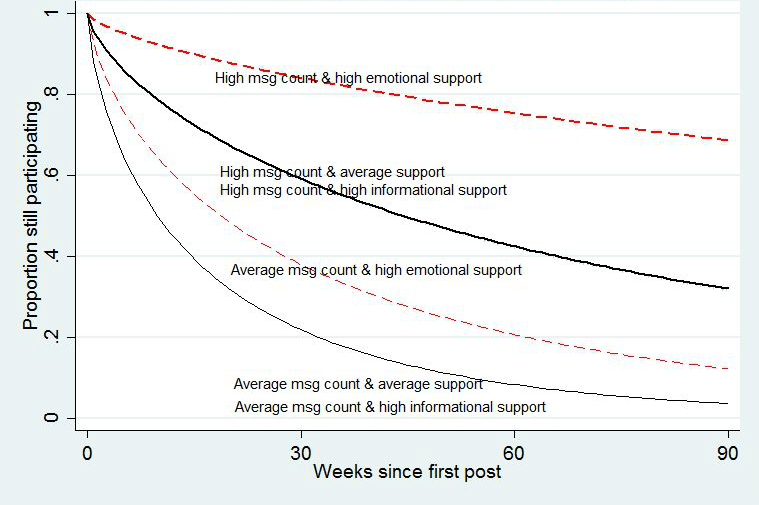
Part 1 used human-coded data to investigate relationships between (1) 4 kinds of self-disclosure and question asking in thread-starting posts and (2) the amount of emotional and informational support in the first reply. Self-disclosure about negative emotions (beta=.24, P<.001), negative events (beta=.25, P<.001), and positive events (beta=.10, P=.02) increased emotional support. However, asking questions depressed emotional support (beta=-.21, P<.001). In contrast, asking questions increased informational support (beta=.38, P<.001), whereas positive informational self-disclosure depressed it (beta=-.09, P=.003). Self-disclosure led to the perception of emotional needs, which elicited emotional support, whereas asking questions led to the perception of informational needs, which elicited informational support. Part 2 used machine-coded data to replicate these results. Part 3 analyzed the machine-coded data and showed that exposure to more emotional support predicted staying in the group longer 33% (hazard ratio=0.67, P<.001), whereas exposure to more informational support predicted leaving the group sooner (hazard ratio=1.05, P<.001).

CONCLUSIONS

Self-disclosure is effective in eliciting emotional support, whereas question asking is effective in eliciting informational support. Moreover, perceptions that people desire particular kinds of support influence the support they receive. Finally, the type of support people receive affects the likelihood of their staying in or leaving the group. These results demonstrate the utility of machine learning methods for investigating the dynamics of social support exchange in online support communities.
https://cdn.ncbi.nlm.nih.gov/pmc/blobs/164f/4419194/6c9bbcefc4fe/jmir_v17i4e99_fig5.jpg
https://cdn.ncbi.nlm.nih.gov/pmc/blobs/164f/4419194/cf1d54e65d59/jmir_v17i4e99_fig1.jpg
https://cdn.ncbi.nlm.nih.gov/pmc/blobs/164f/4419194/7d633420816f/jmir_v17i4e99_fig2.jpg
https://cdn.ncbi.nlm.nih.gov/pmc/blobs/164f/4419194/0ff075dbd353/jmir_v17i4e99_fig3.jpg
https://cdn.ncbi.nlm.nih.gov/pmc/blobs/164f/4419194/3375c016b515/jmir_v17i4e99_fig4.jpg
https://cdn.ncbi.nlm.nih.gov/pmc/blobs/164f/4419194/6c9bbcefc4fe/jmir_v17i4e99_fig5.jpg
https://cdn.ncbi.nlm.nih.gov/pmc/blobs/164f/4419194/cf1d54e65d59/jmir_v17i4e99_fig1.jpg
https://cdn.ncbi.nlm.nih.gov/pmc/blobs/164f/4419194/7d633420816f/jmir_v17i4e99_fig2.jpg
https://cdn.ncbi.nlm.nih.gov/pmc/blobs/164f/4419194/0ff075dbd353/jmir_v17i4e99_fig3.jpg
https://cdn.ncbi.nlm.nih.gov/pmc/blobs/164f/4419194/3375c016b515/jmir_v17i4e99_fig4.jpg
https://cdn.ncbi.nlm.nih.gov/pmc/blobs/164f/4419194/6c9bbcefc4fe/jmir_v17i4e99_fig5.jpg
摘要

背景

尽管许多患有严重疾病的人参与在线支持社区,但很少有研究调查参与者如何在这些网站上寻求和提供社会支持。

目的

第一个目标是提出并测试一个动态过程模型,通过该模型,在线支持社区的参与者寻求和提供情感及信息支持。第二个目标是通过使用机器学习技术对对话数据进行计算机编码来证明其价值:(1)通过复制从人工编码数据中得出的关于人们如何寻求支持的结果;(2)通过回答少量人工编码数据难以解决的问题,即接触不同类型的社会支持如何预测在在线支持社区中的持续参与。第三个目标是详细描述这些机器学习技术,以使其他研究人员能够在这些社区中进行大规模数据分析。

方法

对一个在线癌症支持社区中约90,000名注册用户之间的交流进行了分析。语料库包含1,562,459条消息,这些消息被组织成68,158个讨论线程。亚马逊土耳其机器人工作者对(1)1000条发起线程的消息的5个属性(积极和消极情感自我表露、积极和消极信息自我表露、问题)进行编码,以及(2)1000条关于情感和信息支持的回复进行编码。他们的判断被用于训练机器学习模型,该模型自动估计消息中这7个属性的数量。在各个属性上,基于人工判断和基于计算机判断之间的平均皮尔逊相关系数为0.65。

结果

第一部分使用人工编码数据来研究(1)发起线程的帖子中4种自我表露和提问与(2)第一个回复中的情感和信息支持量之间的关系。关于负面情绪(β = 0.24,P <.001)、负面事件(β = 0.25,P <.001)和正面事件(β = 0.10,P = 0.02)的自我表露增加了情感支持。然而,提问会降低情感支持(β = -0.21,P <.001)。相比之下,提问增加了信息支持(β = 0.38,P <.001),而积极的信息自我表露则降低了信息支持(β = -0.09,P = 0.003)。自我表露导致对情感需求的感知,从而引发情感支持,而提问导致对信息需求的感知,从而引发信息支持。第二部分使用机器编码数据来复制这些结果。第三部分分析了机器编码数据,并表明接触更多情感支持预测在群体中停留更长时间的可能性高33%(风险比 = 0.67,P <.001),而接触更多信息支持预测更早离开群体(风险比 = 1.05,P <.001)。

结论

自我表露在引发情感支持方面有效,而提问在引发信息支持方面有效。此外,人们渴望特定类型支持的认知会影响他们获得的支持。最后,人们获得的支持类型会影响他们留在群体或离开群体的可能性。这些结果证明了机器学习方法在研究在线支持社区中社会支持交换动态方面的实用性。

相似文献

1
Eliciting and receiving online support: using computer-aided content analysis to examine the dynamics of online social support.引出并接受在线支持:使用计算机辅助内容分析来审视在线社会支持的动态变化。
J Med Internet Res. 2015 Apr 20;17(4):e99. doi: 10.2196/jmir.3558.
2
Informational and emotional elements in online support groups: a Bayesian approach to large-scale content analysis.在线支持小组中的信息与情感元素:一种用于大规模内容分析的贝叶斯方法。
J Am Med Inform Assoc. 2016 May;23(3):508-13. doi: 10.1093/jamia/ocv190. Epub 2016 Feb 15.
3
Using Machine Learning of Online Expression to Explain Recovery Trajectories: Content Analytic Approach to Studying a Substance Use Disorder Forum.利用在线表达的机器学习来解释恢复轨迹:研究物质使用障碍论坛的内容分析方法。
J Med Internet Res. 2023 Aug 22;25:e45589. doi: 10.2196/45589.
4
How language affects peer responsiveness in an online cancer support group: implications for treatment design and facilitation.语言如何影响在线癌症支持小组中的同伴反应:对治疗设计与促进的启示
Psychooncology. 2014 Jul;23(7):766-72. doi: 10.1002/pon.3477. Epub 2014 Feb 11.
5
Analyzing and Predicting User Participations in Online Health Communities: A Social Support Perspective.从社会支持视角分析与预测用户在在线健康社区中的参与度
J Med Internet Res. 2017 Apr 24;19(4):e130. doi: 10.2196/jmir.6834.
6
Help-Seeking, Support, and Engagement in Gestational Diabetes Mellitus Online Communities on Facebook: Content Analysis.在脸书上的妊娠期糖尿病在线社区中寻求帮助、获得支持与参与情况:内容分析
JMIR Form Res. 2024 Feb 26;8:e49494. doi: 10.2196/49494.
7
Comparison of social support content within online communities for high- and low-survival-rate cancers.高生存率癌症和低生存率癌症在线社区内社会支持内容的比较。
Comput Inform Nurs. 2011 Aug;29(8):461-7. doi: 10.1097/NCN.0b013e318214093b.
8
Investigating User-Generated Content in an Online Drug Recovery Forum: Lessons for Successful Computer-Mediated Communication of Social Support.调查在线戒毒论坛中的用户生成内容:对成功进行社会支持的计算机中介传播的启示。
IEEE J Biomed Health Inform. 2022 Nov;26(11):5695-5703. doi: 10.1109/JBHI.2022.3196631. Epub 2022 Nov 10.
9
Online social support for obese adults: Exploring the role of forum activity.肥胖成年人的在线社会支持:探究论坛活动的作用。
Int J Med Inform. 2017 May;101:1-8. doi: 10.1016/j.ijmedinf.2017.02.003. Epub 2017 Feb 6.
10
The role of off-topic discussions in online health support groups: insights from a content analysis of an online rectal cancer group.非主题讨论在在线健康支持小组中的作用:对一个在线直肠癌小组的内容分析得出的见解。
Support Care Cancer. 2020 Jul;28(7):3219-3226. doi: 10.1007/s00520-019-05159-4. Epub 2019 Nov 13.

引用本文的文献

1
I know i'm not meant to 'diet' but is it ok to lose a few pounds while pregnant?: a qualitative analysis of Mumsnet discussion forum posts to understand women's experiences of and views on weight and weight management while living with excess weight during and after pregnancy.我知道我不应该“节食”,但怀孕期间瘦几斤可以吗?:对Mumsnet讨论论坛帖子的定性分析,以了解女性在孕期及产后体重超标时对体重及体重管理的经历和看法。
BMC Pregnancy Childbirth. 2025 Aug 28;25(1):898. doi: 10.1186/s12884-025-08035-8.
2
Self-Disclosure and Social Support in a Web-Based Opioid Recovery Community: Machine Learning Analysis.基于网络的阿片类药物康复社区中的自我表露与社会支持:机器学习分析
JMIR Form Res. 2025 Jul 17;9:e71207. doi: 10.2196/71207.
3

本文引用的文献

1
Health-related Internet use among cancer survivors: data from the Health Information National Trends Survey, 2003-2008.癌症幸存者的健康相关互联网使用情况:来自 2003-2008 年健康信息国家趋势调查的数据。
J Cancer Surviv. 2011 Sep;5(3):263-70. doi: 10.1007/s11764-011-0179-5. Epub 2011 Apr 20.
2
Empathic exchanges in online cancer support groups: distinguishing message expression and reception effects.在线癌症支持小组中的同理心交流:区分信息表达和接收效果。
Health Commun. 2011 Mar;26(2):185-97. doi: 10.1080/10410236.2010.544283.
3
Social media use in the United States: implications for health communication.
Quality Measurement of Consumer Health Questions: Content and Language Perspectives.
消费者健康问题的质量衡量:内容和语言视角。
J Med Internet Res. 2024 Sep 12;26:e48257. doi: 10.2196/48257.
4
Connected and supported: a scoping review of how online communities provide social support for breast cancer survivors.相互联系与支持:关于在线社区如何为乳腺癌幸存者提供社会支持的范围界定综述
J Cancer Surviv. 2024 Aug 28. doi: 10.1007/s11764-024-01660-w.
5
A scoping review of empathy recognition in text using natural language processing.使用自然语言处理进行文本同理心识别的范围综述。
J Am Med Inform Assoc. 2024 Feb 16;31(3):762-775. doi: 10.1093/jamia/ocad229.
6
Using Machine Learning of Online Expression to Explain Recovery Trajectories: Content Analytic Approach to Studying a Substance Use Disorder Forum.利用在线表达的机器学习来解释恢复轨迹:研究物质使用障碍论坛的内容分析方法。
J Med Internet Res. 2023 Aug 22;25:e45589. doi: 10.2196/45589.
7
Online health communities influence people's health behaviors in the context of COVID-19.在线健康社区在 COVID-19 背景下影响人们的健康行为。
PLoS One. 2023 Apr 13;18(4):e0282368. doi: 10.1371/journal.pone.0282368. eCollection 2023.
8
Social Support in a Diabetes Online Community: Mixed Methods Content Analysis.糖尿病在线社区中的社会支持:混合方法内容分析
JMIR Diabetes. 2023 Jan 6;8:e41320. doi: 10.2196/41320.
9
Meeting the Unmet Needs of Individuals With Mental Disorders: Scoping Review on Peer-to-Peer Web-Based Interactions.满足精神障碍患者未被满足的需求:基于网络的同伴互动范围综述
JMIR Ment Health. 2022 Dec 5;9(12):e36056. doi: 10.2196/36056.
10
Investigating Self-injury Support Solicitations and Responses on a Mobile Peer Support Application.在移动同伴支持应用程序上调查自我伤害支持请求与回应
Proc ACM Hum Comput Interact. 2021 Oct;5(CSCW2). doi: 10.1145/3479498. Epub 2021 Oct 18.
美国社交媒体的使用:对健康传播的影响。
J Med Internet Res. 2009 Nov 27;11(4):e48. doi: 10.2196/jmir.1249.
4
Emotional and informational support messages in an online hospice support community.在线临终关怀支持社区中的情感与信息支持信息。
Comput Inform Nurs. 2008 Nov-Dec;26(6):358-67. doi: 10.1097/01.NCN.0000336461.94939.97.
5
How cancer survivors provide support on cancer-related Internet mailing lists.癌症幸存者如何在癌症相关的互联网邮件列表上提供支持。
J Med Internet Res. 2007 May 14;9(2):e12. doi: 10.2196/jmir.9.2.e12.
6
Health related virtual communities and electronic support groups: systematic review of the effects of online peer to peer interactions.与健康相关的虚拟社区和电子支持小组:在线 peer-to-peer 互动效果的系统评价
BMJ. 2004 May 15;328(7449):1166. doi: 10.1136/bmj.328.7449.1166.
7
On face-work; an analysis of ritual elements in social interaction.关于面子工程:社会互动中仪式元素的分析
Psychiatry. 1955 Aug;18(3):213-31. doi: 10.1080/00332747.1955.11023008.
8
Evaluation of an internet support group for women with primary breast cancer.对原发性乳腺癌女性互联网支持小组的评估。
Cancer. 2003 Mar 1;97(5):1164-73. doi: 10.1002/cncr.11174.
9
Electronic support groups for breast carcinoma: a clinical trial of effectiveness.乳腺癌电子支持小组:一项有效性临床试验
Cancer. 2003 Feb 15;97(4):920-5. doi: 10.1002/cncr.11145.
10
Long-term effects of educational and peer discussion group interventions on adjustment to breast cancer.教育及同伴讨论组干预对乳腺癌适应情况的长期影响。
Health Psychol. 2001 Sep;20(5):387-92. doi: 10.1037//0278-6133.20.5.387.