Greenway F L
Pennington Biomedical Research Center, Louisiana State University System, Baton Rouge, LA, USA.
Int J Obes (Lond). 2015 Aug;39(8):1188-96. doi: 10.1038/ijo.2015.59. Epub 2015 Apr 21.
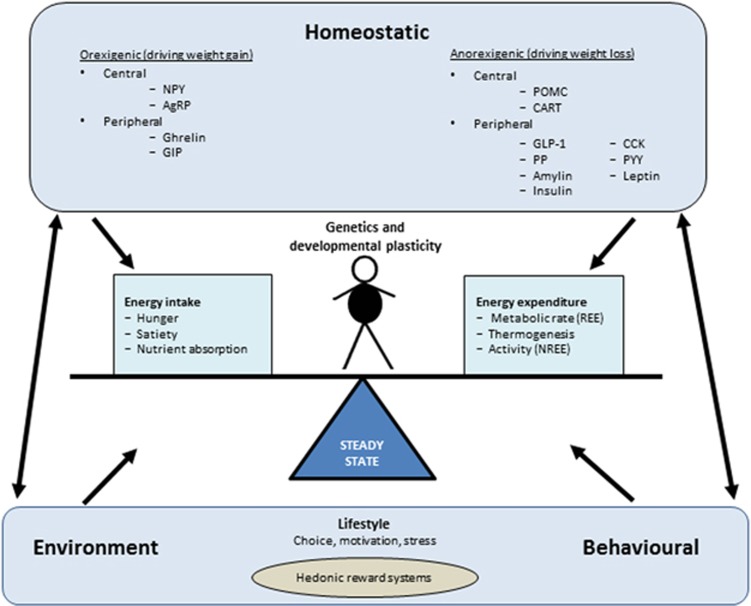
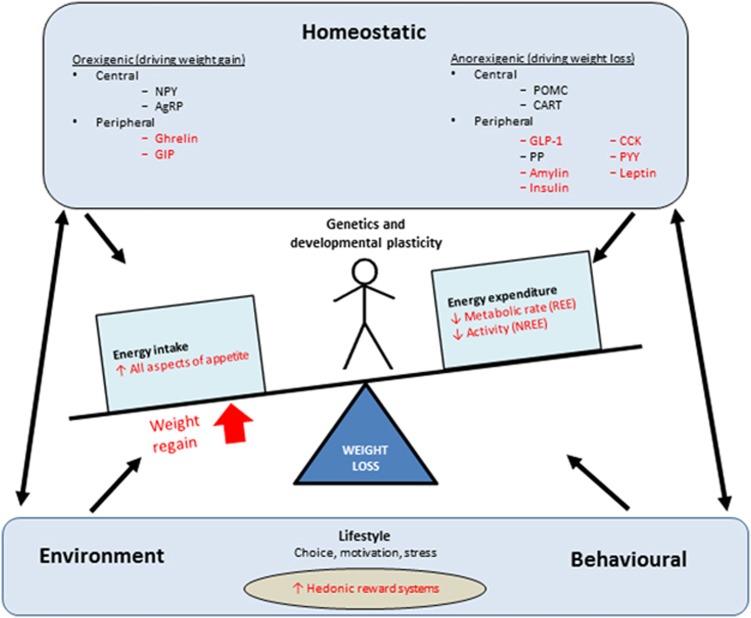
Obesity is a major global health problem and predisposes individuals to several comorbidities that can affect life expectancy. Interventions based on lifestyle modification (for example, improved diet and exercise) are integral components in the management of obesity. However, although weight loss can be achieved through dietary restriction and/or increased physical activity, over the long term many individuals regain weight. The aim of this article is to review the research into the processes and mechanisms that underpin weight regain after weight loss and comment on future strategies to address them. Maintenance of body weight is regulated by the interaction of a number of processes, encompassing homoeostatic, environmental and behavioural factors. In homoeostatic regulation, the hypothalamus has a central role in integrating signals regarding food intake, energy balance and body weight, while an 'obesogenic' environment and behavioural patterns exert effects on the amount and type of food intake and physical activity. The roles of other environmental factors are also now being considered, including sleep debt and iatrogenic effects of medications, many of which warrant further investigation. Unfortunately, physiological adaptations to weight loss favour weight regain. These changes include perturbations in the levels of circulating appetite-related hormones and energy homoeostasis, in addition to alterations in nutrient metabolism and subjective appetite. To maintain weight loss, individuals must adhere to behaviours that counteract physiological adaptations and other factors favouring weight regain. It is difficult to overcome physiology with behaviour. Weight loss medications and surgery change the physiology of body weight regulation and are the best chance for long-term success. An increased understanding of the physiology of weight loss and regain will underpin the development of future strategies to support overweight and obese individuals in their efforts to achieve and maintain weight loss.
肥胖是一个重大的全球健康问题,使个体易患多种可影响预期寿命的合并症。基于生活方式改变的干预措施(例如,改善饮食和增加运动)是肥胖管理的重要组成部分。然而,尽管可以通过饮食限制和/或增加体育活动来实现体重减轻,但从长期来看,许多人会重新增重。本文的目的是回顾关于减肥后体重反弹的过程和机制的研究,并对未来解决这些问题的策略发表评论。体重的维持受多种过程相互作用的调节,包括稳态、环境和行为因素。在稳态调节中,下丘脑在整合有关食物摄入、能量平衡和体重的信号方面起着核心作用,而“致肥胖”环境和行为模式会对食物摄入量和类型以及体育活动产生影响。现在也在考虑其他环境因素的作用,包括睡眠不足和药物的医源性影响,其中许多因素值得进一步研究。不幸的是,身体对体重减轻的生理适应有利于体重反弹。这些变化包括循环中与食欲相关的激素水平和能量稳态的扰动,以及营养代谢和主观食欲的改变。为了维持体重减轻,个体必须坚持能够抵消生理适应和其他有利于体重反弹的因素的行为。用行为来克服生理因素是困难的。减肥药物和手术改变了体重调节的生理机制,是长期成功的最佳机会。对体重减轻和反弹生理机制的进一步了解将为未来制定策略提供支持,以帮助超重和肥胖个体实现并维持体重减轻。