Yamanaka Manabu, Taniguchi Wataru, Nishio Naoko, Hashizume Hiroshi, Yamada Hiroshi, Yoshida Munehito, Nakatsuka Terumasa
Department of Orthopaedic Surgery, Wakayama Medical University, Wakayama, 641-8509, Japan.
Pain Research Center, Kansai University of Health Sciences, Kumatori, Osaka, 590-0482, Japan.
Mol Pain. 2015 Apr 21;11:20. doi: 10.1186/s12990-015-0021-6.
Transient receptor potential (TRP) channels are nonselective cation channels expressed in a variety of sensory structures, and are important molecular mediators of thermal, mechanical, cellular and chemical signals. We investigated the function of one key member of the TRP superfamily, TRPA1, in the spinal dorsal horn using in vivo patch-clamp recordings.
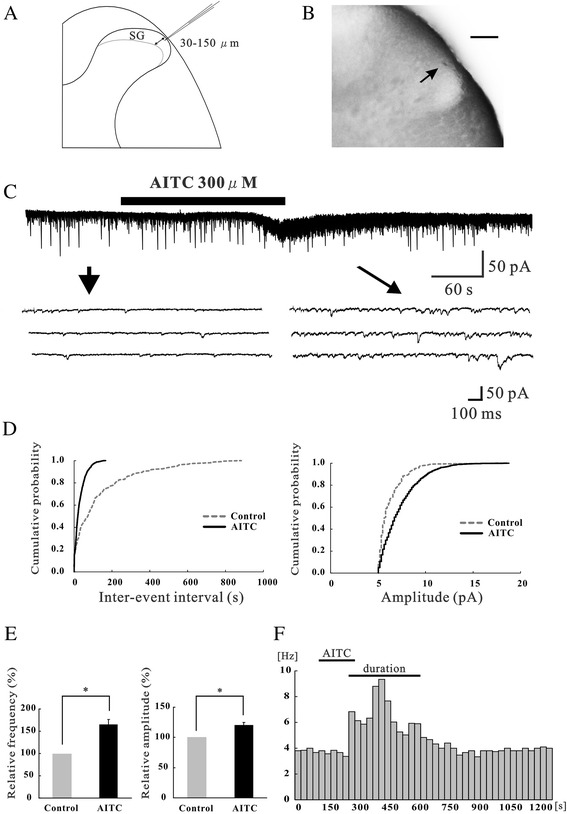
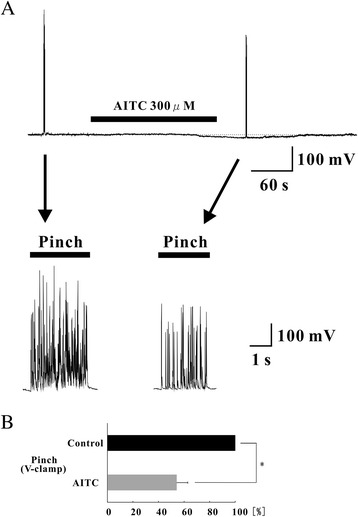
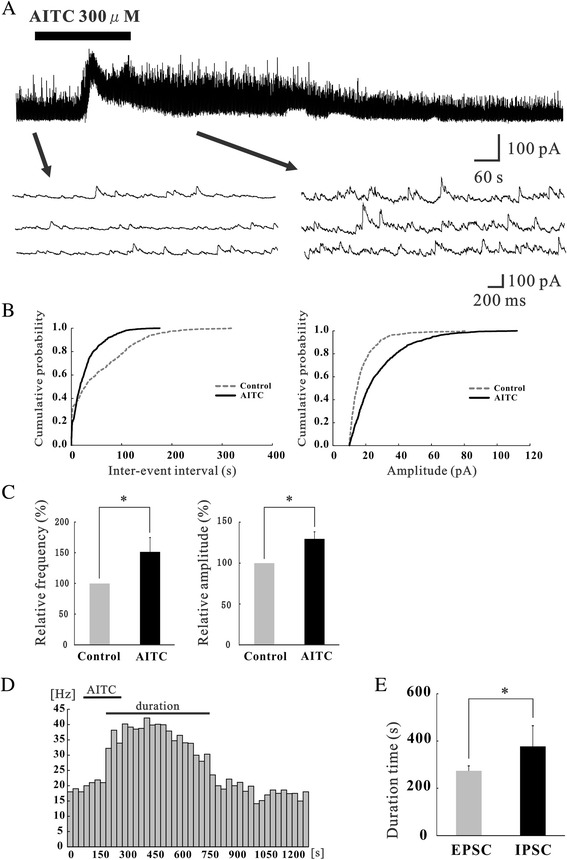
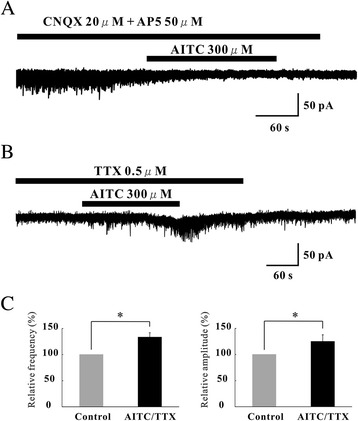
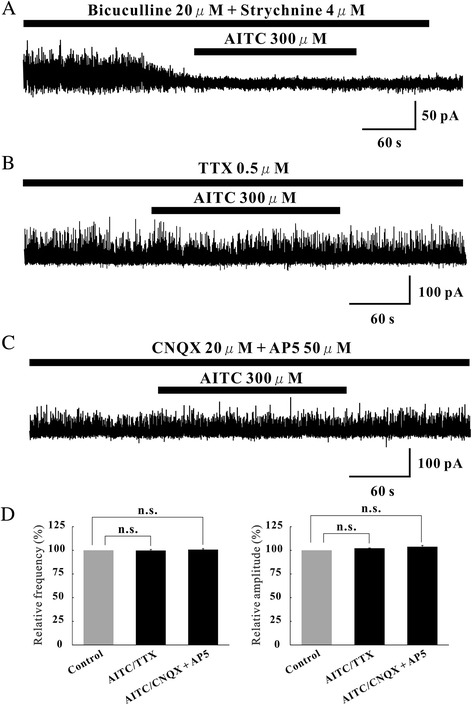
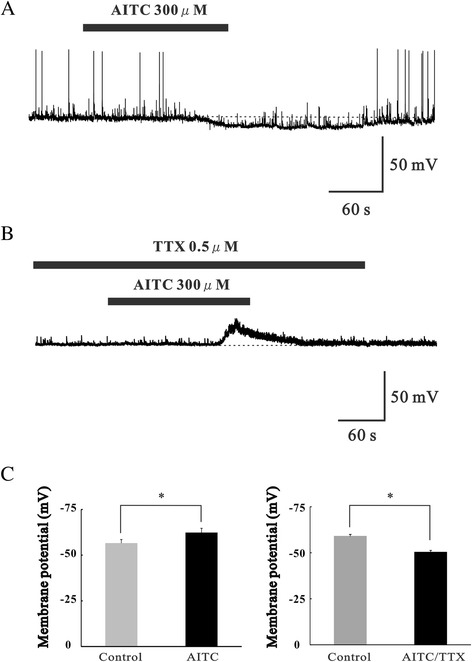
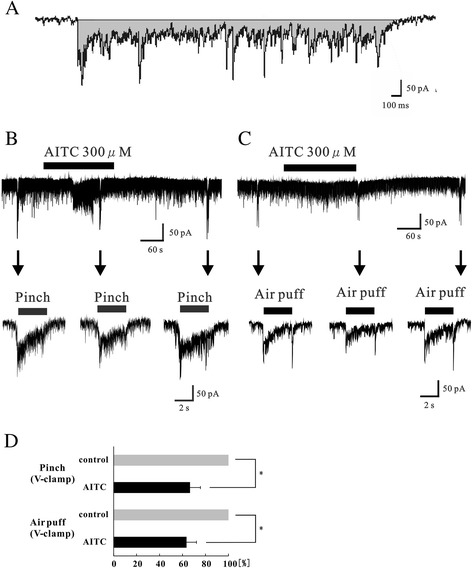
The application of allyl isothiocyanate (AITC), a TRPA1 agonist, significantly increased the frequency and amplitude of inhibitory postsynaptic currents (IPSCs; holding potential (VH) = 0 mV) as well as excitatory postsynaptic currents (EPSCs; VH = -70 mV) in substantia gelatinosa (SG) neurons. The AITC-induced increases in EPSC frequency and amplitude were resistant to the Na(+) channel blocker tetrodotoxin (TTX). In the presence of the glutamate receptor antagonists CNQX and AP5, AITC did not generate any synaptic activity. The AITC-induced increases in IPSC frequency and amplitude were abolished by TTX or glutamate receptor antagonists. Moreover, the duration of IPSCs enhanced by TRPA1 activation were significantly longer than those of EPSCs enhanced by activation of this channel in the spinal dorsal horn. AITC induced hyperpolarization of the membrane potential of SG neurons in the spinal cord but depolarized the membrane potential in the presence of TTX. Furthermore, we examined the effects of mechanical stimuli to the skin during TRPA1 activation in the spinal dorsal horn in normal rats in both voltage-clamp and current-clamp modes. In the peripheral tissue stimuli test, AITC significantly suppressed EPSCs evoked by pinch or air puff stimulation of the skin. In current-clamp mode, AITC significantly suppressed excitatory postsynaptic potentials (EPSPs) evoked by pinch stimuli.
TRPA1 appears to be localized not only at presynaptic terminals on SG neurons, enhancing glutamate release, but also in the terminals of primary afferents innervating spinal inhibitory interneurons, which have synaptic interactions with SG neurons. This study offers further insight into the mechanisms underlying the possible antinociceptive actions of TRPA1 activation in the spinal dorsal horn. Our findings suggest that pharmacological activation of spinal TRPA1 channels may have therapeutic potential for the treatment of pain.
瞬时受体电位(TRP)通道是在多种感觉结构中表达的非选择性阳离子通道,是热、机械、细胞和化学信号的重要分子介质。我们使用体内膜片钳记录研究了TRP超家族的一个关键成员TRPA1在脊髓背角中的功能。
TRPA1激动剂异硫氰酸烯丙酯(AITC)的应用显著增加了脊髓背角胶状质(SG)神经元中抑制性突触后电流(IPSCs;钳制电位(VH)=0 mV)以及兴奋性突触后电流(EPSCs;VH=-70 mV)的频率和幅度。AITC诱导的EPSC频率和幅度增加对钠通道阻滞剂河豚毒素(TTX)具有抗性。在谷氨酸受体拮抗剂CNQX和AP5存在的情况下,AITC不会产生任何突触活动。TTX或谷氨酸受体拮抗剂可消除AITC诱导的IPSC频率和幅度增加。此外,在脊髓背角,TRPA1激活增强的IPSCs持续时间明显长于该通道激活增强的EPSCs持续时间。AITC诱导脊髓中SG神经元的膜电位超极化,但在位TTX存在的情况下使膜电位去极化。此外,我们在电压钳和电流钳模式下,研究了正常大鼠脊髓背角TRPA1激活期间对皮肤机械刺激的影响。在周围组织刺激试验中,AITC显著抑制捏或吹气刺激皮肤诱发的EPSCs。在电流钳模式下,AITC显著抑制捏刺激诱发的兴奋性突触后电位(EPSPs)。
TRPA1似乎不仅定位于SG神经元的突触前终末,增强谷氨酸释放,还定位于支配脊髓抑制性中间神经元的初级传入神经终末,这些终末与SG神经元有突触相互作用。本研究进一步深入了解了脊髓背角TRPA1激活可能的抗伤害感受作用的潜在机制。我们的研究结果表明,脊髓TRPA1通道的药理学激活可能具有治疗疼痛的潜力。