Baldeviano G Christian, Okoth Sheila Akinyi, Arrospide Nancy, Gonzalez Rommell V, Sánchez Juan F, Macedo Silvia, Conde Silvia, Tapia L Lorena, Salas Carola, Gamboa Dionicia, Herrera Yeni, Edgel Kimberly A, Udhayakumar Venkatachalam, Lescano Andrés G
Emerg Infect Dis. 2015 May;21(5):797-803. doi: 10.3201/eid2105.141427.
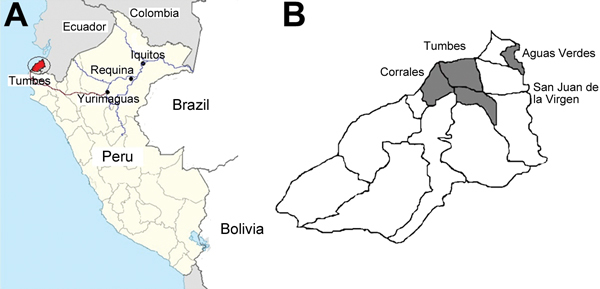
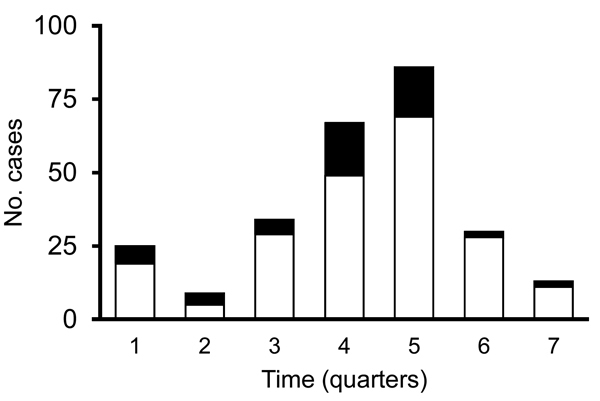
During 2010-2012, an outbreak of 210 cases of malaria occurred in Tumbes, in the northern coast of Peru, where no Plasmodium falciparum malaria case had been reported since 2006. To identify the source of the parasite causing this outbreak, we conducted a molecular epidemiology investigation. Microsatellite typing showed an identical genotype in all 54 available isolates. This genotype was also identical to that of parasites isolated in 2010 in the Loreto region of the Peruvian Amazon and closely related to clonet B, a parasite lineage previously reported in the Amazon during 1998-2000. These findings are consistent with travel history of index case-patients. DNA sequencing revealed mutations in the Pfdhfr, Pfdhps, Pfcrt, and Pfmdr1 loci, which are strongly associated with resistance to chloroquine and sulfadoxine/pyrimethamine, and deletion of the Pfhrp2 gene. These results highlight the need for timely molecular epidemiology investigations to trace the parasite source during malaria reintroduction events.
2010年至2012年期间,秘鲁北部海岸的通贝斯爆发了210例疟疾病例,自2006年以来,该地未曾报告过恶性疟原虫疟疾病例。为确定此次疫情中疟原虫的来源,我们开展了分子流行病学调查。微卫星分型显示,在所有54株可用分离株中基因型相同。该基因型也与2010年在秘鲁亚马逊地区洛雷托分离的寄生虫基因型相同,并且与克隆B密切相关,克隆B是1998年至2000年期间曾在亚马逊地区报告过的一种寄生虫谱系。这些发现与首例病例患者的旅行史相符。DNA测序显示,Pfdhfr、Pfdhps、Pfcrt和Pfmdr1基因座发生了突变,这些突变与对氯喹和磺胺多辛/乙胺嘧啶的耐药性密切相关,并且Pfhrp2基因缺失。这些结果凸显了在疟疾重新出现事件期间及时开展分子流行病学调查以追踪疟原虫来源的必要性。