O'Neill John Stuart, Lee Kate D, Zhang Lin, Feeney Kevin, Webster Simon George, Blades Matthew James, Kyriacou Charalambos Panayiotis, Hastings Michael Harvey, Wilcockson David Charles
MRC Laboratory of Molecular Biology, Cambridge CB2 0QH, UK.
Bioinformatics and Biostatistics Analysis Support Hub & Department of Genetics, University of Leicester, Leicester LE1 7RH, UK.
Curr Biol. 2015 Apr 20;25(8):R326-7. doi: 10.1016/j.cub.2015.02.052.
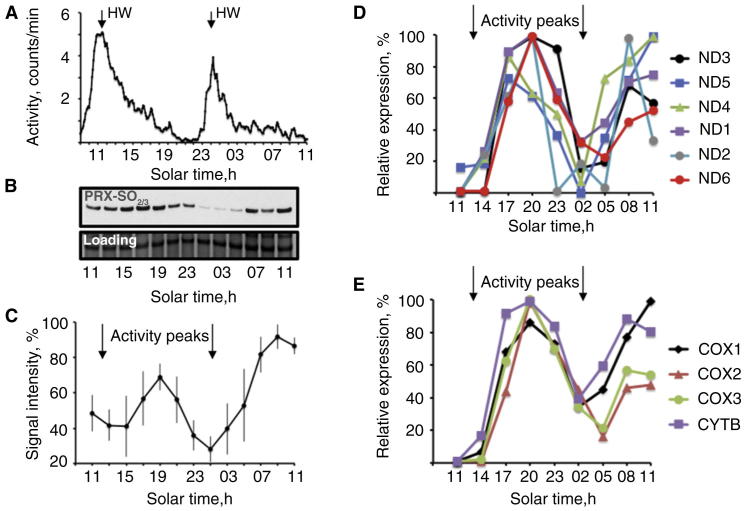
In contrast to the well mapped molecular orchestration of circadian timekeeping in terrestrial organisms, the mechanisms that direct tidal and lunar rhythms in marine species are entirely unknown. Using a combination of biochemical and molecular approaches we have identified a series of metabolic markers of the tidal clock of the intertidal isopod . Specifically, we show that the overoxidation of peroxiredoxin (PRX), a conserved marker of circadian timekeeping in terrestrial eukaryotes , follows a circatidal (approximately 12.4 hours) pattern in , in register with the tidal pattern of swimming. In parallel, we show that mitochondrially encoded genes are expressed with a circatidal rhythm. Together, these findings demonstrate that PRX overoxidation rhythms are not intrinsically circadian; rather they appear to resonate with the dominant metabolic cycle of an organism, regardless of its frequency. Moreover, they provide the first molecular leads for dissecting the tidal clockwork.
与陆生生物中昼夜节律计时的分子调控机制已得到充分研究不同,海洋物种中引导潮汐和月节律的机制完全未知。我们结合生化和分子方法,鉴定出了潮间带等足类动物潮汐钟的一系列代谢标志物。具体而言,我们发现过氧化物还原酶(PRX)的过度氧化,这是陆生真核生物昼夜节律计时的一个保守标志物,在[具体物种]中呈现出约12.4小时的潮汐节律模式,与游泳的潮汐模式同步。同时,我们发现线粒体编码基因也以潮汐节律表达。这些发现共同表明,PRX过度氧化节律并非内在的昼夜节律;相反,它们似乎与生物体的主导代谢周期共振,而不论其频率如何。此外,它们为剖析潮汐生物钟机制提供了首个分子线索。