Awasthi Shally, Nichter Mark, Verma Tuhina, Srivastava Neeraj Mohan, Agarwal Monica, Singh Jai Vir
Department of Pediatrics, King George's Medical University, Lucknow, India.
The School of Anthropology, University of Arizona, Tucson, United States of America.
PLoS One. 2015 Apr 21;10(4):e0123135. doi: 10.1371/journal.pone.0123135. eCollection 2015.
Community-acquired pneumonia (CAP) is the leading cause of under-five mortality globally with almost one-quarter of deaths occurring in India.
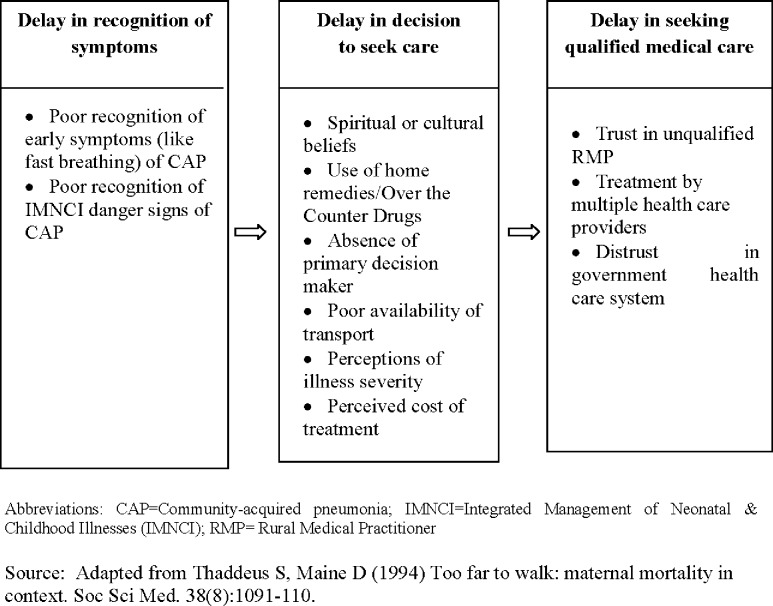
To identify predisposing, enabling and service-related factors influencing treatment delay for CAP in rural communities of two states in India. Factors investigated included recognition of danger signs of CAP, health care decision making, self-medication, treatment and referral by local practitioners, and perceptions about quality of care.
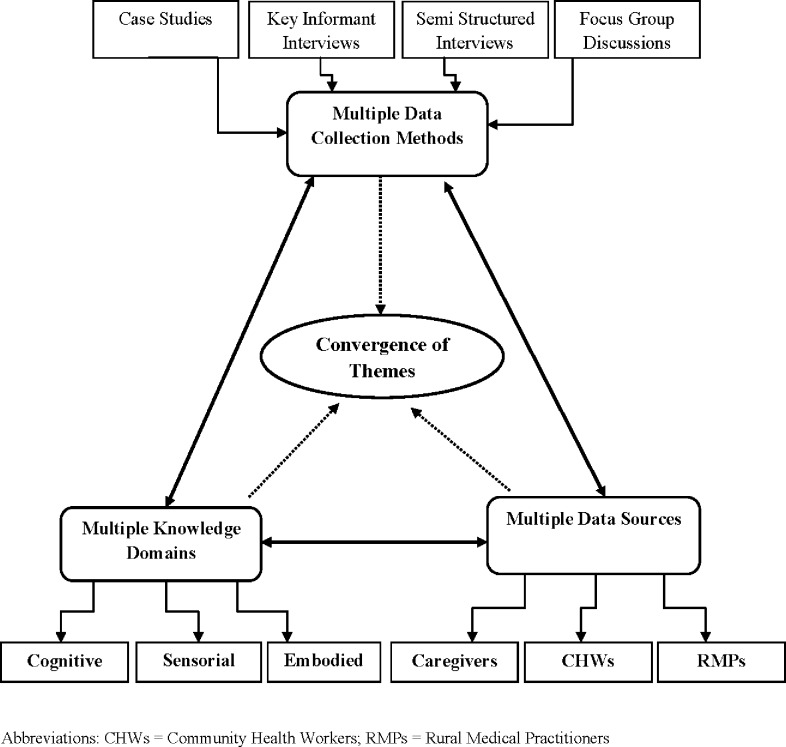
Qualitative research employing case studies (CS) of care-seeking, key informant interviews (KII), semi-structured interviews (SSI) and focus group discussions (FGD) with both video presentations of CAP signs, and case scenarios. Interviews and FGDs were conducted with parents of under-five children who had suffered CAP, community health workers (CHW), and rural medical practitioners (RMP).
From September 2013 to January 2014, 30 CS, 43 KIIs, 42 SSIs, and 42 FGDs were conducted. Recognition of danger signs of CAP among caregivers was poor. Fast breathing, an early sign of CAP, was not commonly recognized. Chest in-drawing was recognized as a sign of serious illness, but not commonly monitored by removing a child's clothing. Most cases of mild to moderate CAP were brought to RMP, and more severe cases taken to private clinics in towns. Mothers consulted local RMP directly, but decisions to visit doctors outside the village required consultation with husband or mother-in-law. By the time most cases reached a public tertiary-care hospital, children had been ill for a week and treated by 2-3 providers. Quality of care at government facilities was deemed poor by caregivers.
To reduce CAP-associated mortality, recognition of its danger signs and the consequences of treatment delay needed to be better recognized by caregivers, and confidence in government facilities increased. The involvement of RMP in community based CAP programs needs to be investigated further given their widespread popularity.
社区获得性肺炎(CAP)是全球五岁以下儿童死亡的主要原因,近四分之一的死亡发生在印度。
确定影响印度两个邦农村社区CAP治疗延迟的诱发因素、促进因素和服务相关因素。调查的因素包括对CAP危险体征的识别、医疗保健决策、自我用药、当地从业者的治疗和转诊,以及对医疗质量的看法。
采用定性研究方法,通过对寻求治疗的案例研究(CS)、关键信息访谈(KII)、半结构化访谈(SSI)以及焦点小组讨论(FGD),同时展示CAP体征的视频和案例场景。对患有CAP的五岁以下儿童的父母、社区卫生工作者(CHW)和农村医生(RMP)进行访谈和FGD。
2013年9月至2014年1月,进行了30次案例研究、43次关键信息访谈、42次半结构化访谈和42次焦点小组讨论。照顾者对CAP危险体征的识别较差。快速呼吸作为CAP的早期体征,并未得到普遍认可。胸凹陷被认为是重病的体征,但通常不会通过脱掉孩子衣服来进行监测。大多数轻度至中度CAP病例被带到农村医生处,更严重的病例则被送往城镇的私人诊所。母亲们直接咨询当地农村医生,但决定去村外看医生需要与丈夫或婆婆商量。大多数病例到达公立三级医院时,孩子已经患病一周,并且已经接受了2至3名医疗服务提供者的治疗。照顾者认为政府机构的医疗质量较差。
为降低与CAP相关的死亡率,照顾者需要更好地认识其危险体征以及治疗延迟的后果,并增强对政府机构的信心。鉴于农村医生广受欢迎,需要进一步调查他们参与基于社区的CAP项目的情况。