Department of Vector Biology, Liverpool School of Tropical Medicine, Liverpool, UK.
IRSS/Centre Muraz, BP 390 Bobo-Dioulasso, Burkina Faso, Africa.
Heredity (Edinb). 2015 Sep;115(3):243-52. doi: 10.1038/hdy.2015.33. Epub 2015 Apr 22.
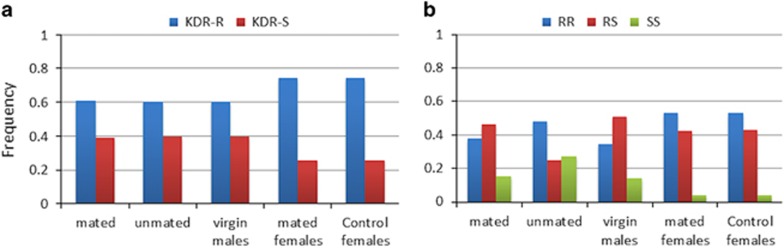
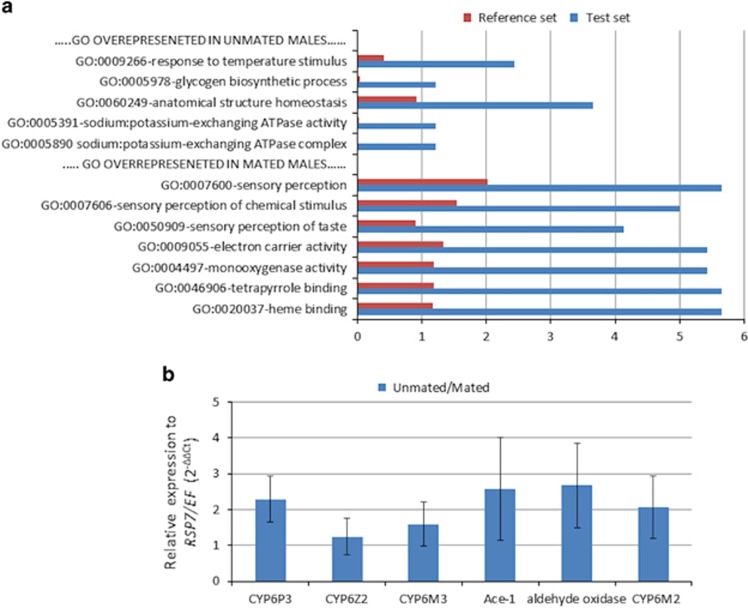
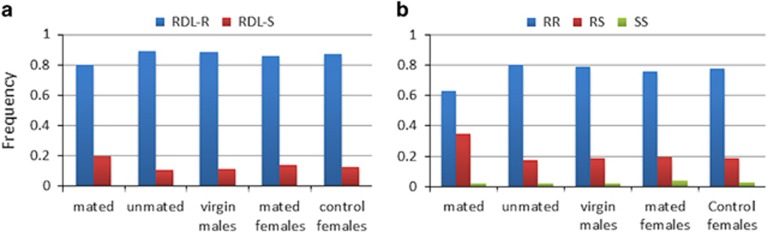
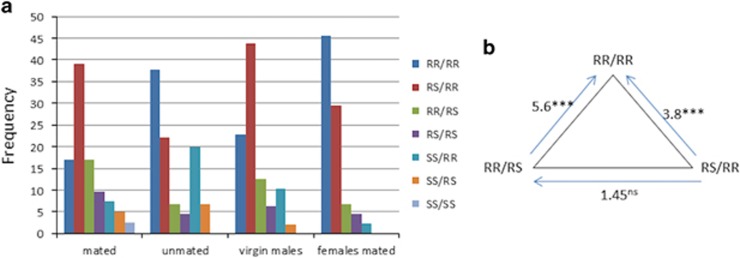
The implementation of successful insecticide resistance management strategies for malaria control is currently hampered by poor understanding of the fitness cost of resistance on mosquito populations, including their mating competiveness. To fill this knowledge gap, coupled and uncoupled Anopheles gambiae s.l. males (all M form (Anopheles coluzzii)) were collected from mating swarms in Burkina Faso. This multiple insecticide resistant population exhibited high 1014F kdr(R) allele frequencies (>60%) and RDL(R) (>80%) in contrast to the Ace-1(R) allele (<6%). Kdr heterozygote males were more likely to mate than homozygote resistant (OR=2.36; P<0.001), suggesting a negative impact of kdr on An. coluzzii mating ability. Interestingly, heterozygote males were also more competitive than homozygote susceptible (OR=3.26; P=0.006), suggesting a heterozygote advantage effect. Similarly, heterozygote RDL(R)/RDL(S) were also more likely to mate than homozygote-resistant males (OR=2.58; P=0.007). Furthermore, an additive mating disadvantage was detected in male homozygotes for both kdr/RDL-resistant alleles. In contrast, no fitness difference was observed for the Ace-1 mutation. Comparative microarray-based genome-wide transcription analysis revealed that metabolic resistance did not significantly alter the mating competitiveness of male An. coluzzii mosquitoes. Indeed, no significant difference of expression levels was observed for the main metabolic resistance genes, suggesting that metabolic resistance has a limited impact on male mating competiveness. In addition, specific gene classes/GO terms associated with mating process were detected including sensory perception and peroxidase activity. The detrimental impact of insecticide resistance on mating competiveness observed here suggests that resistance management strategies such as insecticide rotation could help reverse the resistance, if implemented early.
成功实施杀虫剂耐药管理策略来控制疟疾目前受到阻碍,原因是对蚊子种群的耐药代价(包括交配竞争力)缺乏了解。为了填补这一知识空白,从布基纳法索的交配群中收集了耦合和非耦合的冈比亚按蚊亚种(均为 M 型(冈比亚按蚊))雄蚊。与 Ace-1(R) 等位基因(<6%)相比,该多药耐药种群的 1014F kdr(R) 等位基因频率(>60%)和 RDL(R)(>80%)较高。Kdr 杂合子雄蚊比纯合耐药雄蚊更有可能交配(OR=2.36;P<0.001),这表明 kdr 对冈比亚按蚊交配能力有负面影响。有趣的是,杂合子雄蚊也比纯合敏感雄蚊更具竞争力(OR=3.26;P=0.006),这表明存在杂合子优势效应。同样,杂合子 RDL(R)/RDL(S) 比纯合耐药雄蚊更有可能交配(OR=2.58;P=0.007)。此外,在 kdr/RDL 双耐药等位基因的雄蚊纯合子中检测到了交配的附加劣势。相比之下,Ace-1 突变没有观察到适合度差异。基于比较微阵列的全基因组转录分析表明,代谢耐药并未显著改变雄性冈比亚按蚊的交配竞争力。事实上,主要代谢耐药基因的表达水平没有显著差异,这表明代谢耐药对雄性交配竞争力的影响有限。此外,还检测到与交配过程相关的特定基因类别/GO 术语,包括感觉感知和过氧化物酶活性。这里观察到的杀虫剂耐药对交配竞争力的不利影响表明,如果及早实施,如杀虫剂轮换等耐药管理策略可能有助于逆转耐药性。