Wallings Rebecca, Manzoni Claudia, Bandopadhyay Rina
Reta Lila Weston Institute of Neurological Studies and Department of Molecular Neuroscience, UCL Institute of Neurology, London, UK.
School of Pharmacy, University of Reading, UK.
FEBS J. 2015 Aug;282(15):2806-26. doi: 10.1111/febs.13305. Epub 2015 May 9.
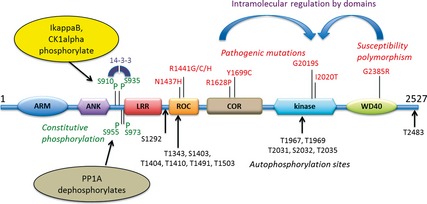
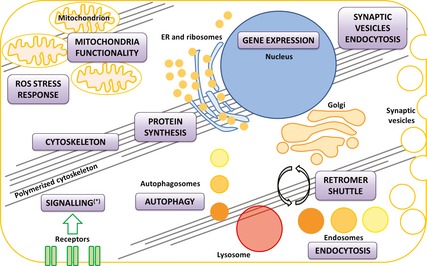
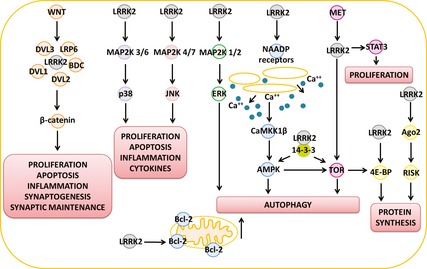
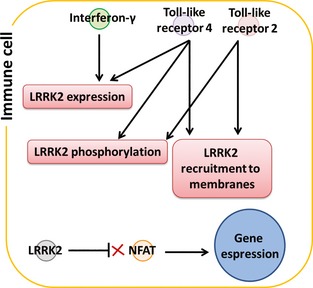
Mutations in the leucine-rich repeat kinase 2 (LRRK2)-encoding gene are the most common cause of monogenic Parkinson's disease. The identification of LRRK2 polymorphisms associated with increased risk for sporadic Parkinson's disease, as well as the observation that LRRK2-Parkinson's disease has a pathological phenotype that is almost indistinguishable from the sporadic form of disease, suggested LRRK2 as the culprit to provide understanding for both familial and sporadic Parkinson's disease cases. LRRK2 is a large protein with both GTPase and kinase functions. Mutations segregating with Parkinson's disease reside within the enzymatic core of LRRK2, suggesting that modification of its activity impacts greatly on disease onset and progression. Although progress has been made since its discovery in 2004, there is still much to be understood regarding LRRK2's physiological and neurotoxic properties. Unsurprisingly, given the presence of multiple enzymatic domains, LRRK2 has been associated with a diverse set of cellular functions and signalling pathways including mitochondrial function, vesicle trafficking together with endocytosis, retromer complex modulation and autophagy. This review discusses the state of current knowledge on the role of LRRK2 in health and disease with discussion of potential substrates of phosphorylation and functional partners with particular emphasis on signalling mechanisms. In addition, the use of immune cells in LRRK2 research and the role of oxidative stress as a regulator of LRRK2 activity and cellular function are also discussed.
富含亮氨酸重复激酶2(LRRK2)编码基因的突变是单基因帕金森病最常见的病因。与散发型帕金森病风险增加相关的LRRK2多态性的鉴定,以及LRRK2型帕金森病具有几乎与散发性疾病形式无法区分的病理表型这一观察结果,表明LRRK2是导致家族性和散发性帕金森病病例的罪魁祸首。LRRK2是一种具有GTP酶和激酶功能的大型蛋白质。与帕金森病相关的突变位于LRRK2的酶核心内,这表明其活性的改变对疾病的发生和进展有很大影响。尽管自2004年发现以来已取得进展,但关于LRRK2的生理和神经毒性特性仍有许多需要了解的地方。不出所料,鉴于存在多个酶结构域,LRRK2与多种细胞功能和信号通路相关,包括线粒体功能、囊泡运输以及内吞作用、retromer复合物调节和自噬。本综述讨论了关于LRRK2在健康和疾病中的作用的当前知识状态,讨论了潜在的磷酸化底物和功能伙伴,特别强调了信号机制。此外,还讨论了免疫细胞在LRRK2研究中的应用以及氧化应激作为LRRK2活性和细胞功能调节剂的作用。