Solari Alessandra, Giordano Andrea, Grasso Maria Grazia, Confalonieri Paolo, Patti Francesco, Lugaresi Alessandra, Palmisano Lucia, Amadeo Roberta, Martino Giovanni, Ponzio Michela, Casale Giuseppe, Borreani Claudia, Causarano Renzo, Veronese Simone, Zaratin Paola, Battaglia Mario Alberto
Unit of Neuroepidemiology, Foundation IRCCS Neurological Institute C. Besta, Via Celoria 11, 20133, Milan, Italy.
Multiple Sclerosis Unit, Foundation IRCCS S. Lucia Rehabilitation Hospital, Via Ardeatina 306, 00179, Rome, Italy.
Trials. 2015 Apr 23;16:184. doi: 10.1186/s13063-015-0695-0.
Preliminary evidence suggests that palliative care may be useful for people with severe multiple sclerosis (MS). The aim of this study is to determine the effectiveness of a home-based palliative approach (HPA) for people with severe MS and their carers.
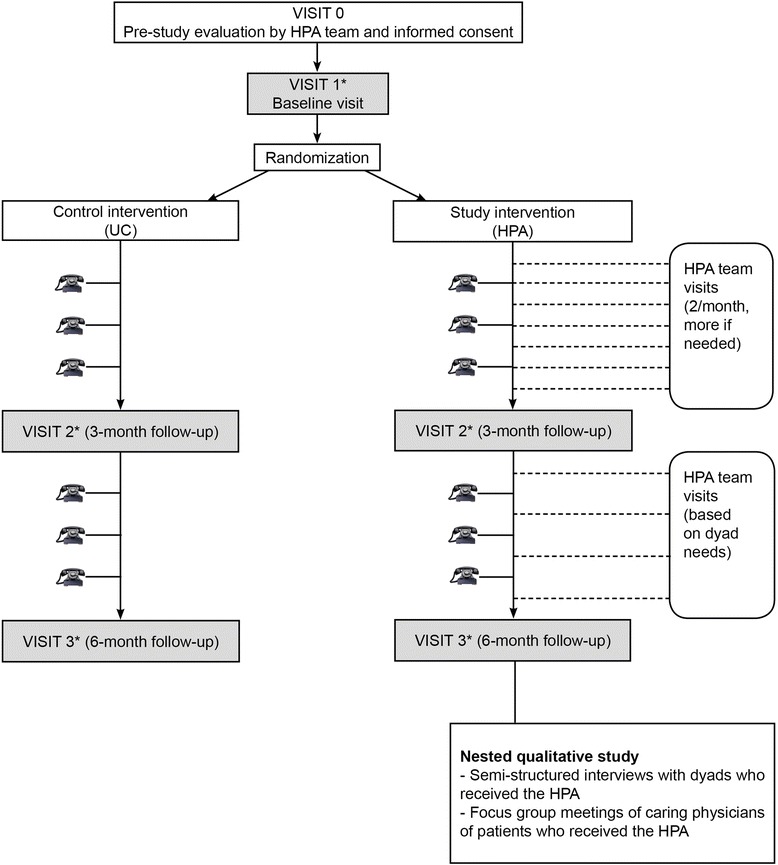
METHODS/DESIGN: This is a single-blind randomized controlled trial with a nested qualitative study. Seventy-five severe MS-carer dyads are being randomized (at three centers, one in each area of Italy) to HPA or usual care (UC) in a 2:1 ratio. Each center has a specially trained team consisting of four professionals (physician, nurse, psychologist, social worker). The team makes a comprehensive assessment of the needs of the dyads. HPA content is then agreed on, discussed with the patient's caring physician, and delivered over six months. The intervention is not intended to replace existing services. At later visits, the team checks the HPA delivery and reviews/modifies it as necessary. HPA and UC dyads are assessed at home by a blind examiner at baseline, and three and six months later; they also receive monthly telephone interviews. Dyads assigned to UC receive the examiner's visits and telephone interviews, but not the team visits. Primary outcome measures are changes in symptoms (Palliative care Outcome Scale-Symptoms-MS, POS-S-MS), and quality of life (the Schedule for the Evaluation of Individual Quality of Life-Direct Weighting (SEIQoL-DW), not assessed in patients with severe cognitive compromise) at three and six months. Other outcomes are changes in patient functional status and mood; changes in carer quality of life, mood and caregiving burden; costs; incorporation with standard care; unplanned hospital admissions; referrals to hospice; and deaths. The experience of participants will be evaluated qualitatively by individual semi-structured interviews (HPA patients and carers) and focus group meetings (HPA patients' caring physicians).
The results of our study will show whether the HPA is feasible and beneficial to people with severe MS and their carers living in the three Italian geographic areas. The nested qualitative study will add to the understanding of the strengths and limitations of the intervention.
The trial was registered with Current Controlled Trials (identifier: ISRCTN73082124) on 19 June 2014.
初步证据表明,姑息治疗可能对重度多发性硬化症(MS)患者有用。本研究的目的是确定居家姑息治疗方法(HPA)对重度MS患者及其照料者的有效性。
方法/设计:这是一项带有嵌套定性研究的单盲随机对照试验。75对重度MS患者-照料者二元组(在意大利的三个中心,每个地区一个)按2:1的比例随机分为接受HPA或常规护理(UC)。每个中心都有一个由四名专业人员(医生、护士、心理学家、社会工作者)组成的经过专门培训的团队。该团队对二元组的需求进行全面评估。然后确定HPA的内容,与患者的照料医生进行讨论,并在六个月内实施。该干预并非旨在取代现有服务。在后续访视中,团队检查HPA的实施情况,并根据需要进行审查/修改。HPA组和UC组的二元组在基线、三个月和六个月时由一名盲法检查者在家中进行评估;他们还每月接受电话访谈。分配到UC组的二元组接受检查者的访视和电话访谈,但不接受团队访视。主要结局指标是三个月和六个月时症状的变化(姑息治疗结局量表-症状-MS,POS-S-MS)以及生活质量(个体生活质量评估量表-直接加权法(SEIQoL-DW),重度认知功能损害患者不进行评估)。其他结局包括患者功能状态和情绪的变化;照料者生活质量、情绪和照料负担的变化;成本;与标准护理的整合;非计划住院;转诊至临终关怀机构;以及死亡情况。将通过个体半结构式访谈(HPA患者和照料者)和焦点小组会议(HPA患者的照料医生)对参与者的体验进行定性评估。
我们研究的结果将表明HPA对生活在意大利三个地理区域的重度MS患者及其照料者是否可行且有益。嵌套定性研究将增进对该干预措施优缺点的理解。
该试验于2014年6月19日在当前对照试验注册库(标识符:ISRCTN73082124)注册。