Unit of Neuroepidemiology, Fondazione IRCCS Istituto Neurologico Carlo Besta, Milan, Italy.
Department of Psychology, University of Turin, Turin, Italy.
J Palliat Med. 2020 Nov;23(11):1426-1443. doi: 10.1089/jpm.2020.0220. Epub 2020 May 29.
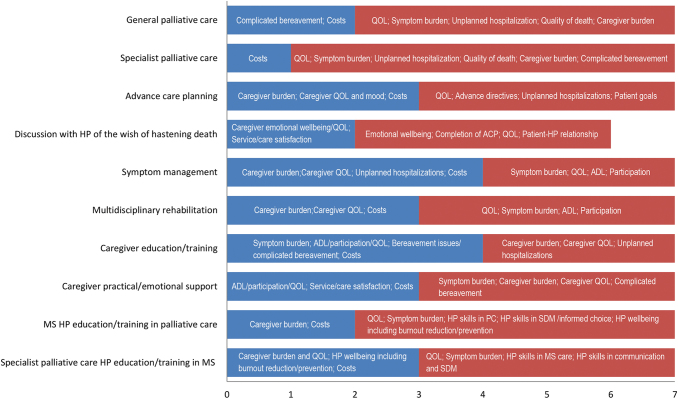
Patients with severe, progressive multiple sclerosis (MS) have complex physical and psychosocial needs, typically over several years. Few treatment options are available to prevent or delay further clinical worsening in this population. The objective was to develop an evidence-based clinical practice guideline for the palliative care of patients with severe, progressive MS. This guideline was developed using the Grading of Recommendations Assessment, Development and Evaluation methodology. Formulation of the clinical questions was performed in the Patients-Intervention-Comparator-Outcome format, involving patients, carers and healthcare professionals (HPs). No uniform definition of severe MS exists: in this guideline, constant bilateral support required to walk 20 m without resting (Expanded Disability Status Scale score >6.0) or higher disability is referred to. When evidence was lacking for this population, recommendations were formulated using indirect evidence or good practice statements were devised. Ten clinical questions were formulated. They encompassed general and specialist palliative care, advance care planning, discussing with HPs the patient's wish to hasten death, symptom management, multidisciplinary rehabilitation, interventions for caregivers and interventions for HPs. A total of 34 recommendations (33 weak, 1 strong) and seven good practice statements were devised. The provision of home-based palliative care (either general or specialist) is recommended with weak strength for patients with severe, progressive MS. Further research on the integration of palliative care and MS care is needed. Areas that currently lack evidence of efficacy in this population include advance care planning, the management of symptoms such as fatigue and mood problems, and interventions for caregivers and HPs.
患有严重、进行性多发性硬化症(MS)的患者存在复杂的身体和心理社会需求,通常持续数年。在这一人群中,可用于预防或延缓进一步临床恶化的治疗选择很少。本研究旨在制定严重、进行性多发性硬化症患者姑息治疗的循证临床实践指南。 本指南使用推荐评估、制定和评估(Grading of Recommendations Assessment, Development and Evaluation)方法制定。临床问题的制定采用患者-干预-比较-结果(Patients-Intervention-Comparator-Outcome)格式,涉及患者、照顾者和医疗保健专业人员(HPs)。目前,严重 MS 尚无统一的定义:本指南中,需要双侧支撑才能在不休息的情况下行走 20 米(扩展残疾状态量表评分>6.0)或更高残疾程度被认为是严重 MS。当针对这一人群缺乏证据时,使用间接证据制定建议或制定良好实践声明。 共提出了 10 个临床问题。它们涵盖了一般和专业姑息治疗、预先护理计划、与 HPs 讨论患者希望加速死亡、症状管理、多学科康复、照顾者干预和 HPs 干预。共制定了 34 项建议(33 项弱,1 项强)和 7 项良好实践声明。 建议为患有严重、进行性多发性硬化症的患者提供家庭姑息治疗(无论是一般还是专业),其强度较弱。需要进一步研究姑息治疗和多发性硬化症护理的整合。目前在这一人群中缺乏疗效证据的领域包括预先护理计划、疲劳和情绪问题等症状的管理,以及照顾者和 HPs 的干预。