Li Xuan, Yang Yuechao, Gao Bin, Zhang Min
National Engineering Laboratory for Efficient Utilization of Soil & Fertilizer Resources, National Engineering & Technology Research Center for Slow & Controlled Release Fertilizers, College of Resources and Environment, Shandong Agricultural University, Taian, Shandong 271018, China.
National Engineering Laboratory for Efficient Utilization of Soil & Fertilizer Resources, National Engineering & Technology Research Center for Slow & Controlled Release Fertilizers, College of Resources and Environment, Shandong Agricultural University, Taian, Shandong 271018, China; Department of Soil and Water Science, Tropical Research and Education Center, University of Florida, Homestead, Florida, United States of America.
PLoS One. 2015 Apr 22;10(4):e0122884. doi: 10.1371/journal.pone.0122884. eCollection 2015.
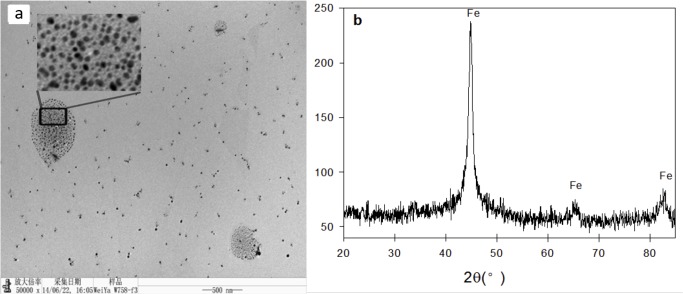
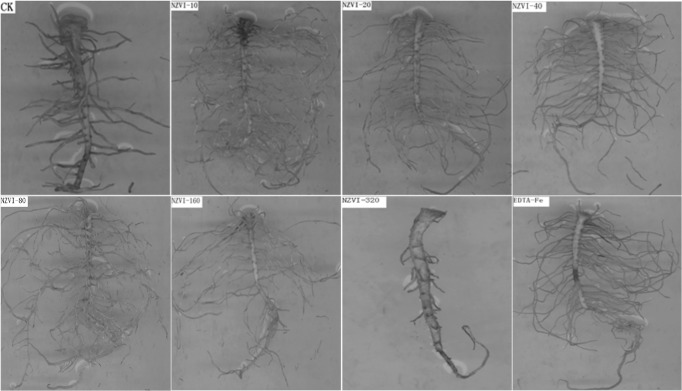
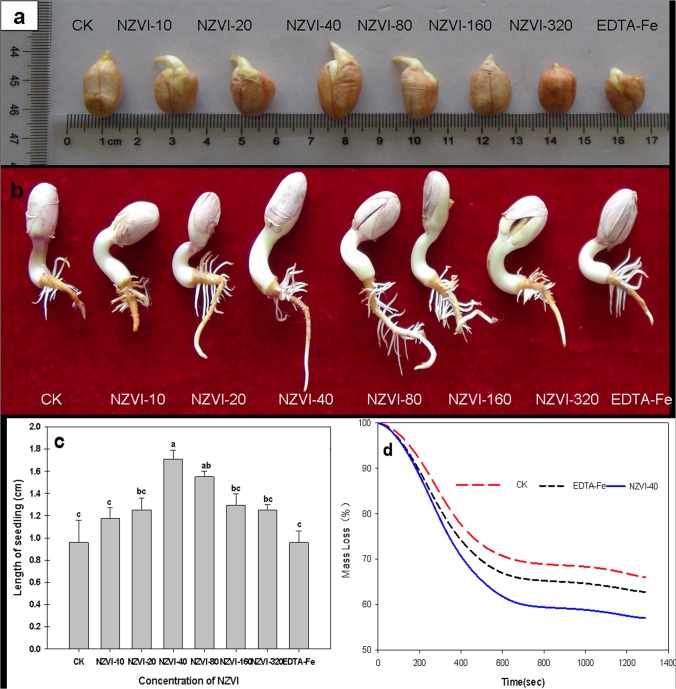
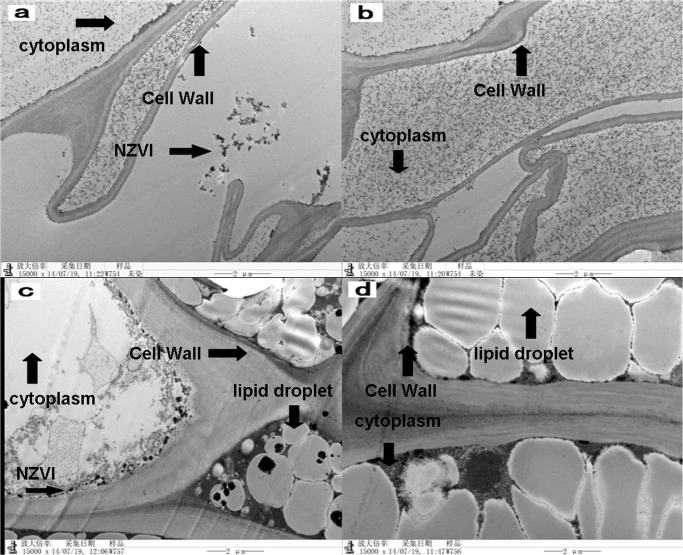
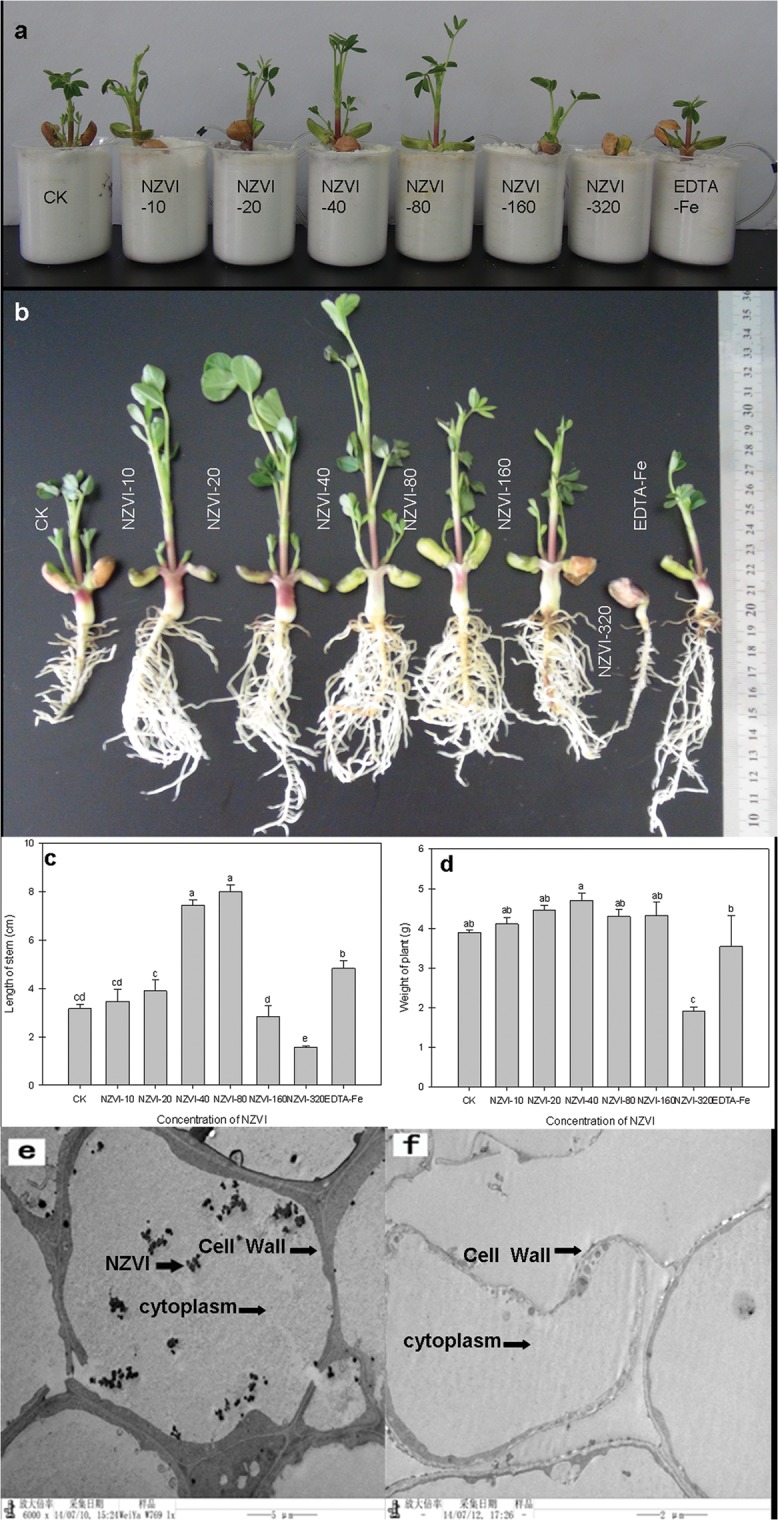
Because of its strong pollutant degradation ability, nanoscale zerovalent iron (NZVI) has been introduced to soils and groundwater for remediation purposes, but its impacts on plants are still not very clear. In this work, the effects of low concentration (10-320 μmol/L) NZVI particles on seed germination and growth of peanut plants were evaluated. The exposure of peanut seeds to NZVI at all the tested concentrations altered the seed germination activity, especially the development of seedlings. In comparison with the deionized water treated controls (CK), all of the NZVI treatments had significantly larger average lengths. Further investigations with transmission electron microscopy (TEM) and thermogravimetric analysis (TGA) suggested that NZVI particles may penetrate the peanut seed coats to increase the water uptake to stimulate seed germination. The growth experiments showed that although NZVI at a relatively high concentration (320 μmol/L) showed phytotoxicity to the peanut plants, the lower concentrations of NZVI particles stimulated the growth and root development of the plants. At certain concentrations (e.g., 40 and 80 μmol/L), the NZVI treated samples were even better than the ethylenediaminetetraacetate-iron (EDTA-Fe) solution, a commonly used iron nutrient solution, in stimulating the plant growth. This positive effect was probably due to the uptake of NZVI by the plants, as indicated in the TEM analyses. Because low concentrations of NZVI particles stimulated both the seedling development and growth of peanut, they might be used to benefit the growth of peanuts in large-scale agricultural settings.
由于其强大的污染物降解能力,纳米零价铁(NZVI)已被引入土壤和地下水用于修复目的,但其对植物的影响仍不太清楚。在这项工作中,评估了低浓度(10 - 320 μmol/L)NZVI颗粒对花生种子萌发和植株生长的影响。在所有测试浓度下,将花生种子暴露于NZVI会改变种子萌发活性,尤其是幼苗的发育。与去离子水处理的对照(CK)相比,所有NZVI处理的平均长度都显著更长。通过透射电子显微镜(TEM)和热重分析(TGA)的进一步研究表明,NZVI颗粒可能穿透花生种皮以增加水分吸收来刺激种子萌发。生长实验表明,尽管相对高浓度(320 μmol/L)的NZVI对花生植株表现出植物毒性,但较低浓度的NZVI颗粒刺激了植株的生长和根系发育。在某些浓度(例如40和80 μmol/L)下,NZVI处理的样品在刺激植物生长方面甚至优于常用的铁营养溶液乙二胺四乙酸铁(EDTA - Fe)溶液。如TEM分析所示,这种积极作用可能是由于植物对NZVI的吸收。由于低浓度的NZVI颗粒刺激了花生的幼苗发育和生长,它们可能用于大规模农业环境中促进花生生长。