Wolff Wanja, Schindler Sebastian, Brand Ralf
Division of Sport and Exercise Psychology, University Potsdam, Potsdam, Germany.
Department of Psychology, University of Bielefeld, Bielefeld, Germany; Center of Excellence Cognitive Interaction Technology (CITEC), University of Bielefeld, Bielefeld, Germany.
PLoS One. 2015 Apr 22;10(4):e0118507. doi: 10.1371/journal.pone.0118507. eCollection 2015.
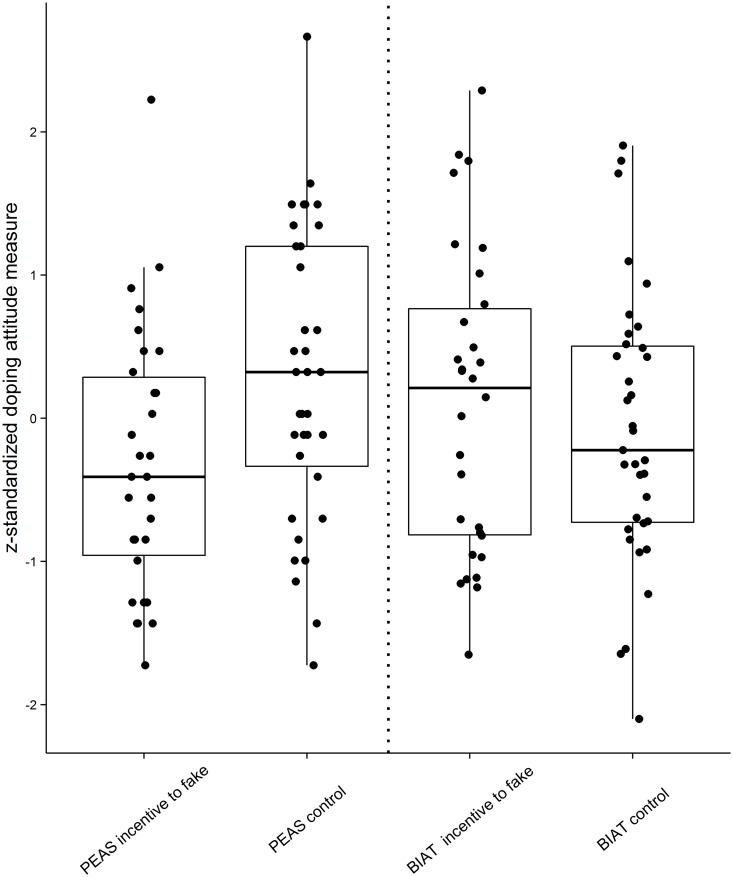
The Implicit Association Test (IAT) aims to measure participants' automatic evaluation of an attitude object and is useful especially for the measurement of attitudes related to socially sensitive subjects, e.g. doping in sports. Several studies indicate that IAT scores can be faked on instruction. But fully or semi-instructed research scenarios might not properly reflect what happens in more realistic situations, when participants secretly decide to try faking the test. The present study is the first to investigate IAT faking when there is only an implicit incentive to do so. Sixty-five athletes (22.83 years ± 2.45; 25 women) were randomly assigned to an incentive-to-fake condition or a control condition. Participants in the incentive-to-fake condition were manipulated to believe that athletes with lenient doping attitudes would be referred to a tedious 45-minute anti-doping program. Attitudes were measured with the pictorial doping brief IAT (BIAT) and with the Performance Enhancement Attitude Scale (PEAS). A one-way MANOVA revealed significant differences between conditions after the manipulation in PEAS scores, but not in the doping BIAT. In the light of our hypothesis this suggests that participants successfully faked an exceedingly negative attitude to doping when completing the PEAS, but were unsuccessful in doing so on the reaction time-based test. This study assessed BIAT faking in a setting that aimed to resemble a situation in which participants want to hide their attempts to cheat. The two measures of attitude were differentially affected by the implicit incentive. Our findings provide evidence that the pictorial doping BIAT is relatively robust against spontaneous and naïve faking attempts. (B)IATs might be less prone to faking than implied by previous studies.
内隐联想测验(IAT)旨在测量参与者对态度对象的自动评价,尤其适用于测量与社会敏感主题相关的态度,例如体育界的兴奋剂问题。多项研究表明,IAT分数可以根据指令伪造。但完全或半指导性的研究场景可能无法恰当地反映在更现实的情况下会发生什么,即参与者暗自决定尝试伪造测试结果。本研究首次调查了在只有隐性动机的情况下IAT伪造的情况。65名运动员(年龄22.83岁±2.45;25名女性)被随机分配到伪造激励组或对照组。伪造激励组的参与者被操纵,使其相信对兴奋剂态度宽松的运动员将被送去参加一个长达45分钟的冗长的反兴奋剂项目。使用图片兴奋剂简要内隐联想测验(BIAT)和成绩提高态度量表(PEAS)来测量态度。单因素多变量方差分析显示,操纵后PEAS分数在不同组间存在显著差异,但在兴奋剂BIAT中没有。根据我们的假设,这表明参与者在完成PEAS时成功伪造了对兴奋剂极其负面的态度,但在基于反应时间的测试中未能成功。本研究在一个旨在模拟参与者试图隐藏作弊行为的情境中评估了BIAT伪造情况。两种态度测量方法受到隐性激励的影响不同。我们的研究结果表明,图片兴奋剂BIAT相对不易受到自发和幼稚的伪造企图的影响。(B)IAT可能比先前研究所暗示的更不易被伪造。