School of Life Sciences, Kingston University London, Kingston upon Thames, Surrey, United Kingdom.
PLoS One. 2011 Apr 26;6(4):e18804. doi: 10.1371/journal.pone.0018804.
Social psychology research on doping and outcome based evaluation of primary anti-doping prevention and intervention programmes have been dominated by self-reports. Having confidence in the validity and reliability of such data is vital.
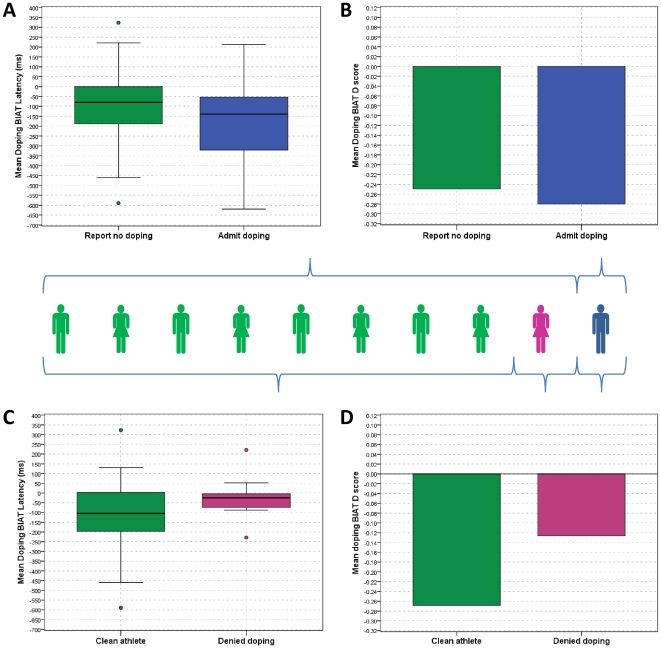
METHODOLOGY/PRINCIPAL FINDINGS: The sample of 82 athletes from 30 sports (52.4% female, mean age: 21.48±2.86 years) was split into quasi-experimental groups based on i) self-admitted previous experience with prohibited performance enhancing drugs (PED) and ii) the presence of at least one prohibited PED in hair covering up to 6 months prior to data collection. Participants responded to questionnaires assessing a range of social cognitive determinants of doping via self-reports; and completed a modified version of the Brief Implicit Association Test (BIAT) assessing implicit attitudes to doping relative to the acceptable nutritional supplements (NS). Social projection regarding NS was used as control. PEDs were detected in hair samples from 10 athletes (12% prevalence), none of whom admitted doping use. This group of 'deniers' was characterised by a dissociation between explicit (verbal declarations) and implicit (BIAT) responding, while convergence was observed in the 'clean' athlete group. This dissociation, if replicated, may act as a cognitive marker of the denier group, with promising applications of the combined explicit-implicit cognitive protocol as a proxy in lieu of biochemical detection methods in social science research. Overall, discrepancies in the relationship between declared doping-related opinion and implicit doping attitudes were observed between the groups, with control measures remaining unaffected. Questionnaire responses showed a pattern consistent with self-reported doping use.
CONCLUSIONS/SIGNIFICANCE: Following our preliminary work, this study provides further evidence that both self-reports on behaviour and social cognitive measures could be affected by some form of response bias. This can question the validity of self-reports, with reliability remaining unaffected. Triangulation of various assessment methods is recommended.
在兴奋剂和基于结果的主要反兴奋剂预防和干预计划的社会心理学研究中,一直以自我报告为主。对这些数据的有效性和可靠性有信心是至关重要的。
方法/主要发现:本研究的样本包括来自 30 项运动的 82 名运动员(52.4%为女性,平均年龄:21.48±2.86 岁),根据以下两种情况将其分为准实验组:i)自我承认之前使用过禁用的提高运动成绩的药物(PED),ii)在数据收集前 6 个月内,头发中至少有一个禁用的 PED。参与者通过自我报告回答了一系列与兴奋剂有关的社会认知决定因素的问卷;并完成了改良版的Brief Implicit Association Test(BIAT),该测试评估了相对于可接受的营养补充剂(NS)的对兴奋剂的内隐态度。将对 NS 的社会预测作为对照。在 10 名运动员(12%的患病率)的头发样本中检测到 PED,但他们都没有承认使用过兴奋剂。这群“否认者”的特点是外显(口头声明)和内隐(BIAT)反应之间存在差异,而“干净”运动员组则存在一致性。如果这种差异得到复制,它可能成为否认者群体的认知标志物,将外显-内隐认知协议的组合作为生物化学检测方法的替代物,在社会科学研究中具有广阔的应用前景。总体而言,两组之间观察到了与宣布的与兴奋剂相关的意见和内隐的兴奋剂态度之间的关系存在差异,而对照措施不受影响。问卷回答显示出与自我报告的兴奋剂使用一致的模式。
结论/意义:在我们的初步工作之后,本研究进一步证明,行为的自我报告和社会认知测量都可能受到某种形式的反应偏差的影响。这可能会对自我报告的有效性提出质疑,而可靠性不受影响。建议对各种评估方法进行三角测量。