Desmond Matthew J, Pritchard Daniel W, Hepburn Christopher D
Department of Marine Science, University of Otago, Dunedin, New Zealand.
PLoS One. 2015 Apr 22;10(4):e0123676. doi: 10.1371/journal.pone.0123676. eCollection 2015.
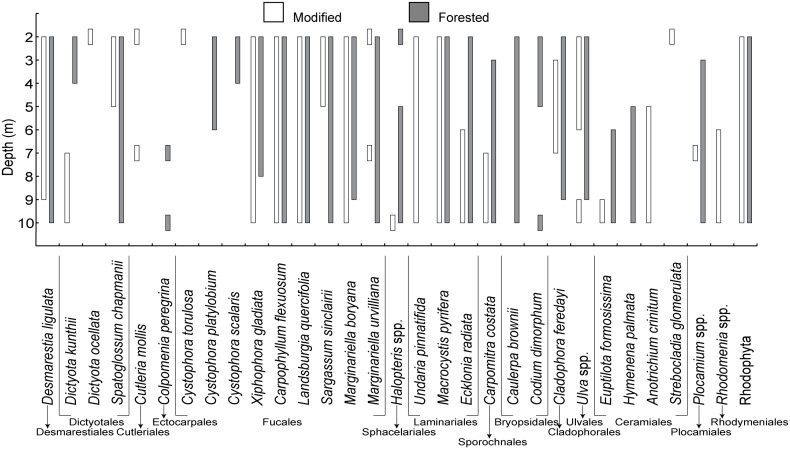
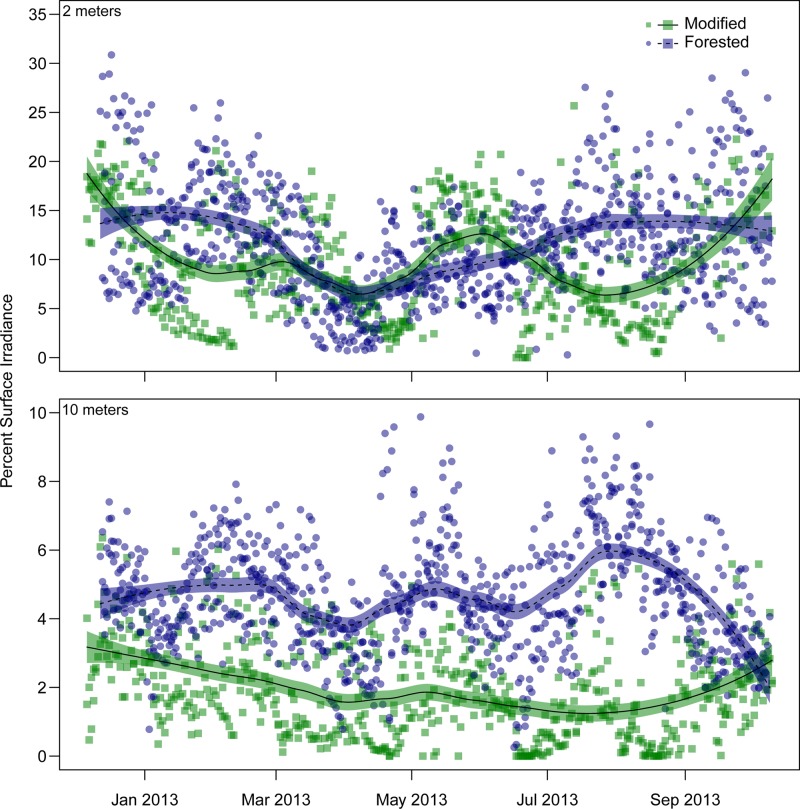
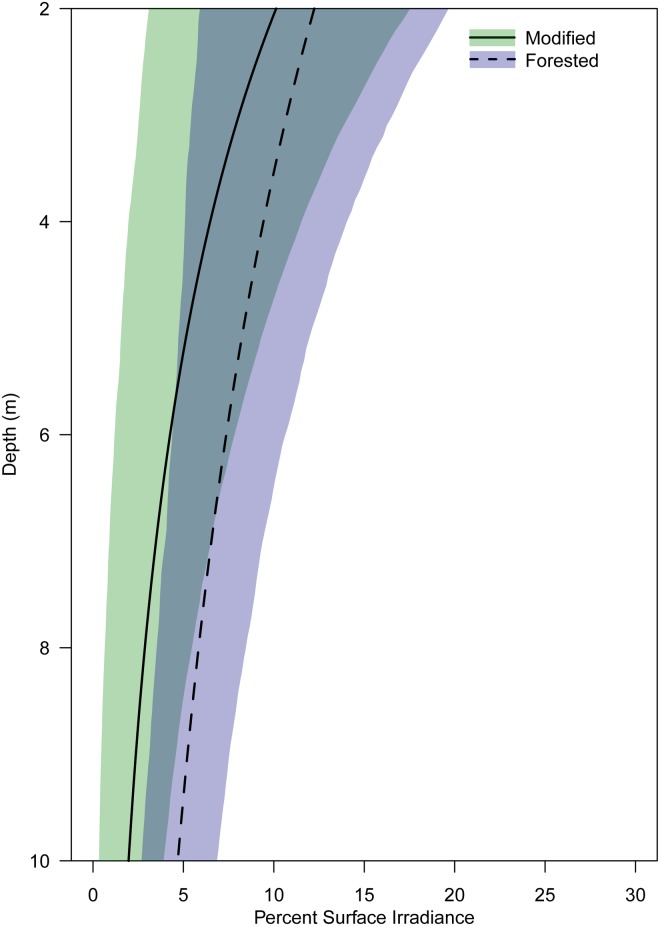
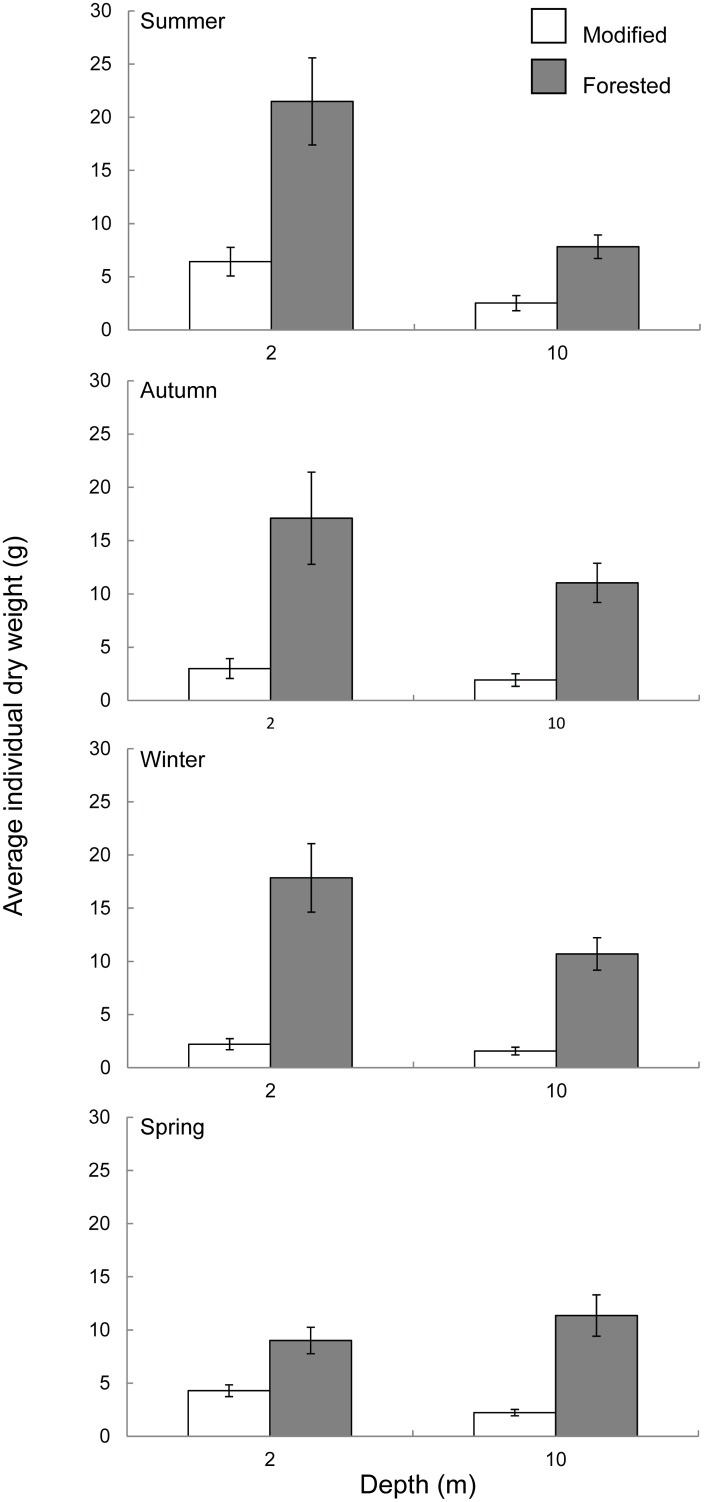
Light is the fundamental driver of primary productivity in the marine environment. Reduced light availability has the potential to alter the distribution, community composition, and productivity of key benthic primary producers, potentially reducing habitat and energy provision to coastal food webs. We compared the underwater light environment of macroalgal dominated shallow subtidal rocky reef habitats on a coastline modified by human activities with a coastline of forested catchments. Key metrics describing the availability of photosynthetically active radiation (PAR) were determined over 295 days and were related to macroalgal depth distribution, community composition, and standing biomass patterns, which were recorded seasonally. Light attenuation was more than twice as high in shallow subtidal zones along the modified coast. Macroalgal biomass was 2-5 times greater within forested sites, and even in shallow water (2m) a significant difference in biomass was observed. Long-term light dose provided the best explanation for differences in observed biomass between modified and forested coasts, with light availability over the study period differing by 60 and 90 mol photons m-2 at 2 and 10 metres, respectively. Higher biomass on the forested coast was driven by the presence of larger individuals rather than species diversity or density. This study suggests that commonly used metrics such as species diversity and density are not as sensitive as direct measures of biomass when detecting the effects of light limitation within macroalgal communities.
光是海洋环境中初级生产力的基本驱动因素。光照可用性的降低有可能改变关键底栖初级生产者的分布、群落组成和生产力,从而可能减少为沿海食物网提供的栖息地和能量。我们将受人类活动影响的海岸线上大型藻类主导的浅潮下带岩石礁栖息地的水下光照环境与森林集水区的海岸线进行了比较。在295天的时间里测定了描述光合有效辐射(PAR)可用性的关键指标,并将其与大型藻类的深度分布、群落组成和现存生物量模式相关联,这些数据是季节性记录的。在受影响海岸的浅潮下带区域,光衰减程度是原来的两倍多。森林区域内的大型藻类生物量是其他区域的2至5倍,甚至在浅水区(2米)也观察到了生物量的显著差异。长期光剂量最能解释受影响海岸和森林海岸之间观察到的生物量差异,在研究期间,2米和10米深处的光照可用性分别相差60和90摩尔光子/平方米。森林海岸较高的生物量是由较大个体的存在驱动的,而不是物种多样性或密度。这项研究表明,在检测大型藻类群落内光限制的影响时,常用的指标如物种多样性和密度不如生物量的直接测量敏感。