Garner Michael J, Carson Carolee, Lingohr Erika J, Fazil Aamir, Edge Victoria L, Trumble Waddell Jan
Population Health Assessment and Scenarios Team, Public Health Agency of Canada, Ottawa, Ontario, Canada.
Laboratory for Foodborne Zoonoses, Public Health Agency of Canada, Guelph, Ontario, Canada.
PLoS One. 2015 Apr 23;10(4):e0125155. doi: 10.1371/journal.pone.0125155. eCollection 2015.
Antimicrobial resistance (AMR) of infectious agents is a growing concern for public health organizations. Given the complexity of this issue and how widespread the problem has become, resources are often insufficient to address all concerns, thus prioritization of AMR pathogens is essential for the optimal allocation of risk management attention. Since the epidemiology of AMR pathogens differs between countries, country-specific assessments are important for the determination of national priorities.
To develop a systematic and transparent approach to AMR risk prioritization in Canada.
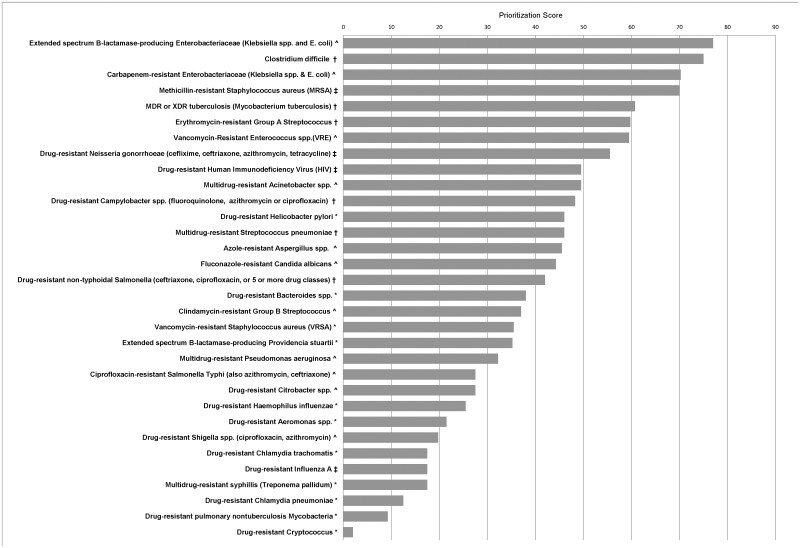
Relevant AMR pathogens in Canada were selected through a transparent multi-step consensus process (n=32). Each pathogen was assessed using ten criteria: incidence, mortality, case-fatality, communicability, treatability, clinical impact, public/political attention, ten-year projection of incidence, economic impact, and preventability. For each pathogen, each criterion was assigned a numerical score of 0, 1, or 2, and multiplied by criteria-specific weighting determined through researcher consensus of importance. The scores for each AMR pathogen were summed and ranked by total score, where a higher score indicated greater importance. A sensitivity analysis was conducted to determine the effects of changing the criteria-specific weights.
The AMR pathogen with the highest total weighted score was extended spectrum B-lactamase-producing (ESBL) Enterobacteriaceae (score=77). When grouped by percentile, ESBL Enterobacteriaceae, Clostridium difficile, carbapenem-resistant Enterobacteriaceae, and methicillin-resistant Staphylococcus aureus were in the 80-100th percentile.
This assessment provides useful information for prioritising public health strategies regarding AMR resistance at the national level in Canada. As the AMR environment and challenges change over time and space, this systematic and transparent approach can be adapted for use by other stakeholders domestically and internationally. Given the complexity of influences, resource availability and multiple stakeholders, regular consideration of AMR activities in the public health realm is essential for appropriate and responsible prioritisation of risk management that optimises the health and security of the population.
传染病病原体的抗菌药物耐药性(AMR)日益引起公共卫生组织的关注。鉴于此问题的复杂性以及其广泛程度,资源往往不足以解决所有问题,因此对AMR病原体进行优先级排序对于风险管理关注的最佳分配至关重要。由于不同国家AMR病原体的流行病学情况不同,特定国家的评估对于确定国家优先事项很重要。
制定一种系统且透明的方法对加拿大的AMR风险进行优先级排序。
通过透明的多步骤共识过程选择加拿大相关的AMR病原体(n = 32)。使用十个标准对每种病原体进行评估:发病率、死亡率、病死率、传染性、可治疗性、临床影响、公众/政治关注度、发病率的十年预测、经济影响和可预防性。对于每种病原体,每个标准被赋予0、1或2的数值分数,并乘以通过研究人员对重要性的共识确定的特定标准权重。计算每种AMR病原体的分数总和,并按总分进行排名,分数越高表明重要性越高。进行敏感性分析以确定改变特定标准权重的影响。
总加权分数最高的AMR病原体是产超广谱β-内酰胺酶(ESBL)的肠杆菌科细菌(分数 = 77)。按百分位数分组时,ESBL肠杆菌科细菌、艰难梭菌、耐碳青霉烯类肠杆菌科细菌和耐甲氧西林金黄色葡萄球菌处于第80 - 100百分位数。
该评估为加拿大国家层面关于AMR耐药性的公共卫生策略优先级排序提供了有用信息。随着AMR环境和挑战随时间和空间变化,这种系统且透明的方法可被国内和国际其他利益相关者采用。鉴于影响因素的复杂性、资源可用性和多个利益相关者,在公共卫生领域定期考虑AMR活动对于进行适当且负责的风险管理优先级排序至关重要,这能优化人群的健康和安全。