Naylor Nichola R, Lines Jo, Waage Jeff, Wieland Barbara, Knight Gwenan M
London School of Hygiene & Tropical Medicine, London, United Kingdom.
International Livestock Research Institute (ILRI), Addis Ababa, Ethiopia.
One Health. 2020 Nov 14;11:100194. doi: 10.1016/j.onehlt.2020.100194. eCollection 2021 Jun.
Current frameworks evaluating One Health (OH) interventions focus on intervention-design and -implementation. Cross-sectoral impact evaluations are needed to more effectively tackle OH-issues, such as antimicrobial resistance (AMR). We aimed to describe quantitative evaluation methods for interventions related to OH and cross-sectoral issues, to propose an explicit approach for evaluating such interventions, and to apply this approach to AMR.
A scoping review was performed using WebofScience, EconLit, PubMed and gray literature. Quantitative evaluations of interventions that had an impact across two or more of the human, animal and environment sectors were included. Information on the interventions, methods and outcome measures found was narratively summarised. The information from this review informed the construction of a new approach to OH-related intervention evaluation, which then was applied to the field of AMR.
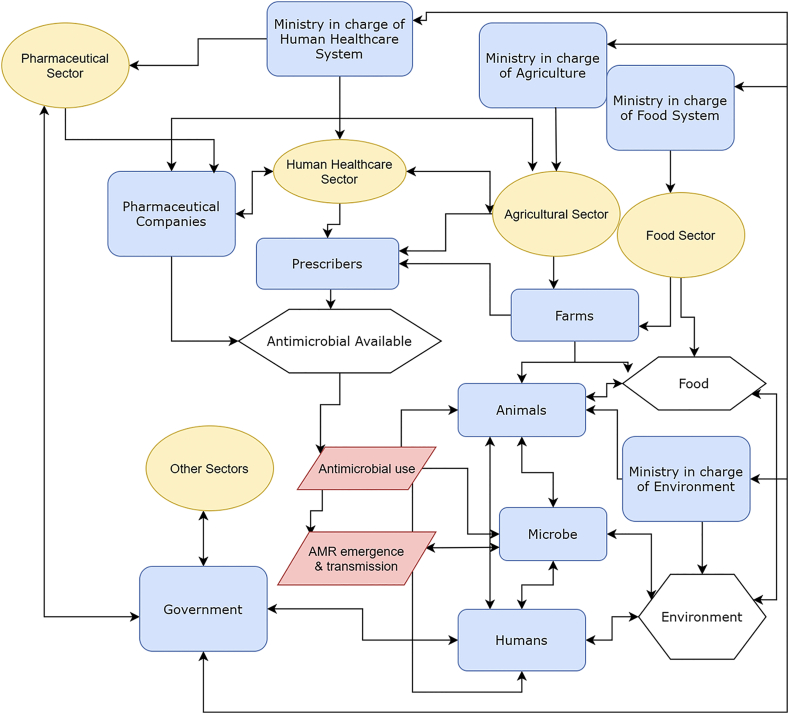
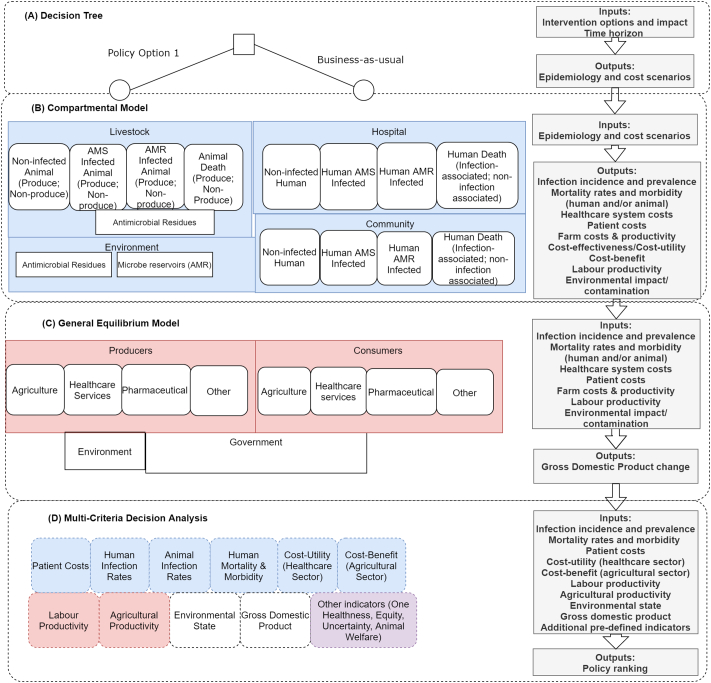
The review included 90 studies: 73 individual evaluations (from 72 papers) and 18 reviews, with a range of statistical modelling ( = 13 studies), mathematical modelling ( = 53) and index-creation/preference-ranking ( = 14) methods discussed. The literature highlighted the need to (I) establish stakeholder objectives, (II) establish quantifiable outcomes that feed into those objectives, (III) establish agents and compartments that affect these outcomes and (IV) select appropriate methods (described in this review) accordingly. Based on this, an evaluation model for AMR was conceptualised; a decision-tree of intervention options, a compartmental-microeconomic model across sectors and a general-equilibrium (macroeconomic) model are linked. The outcomes of this multi-level model (including cost-utility and Gross Domestic Product impact) can then feed into multi-criteria-decision analyses that weigh respective impact estimates alongside other chosen outcome estimates (for example equity or uncertainty).
In conclusion, stakeholder objectives are key in establishing which evaluation methods (and associated outcome measures) should be used for OH-related interventions. The stated multi-level approach also allows for sub-systems to be modelled in succession, where resources are constrained.
当前评估“同一健康”(OH)干预措施的框架侧重于干预设计和实施。需要进行跨部门影响评估,以更有效地解决OH问题,如抗菌药物耐药性(AMR)。我们旨在描述与OH及跨部门问题相关干预措施的定量评估方法,提出评估此类干预措施的明确方法,并将该方法应用于AMR。
使用Web of Science、EconLit、PubMed和灰色文献进行范围综述。纳入对人类、动物和环境两个或更多部门产生影响的干预措施的定量评估。对所发现的干预措施、方法和结果指标信息进行叙述性总结。本次综述的信息为构建一种新的OH相关干预评估方法提供了依据,该方法随后应用于AMR领域。
该综述纳入90项研究:73项个体评估(来自72篇论文)和18篇综述,讨论了一系列统计建模(n = 13项研究)、数学建模(n = 53)和指标创建/偏好排序(n = 14)方法。文献强调需要(I)确定利益相关者目标,(II)确定有助于实现这些目标的可量化结果,(III)确定影响这些结果的因素和部分,以及(IV)相应地选择适当方法(本综述中描述)。基于此,构建了AMR评估模型;干预选项决策树、跨部门的部分微观经济模型和一般均衡(宏观经济)模型相互关联。然后,这个多层次模型的结果(包括成本效益和国内生产总值影响)可用于多标准决策分析,将各自的影响估计与其他选定的结果估计(如公平性或不确定性)进行权衡。
总之,利益相关者目标是确定应使用哪些评估方法(及相关结果指标)来评估OH相关干预措施的关键。所述的多层次方法还允许在资源受限的情况下依次对子系统进行建模。