Lopes-Aguiar Leisa, Visacri Marília Berlofa, Nourani Carolina Marques Lopes, Costa Ericka Francislaine Dias, Nogueira Guilherme Augusto Silva, Lima Tathiane Regine Penna, Pincinato Eder Carvalho, Moriel Patrícia, Altemani João Maurício Carrasco, Lima Carmen Silvia Passos
From the Department of Internal Medicine (LLA, CMLN, EFDC, GASN, TRPL, ECP, CSPL); Department of Clinical Pathology Brazil (MBV, PM); and Department of Radiology (JMCA), Faculty of Medical Sciences, University of Campinas, Campinas, São Paulo, Brazil.
Medicine (Baltimore). 2015 Apr;94(16):e578. doi: 10.1097/MD.0000000000000578.
Cisplatin (CDDP) plus radiotherapy (RT) has been used to treat advanced laryngeal squamous cell carcinoma (LSCC) patients. Single nucleotide polymorphisms (SNPs) may be responsible for differences in chemo/radiosensitivity and side effects in those patients. We reported an advanced LSCC patient, who obtained durable complete response and unexpected pronounced toxicity during CDDP and RT, possibly due to SNPs in genes that modulate the effects of this therapeutic modality.
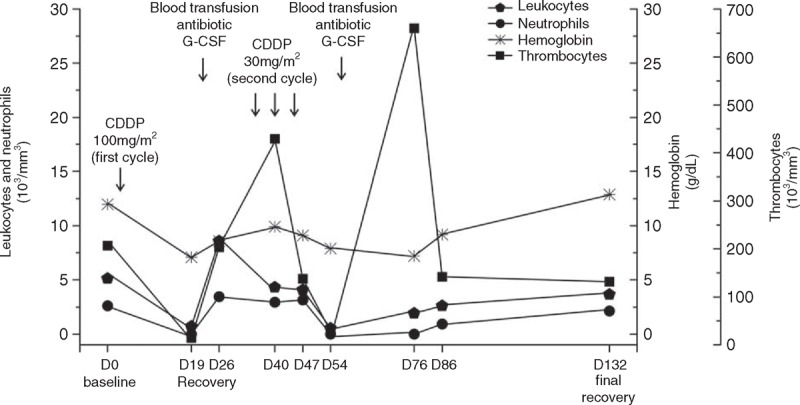
A 30-year-old man with advanced LSCC obtained durable complete response and severe alopecia and pancytopenia after standard and reduced doses of CDDP and RT. Analyses of SNPs revealed that the patient presented GSTT1 deletion, variant MSH3 1045ThrThr, wild GSTP1 105IleIle, and wild BAX -248GG genotypes, which were previously described in association with abnormal detoxification, DNA repair, and damaged cell apoptosis, respectively. Seven other advanced LSCC patients with GSTT1 gene, MSH3 AlaAla or AlaThr, GSTP1 IleVal or ValVal, and BAX GA or AA genotypes served as controls of the study. Only 1 control presented complete response; the other 6 controls obtained partial response of short duration. Four and 3 controls presented grade 1 or 2 and grade 3 anemia or leukopenia during treatment, respectively. The CDDP level in urine collected after CDDP infusion in the reported patient was lower than the median value obtained in controls, suggesting a higher amount of intracellular CDDP in the reported case.The data suggest, for the first time, that inherited abnormalities in intracellular detoxification of CDDP, DNA repair of lesions induced by CDDP and RT, and damaged cell apoptosis may alter treatment response and toxicity in LSCC, but should be confirmed by large pharmacogenomic studies.
顺铂(CDDP)联合放疗(RT)已用于治疗晚期喉鳞状细胞癌(LSCC)患者。单核苷酸多态性(SNP)可能是导致这些患者化疗/放疗敏感性及副作用差异的原因。我们报告了1例晚期LSCC患者,其在接受CDDP和RT治疗期间获得了持久的完全缓解,但出现了意外的明显毒性反应,这可能是由于调节该治疗方式效果的基因中的SNP所致。
1例30岁晚期LSCC男性患者在接受标准剂量及减量的CDDP和RT治疗后获得了持久的完全缓解,但出现了严重脱发和全血细胞减少。SNP分析显示,该患者存在GSTT1缺失、MSH3 1045ThrThr变异、野生型GSTP1 105IleIle以及野生型BAX -248GG基因型,这些基因型此前分别被描述与解毒异常、DNA修复及受损细胞凋亡有关。另外7例具有GSTT1基因、MSH3 AlaAla或AlaThr、GSTP1 IleVal或ValVal以及BAX GA或AA基因型的晚期LSCC患者作为该研究的对照。只有1例对照获得了完全缓解;其他6例对照获得了短期的部分缓解。4例和3例对照在治疗期间分别出现了1级或2级以及3级贫血或白细胞减少。该报告患者在输注CDDP后收集的尿液中CDDP水平低于对照的中位数,提示该病例中细胞内CDDP含量较高。这些数据首次表明,CDDP细胞内解毒、CDDP和RT诱导损伤的DNA修复以及受损细胞凋亡的遗传异常可能会改变LSCC的治疗反应和毒性,但这需要通过大型药物基因组学研究来证实。