Soares Pamela de Oliveira, Maluf Cury Patrícia, Mendoza López Rossana Verónica, Cernea Cláudio Roberto, Fukuyama Erika Erina, Livingstone Alves Figueiredo David, Gorgonio da Nobrega Francisco, Curioni Otavio Alberto, Nunes Fabio Daumas, Ajub Moyses Raquel, Bueno Garcia Maria Lúcia
Department of Head and Neck Surgery, Hospital das Clinicas da Faculdade de Medicina da Universidade de São Paulo / LIM-28-São Paulo, SP, Brazil.
Department of Pathology and Legal Medicine-Faculdade de Medicina de São José do Rio Preto São José do Rio Preto, SP, Brazil.
PLoS One. 2017 Aug 17;12(8):e0182600. doi: 10.1371/journal.pone.0182600. eCollection 2017.
The main risk factors for head and neck squamous cell carcinoma (HNSCC) are tobacco and alcohol consumption and human papillomavirus (HPV) infection. However, in a subset of patients, no risk factors can be identified. Glutathione S-transferase π (GTSP1) is a carcinogen-detoxifying enzyme that is activated by exposure to carcinogens, and it is associated with a reduction in response to toxic therapies. We studied the expression of GTSP1 in tumor and non-tumor tissue samples from patients with and without these risks to identify whether GTSP1 expression differs according to exposure to carcinogens.
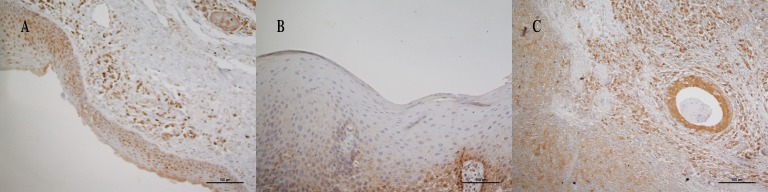
Non-smoker/non-drinker (NSND) and smoker/drinker (SD) patients were matched according to age, gender, tumor site, TNM stage, grade and histological variants to establish 47 pairs of patients who have been previously tested for HPV. GTSP1 immunostaining was analyzed using a semi-quantitative method with scores ranging from 0 to 3 according to the area of immunostaining.
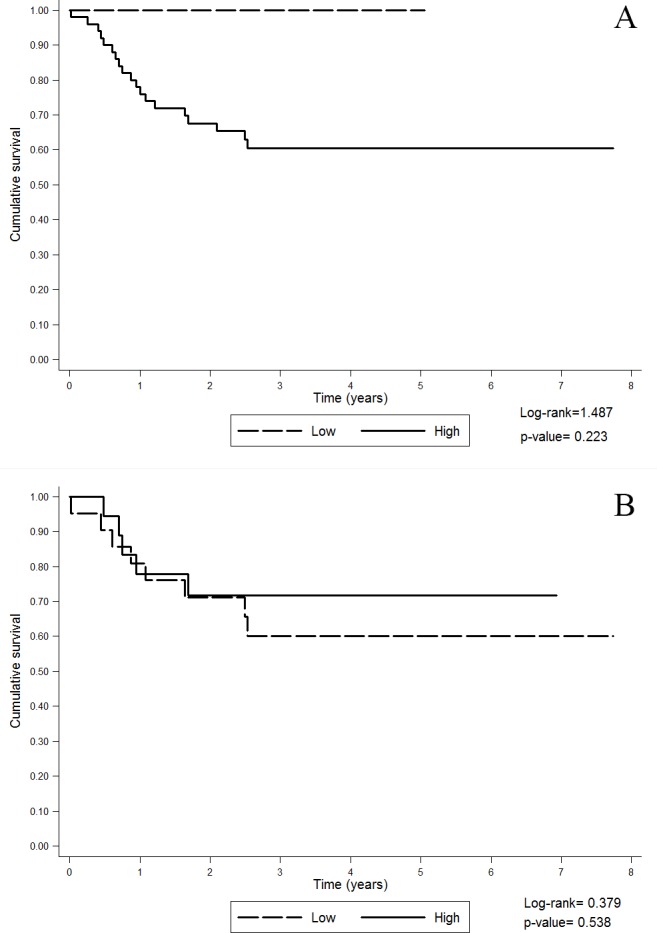
GTSP1 expression was detected in the tumors of both groups. GTSP1 expression was higher in the non-tumor margins of SD patients (p = 0.004). There was no association between GTSP1 expression and positivity for HPV. No differences in survival were observed according to GTSP1 staining in tumors and non-tumor margins.
This study showed that GTSP1 was expressed in tumors of HNSCC patients regardless of smoking, drinking or HPV infection status. The difference in GTSP1 expression in non-tumor margins between the two groups may have been due to two possible reasons. First, elevated GTSP1 expression in SD patients might be the result of activation of GTSP1 in response to exposure to carcinogens. Second, alternatively, impairment in the detoxifying system of GTSP1, as observed by the reduced expression of GTSP1, might make patients susceptible to carcinogens other than tobacco and alcohol, which may be the underlying mechanism of carcinogenesis in the absence of risk factors.
头颈部鳞状细胞癌(HNSCC)的主要危险因素是烟草和酒精消费以及人乳头瘤病毒(HPV)感染。然而,在一部分患者中,无法确定危险因素。谷胱甘肽S-转移酶π(GTSP1)是一种致癌物解毒酶,通过接触致癌物而被激活,并且它与对毒性疗法的反应降低有关。我们研究了GTSP1在有或无这些风险的患者的肿瘤和非肿瘤组织样本中的表达,以确定GTSP1表达是否因接触致癌物而有所不同。
非吸烟者/非饮酒者(NSND)和吸烟者/饮酒者(SD)患者根据年龄、性别、肿瘤部位、TNM分期、分级和组织学变异进行匹配,以建立47对先前已检测HPV的患者。使用半定量方法分析GTSP1免疫染色,根据免疫染色面积评分范围为0至3。
两组肿瘤中均检测到GTSP1表达。SD患者非肿瘤边缘的GTSP1表达较高(p = 0.004)。GTSP1表达与HPV阳性之间无关联。根据肿瘤和非肿瘤边缘的GTSP1染色,未观察到生存差异。
本研究表明,无论吸烟、饮酒或HPV感染状态如何,GTSP1在HNSCC患者的肿瘤中均有表达。两组非肿瘤边缘GTSP1表达的差异可能有两个原因。首先,SD患者中GTSP1表达升高可能是GTSP1因接触致癌物而被激活的结果。其次,或者,如GTSP1表达降低所观察到的,GTSP1解毒系统的损害可能使患者易患除烟草和酒精以外的致癌物,这可能是无危险因素时致癌的潜在机制。