Ge Yu-Zheng, Xu Lu-Wei, Xu Zheng, Wu Ran, Xin Hui, Zhu Meng, Lu Tian-Ze, Geng Li-Guo, Liu Hao, Zhou Chang-Cheng, Yu Peng, Zhao You-Cai, Hu Zhi-Kai, Zhao Yan, Zhou Liu-Hua, Wu Jian-Ping, Li Wen-Cheng, Zhu Jia-Geng, Jia Rui-Peng
From the Department of Urology (YZG, LWX, ZX, RW, HX, TL, CCZ, ZKH, LHZ, JPW, WCL, JGZ, RPJ), Nanjing First Hospital, Nanjing Medical University, Nanjing; Department of Epidemiology and Biostatistics and Ministry of Education (MOE) Key Lab for Modern Toxicology (MZ, LGG), School of Public Health, Nanjing Medical University, Nanjing; Department of Urology (HL), The Second Affiliated Hospital of Zhejiang University School of Medicine, Hangzhou; Department of Urology (PY), The First Hospital of Nanchang, Nanchang University, Nanchang; Department of Pathology (YCZ, ZKH), Nanjing First Hospital, Nanjing Medical University, Nanjing; and Department of Urology (YZ), Xuzhou Third People's Hospital, Jiangsu University, Xuzhou, China.
Medicine (Baltimore). 2015 Apr;94(16):e767. doi: 10.1097/MD.0000000000000767.
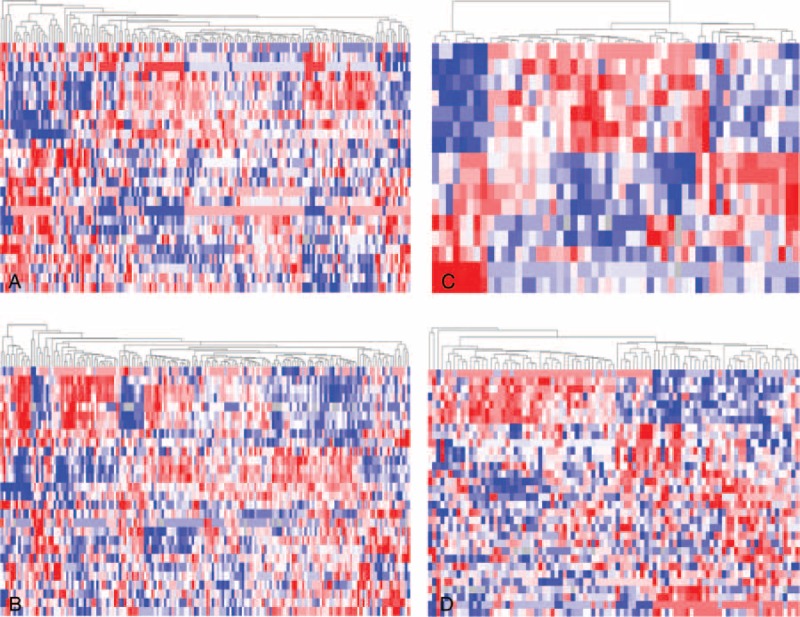
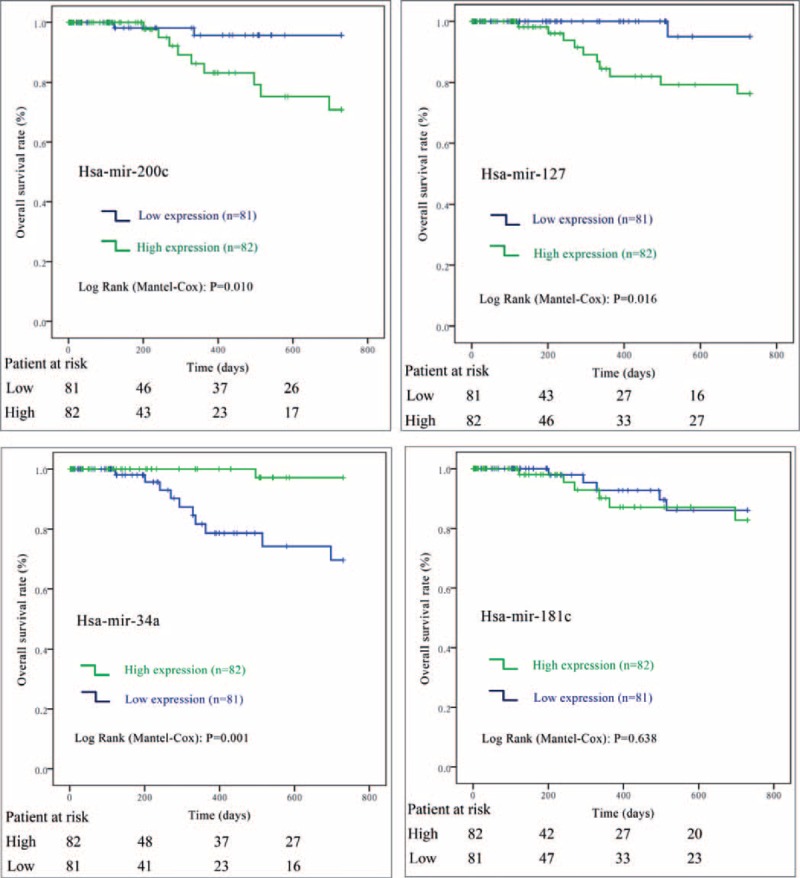
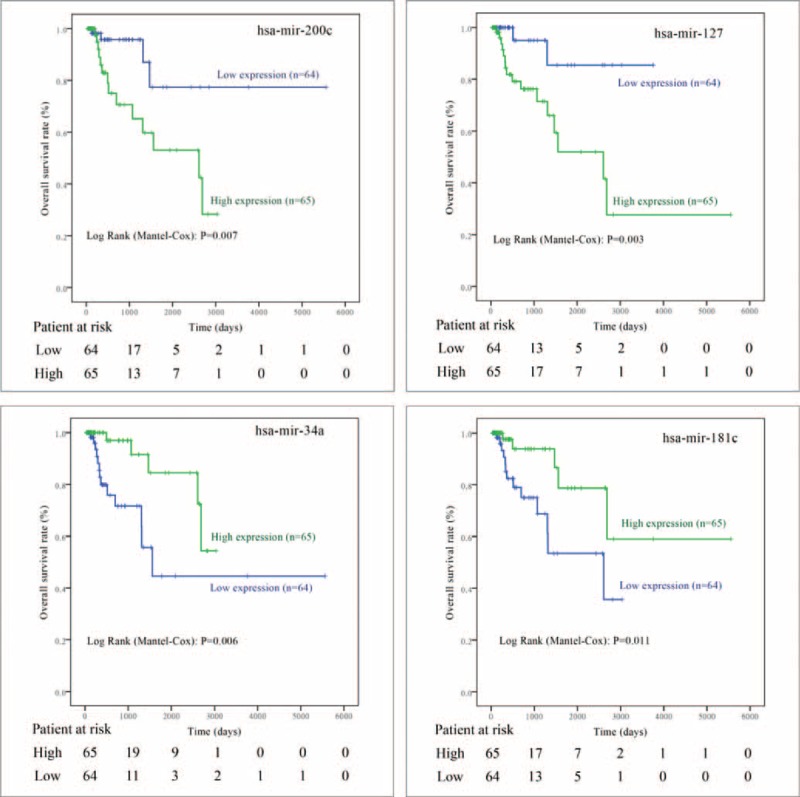
Papillary renal cell carcinoma (pRCC) is the second most prevalent subtype of kidney cancers. In the current study, we analyzed the global microRNA (miRNA) expression profiles in pRCC, with the aim to evaluate the relationship of miRNA expression with the progression and prognosis of pRCC.A total of 163 treatment-naïve primary pRCC patients were identified from the Cancer Genome Atlas dataset and included in this retrospective observational study. The miRNA expression profiles were graded by tumor-node-metastasis information, and compared between histologic subtypes. Furthermore, the training-validation approach was applied to identify miRNAs of prognostic values, with the aid of Kaplan-Meier survival, and univariate and multivariate Cox regression analyses. Finally, the online DAVID (Database for Annotation, Visualization, and Integrated Discover) program was applied for the pathway enrichment analysis with the target genes of prognosis-associated miRNAs, which were predicted by 3 computational algorithms (PicTar, TargetScan, and Miranda).In the progression-related miRNA profiles, 26 miRNAs were selected for pathologic stage, 28 for pathologic T, 16 for lymph node status, 3 for metastasis status, and 32 for histologic types, respectively. In the training stage, the expression levels of 12 miRNAs (mir-134, mir-379, mir-127, mir-452, mir-199a, mir-200c, mir-141, mir-3074, mir-1468, mir-181c, mir-1180, and mir-34a) were significantly associated with patient survival, whereas mir-200c, mir-127, mir-34a, and mir-181c were identified by multivariate Cox regression analyses as potential independent prognostic factors in pRCC. Subsequently, mir-200c, mir-127, and mir-34a were confirmed to be significantly correlated with patient survival in the validation stage. Finally, target gene prediction analysis identified a total of 113 target genes for mir-200c, 37 for mir-127, and 180 for mir-34a, which further generated 15 molecular pathways.Our results identified the specific miRNAs associated with the progression and aggressiveness of pRCC, and 3 miRNAs (mir-200c, mir-127, and mir-34a) as promising prognostic factors of pRCC.
乳头状肾细胞癌(pRCC)是肾癌中第二常见的亚型。在本研究中,我们分析了pRCC中的整体微小RNA(miRNA)表达谱,旨在评估miRNA表达与pRCC进展和预后的关系。
从癌症基因组图谱数据集中识别出163例未经治疗的原发性pRCC患者,并纳入本回顾性观察研究。miRNA表达谱根据肿瘤-淋巴结-转移信息进行分级,并在组织学亚型之间进行比较。此外,借助Kaplan-Meier生存分析以及单因素和多因素Cox回归分析,采用训练-验证方法来识别具有预后价值的miRNA。最后,使用在线DAVID(注释、可视化和综合发现数据库)程序对通过3种计算算法(PicTar、TargetScan和Miranda)预测的与预后相关miRNA的靶基因进行通路富集分析。
在与进展相关的miRNA谱中,分别为病理分期选择了26个miRNA,为病理T选择了28个,为淋巴结状态选择了16个,为转移状态选择了3个,为组织学类型选择了32个。在训练阶段,12个miRNA(mir-134、mir-379、mir-127、mir-452、mir-199a、mir-200c、mir-141、mir-3074、mir-1468、mir-181c、mir-1180和mir-34a)的表达水平与患者生存显著相关,而通过多因素Cox回归分析确定mir-200c、mir-127、mir-34a和mir-181c为pRCC潜在的独立预后因素。随后,在验证阶段证实mir-200c、mir-127和mir-34a与患者生存显著相关。最后,靶基因预测分析确定mir-200c共有113个靶基因,mir-127有37个,mir-34a有180个,这些进一步产生了15条分子通路。
我们的结果确定了与pRCC进展和侵袭性相关的特定miRNA,以及3个miRNA(mir-200c、mir-127和mir-34a)作为pRCC有前景的预后因素。